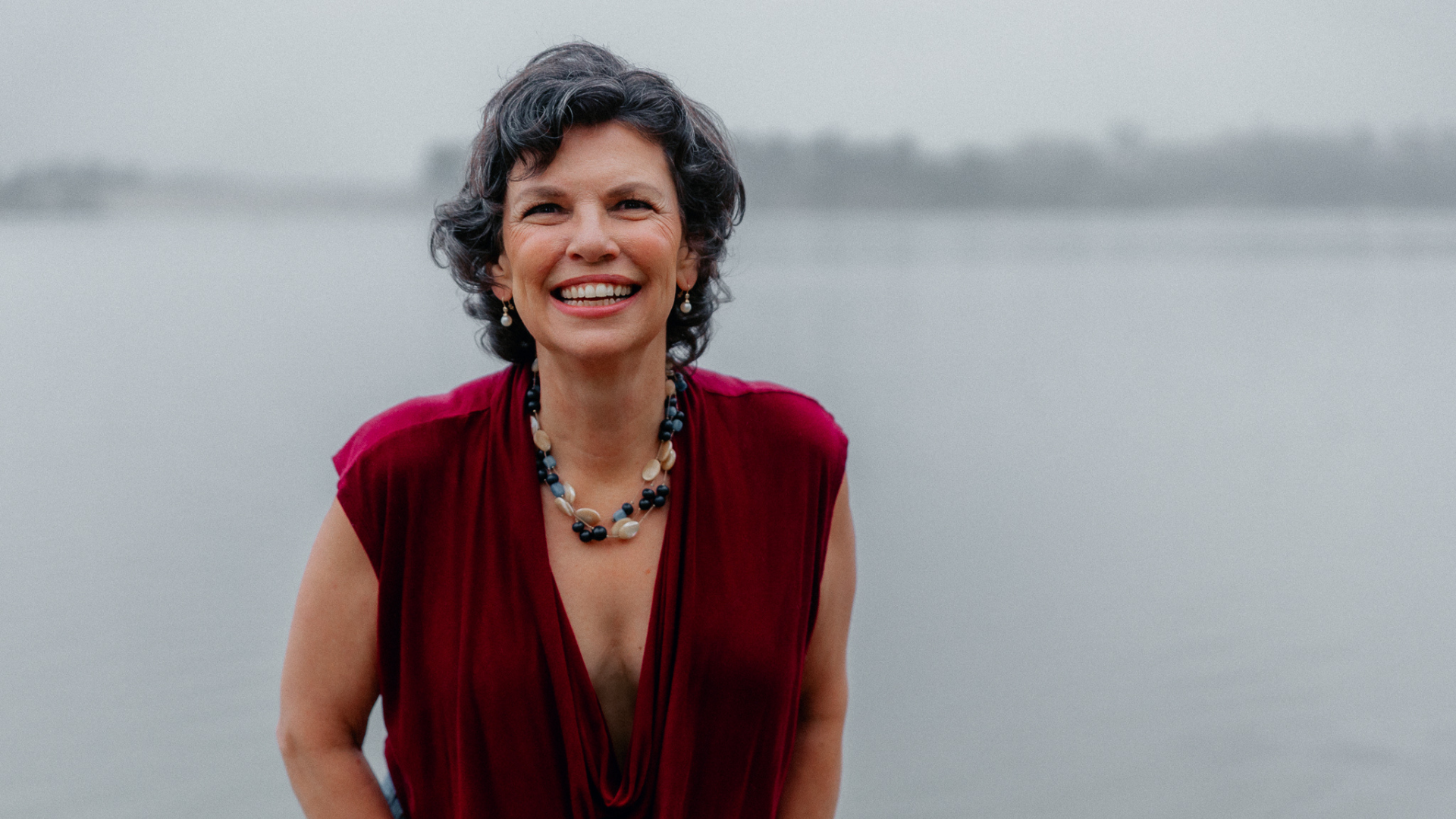
The Chapters That Shape Us: Sarah Stockham on Reinvention, Resilience, and Finally Becoming Yourself
There is a particular kind of courage in telling your own story without softening it.
Sarah Stockham has that courage. And over the course of a life that has taken her from the jungles of the Democratic Republic of Congo to the front lines of education, through personal crisis, profound grief, and unexpected reinvention, she has learned that the chapters you would never have chosen are often the ones that matter most.
She calls them chapters deliberately. Not mistakes. Not setbacks. Chapters. Each one complete in itself. Each one leading somewhere.
A childhood that belonged to the whole world
Sarah’s earliest memories are sensory and vivid. Dancing barefoot in a cotton dress to African drums. Looking up at stars visible only from one degree south of the equator. Sitting at a dining table made from two sawhorses and a door, covered with an African panya cloth, sharing rice and fruit salad with dignitaries who had flown in from across the world to visit her parents’ remote community.
She grew up in a household where the table was always open and the conversation was always global. Where music was the language that crossed every cultural boundary. Where her friends outside the house spoke a dialect she navigated alongside her formal English education. And where learning to find the right words for what she was feeling was a lifelong and sometimes humbling project.
That upbringing gave her something extraordinary. A capacity for connection that transcends background, belief, and geography. But it also left her without a roadmap when her family periodically returned to the United States. She looked like she was supposed to belong. The culture, however, was entirely foreign to her.
That gap between appearance and identity became one of the first great questions of her life.
The chapters that cracked everything open
Sarah does not flinch from the harder parts of her story. A first marriage that turned dangerous. The discovery of a weapon in her home and the slow, frightening unravelling of a reality she had not known she was living inside. A therapist named Carol who became, as Sarah puts it, her thesaurus. Someone who had the words for what Sarah was experiencing when Sarah could only gesture toward them.
That therapeutic relationship did something specific and lasting. It gave Sarah a model for what genuine help looks like. Not years of dependency, but tools. Not someone to hold your hand forever, but someone to walk with you until you no longer needed them to.
Later chapters brought their own weight. Miscarriages. The death of her aunt in an accident caused by a drunk driver, a loss that sent her family to Michigan for years and sent a teenage Sarah to a therapist’s office in a state of pure, protective fury. A student attack after 35 years in the classroom that triggered PTSD and finally brought her work with EMDR, a therapeutic process that helps the subconscious release what it has been holding in order to keep you safe.
And through all of it, the same quiet truth surfacing again and again. It was not happening to her. It was happening for her.
The practice that has held everything together
From around the age of eleven, Sarah discovered something she has returned to every decade since. A quiet time in the early morning, before the rest of the world wakes up. It has taken different forms over the years. Journaling. Music. Spiritual reading. Intentional reflection on the subconscious scripts that shape how we move through our days.
What has remained constant is the commitment itself. The deliberate act of beginning each day in conversation with her own inner world before the outer world makes its demands.
She is clear that this is her path, not a prescription. What she does advocate for is the principle underneath it. Know what works for you. Return to it consistently. And be willing to update it as you grow, because who you are at 61 is not who you were at 30, and your practices should reflect that.
Closing the open loop
One of the most practically useful ideas Sarah shares comes from a conversation she had with a brain health expert. When we carry unresolved thoughts in our minds, circling them without resolution, it creates what researchers call open loops. And open loops, it turns out, are genuinely stressful. The brain cannot properly rest while it is still tracking unfinished business.
Sarah’s solution is disarmingly simple. Get it out of your head. Write it down. Voice memo it. Draw it. Whatever the method, externalise it. Then look at what you have written and ask a harder question: is this actually mine to carry? Or have I simply absorbed someone else’s expectation and been hauling it around ever since?
This practice, she notes, has helped her write books, run a television show, support her clients, and care for an ageing parent. It is not glamorous. It is not trending. But it works.
The discipline of protecting your energy
Sarah has built her professional life around a principle that took her decades to fully trust. Protecting her energy is not indulgence. It is the actual work.
Every Sunday she writes out her week by hand. A practice she began in 2008 and has maintained without exception. She batches her client days into Tuesday, Wednesday, and Thursday. She keeps the last week of every month clear, so that life, not just work, has room to breathe. She pre-records her television segments in a dedicated week each month so that the creative work does not bleed into everything else.
She gives Thanksgiving gifts instead of Christmas gifts, a small shift that means she is resourced and present when others are depleted and rushed.
And when she says no, something unexpected happens. The people who ask again come back differently. The entitlement softens. The assumption disappears. In its place, something she describes as reverence. A recognition that her time and energy are worth asking for, not simply expecting.
The boundary itself becomes the teacher.
Why women teachers need Peaceful Pathways
Peaceful Pathways, Sarah’s community for women teachers approaching retirement, did not begin as a business idea. It began as a recognition.
She had been through the transition. She had felt the particular disorientation of leaving behind a professional identity built across more than three decades. The structure. The purpose. The daily sense of mattering in a specific, defined way. And she had found, with time and tools, a way through.
The people around her kept telling her that others needed what she had found.
Retirement, she observes, can feel anything but free. Even for women who have plans, who have things to step toward, the transition itself is often underestimated. You are not just leaving a job. You are leaving a version of yourself. And without a community that understands that specific grief, the crossing can feel very lonely indeed.
Peaceful Pathways brings women together three Tuesdays a month to share tools, explore new perspectives, and walk a threshold that is genuinely significant. Teachers who have spent careers pouring into others now have a space where someone is pouring into them.
Finally, just herself
When asked what lesson she wishes she had known earlier, Sarah takes a moment. Then she says something she has never quite said out loud before.
She grew up as the only white child in her community in Congo. She had blonde hair and a tight circle of friends and a deep sense of belonging. When she came to America and was surrounded by people who looked like her, she felt more lost than she ever had in the jungle.
Sixty-one years in, she is finally learning to walk through a door and simply be herself. Not the version shaped by cultural expectations she never asked for. Not the girl performing belonging she could not quite feel. Just Sarah.
She describes the process like the outer layers of a coconut slowly coming away. The real thing has always been underneath. It has simply taken a lifetime of chapters to reach it.
And that, perhaps, is the most honest and hopeful thing she could offer anyone still in the middle of their own story. The real you is already there. The chapters are just the way home.
To learn more about Sarah Stockham, her TV show Simply Sarah, and the Peaceful Pathways community, visit her website and explore her books, Reiki work, and group programmes.