
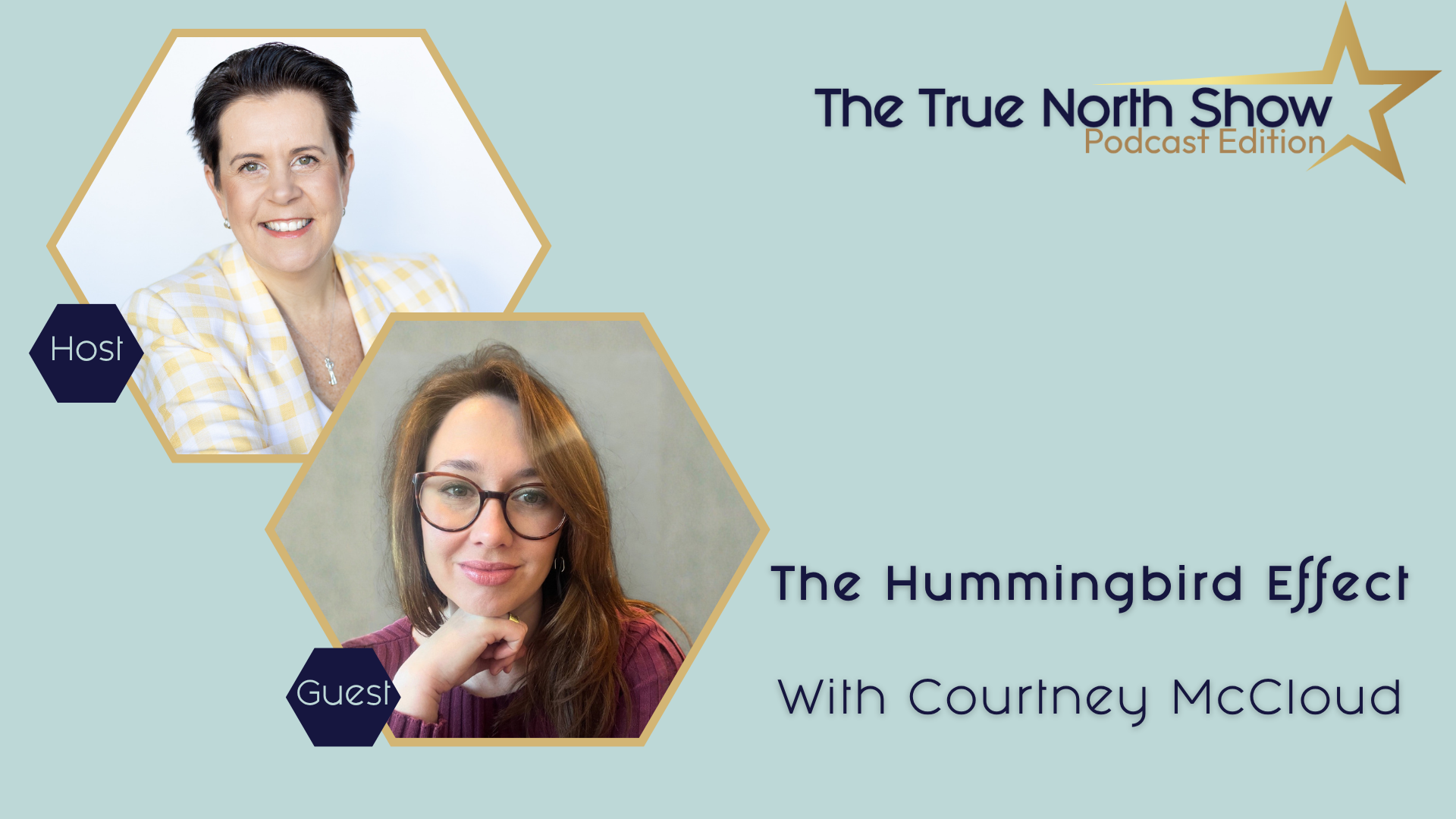
The Hummingbird Effect with Courtney McCloud | Ep. 50
On this week’s episode of Season 5 of The True North Show, I am joined by Courtney McCloud, an incredible and wonderful woman who I’ve had the pleasure of knowing and being friends with for quite a few years. Courtney shares with us where her journey began and how it has come full circle to where she originally wanted to start. Her view on the importance of good communication is so deep and is weaved into everything she does, in particular the work she does within organisations. Courtney’s own communication style is light yet focused and precise with a little bit of fun as well. I loved our conversation and I am sure you will too.
Bio:
Courtney McCloud has built a career that doesn’t fit neatly into a single box, and that’s part of what makes her story worth telling.
After starting her career as a high school English teacher, she now has over a decade of experience in communications and engagement. Courtney has worked across some of Australia’s most recognisable organisations, from secondary and tertiary education institutions to a national construction company. Add to that her time as a teacher, advocacy for young people, international development, and the not-for-profit sector, and it’s clear her career has not been shaped by the status quo, but by a genuine curiosity about people and what moves them.
At the heart of Courtney’s current work is a simple but powerful belief: that communications is transformative. Whether that’s supporting business leaders through a period of difficult change, creating community in workplaces through campaigns such as International Women’s Day, developing breakthrough campaigns to support advocacy efforts, or producing a magazine that makes frontline workers feel seen, Courtney has spent her career turning this belief into measurable outcomes.
But the journey hasn’t been straightforward. Courtney has navigated the tension that many professionals quietly face: building a strong career on paper while wondering if the work truly reflects who she is and what she cares about. That question eventually led her to build an independent consulting practice, which has been a period of professional reinvention that proved to be one of the most clarifying decisions of her life.
Courtney holds a Master of Arts in Communication Management from the University of Technology Sydney, and a Bachelor of Arts with a Diploma of Education from Macquarie University; a combination that tells you something about how she thinks: rigorously, and always with people at the centre.
These days, Courtney is focused on maximising the power of communications strategy for organisations making a tangible impact. She’s also developing a vision for mentoring young people and young professionals and continuing her board training.
Warm, direct, and refreshingly honest about the messy reality of building a meaningful career, Courtney brings both hard-won expertise and genuine heart to this conversation.
Social Media:
Website: www.thehummingbirdeffect.com.au
LinkedIn: https://www.linkedin.com/company/the-hummingbird-effect/
Transcript:
[00:34] Megan North: Hello and welcome to The True North Show, and welcome to Season Five of The True North Show. Before I introduce my guest, I want to say a very big thank you to everyone who has supported me on this show over the last year. The last four seasons of The True North Show have had over 150 viewers tune in, and I am so genuinely grateful to all of you.
To kick off Season Five, I am thrilled to introduce an incredible and wonderful woman who I have had the pleasure of knowing and working with for about four years now. Courtney McCloud has built a career that does not fit neatly into a single box. And that is part of what makes her story worth telling.
After starting out as a high school English teacher, Courtney went on to spend over a decade working across communications and engagement in some of Australia’s most recognisable organisations, from secondary and tertiary education institutions to a national construction company, which is actually where we first met. Her career has also taken her into international development and the not-for-profit sector, shaped not by the status quo but by genuine curiosity about people and what moves them.
At the heart of Courtney’s work is a simple but powerful belief: that communications is transformative. Whether supporting business leaders through difficult change, building community in workplaces, or producing work that makes frontline workers feel seen, she has spent her career turning that belief into measurable outcomes. That journey eventually led her to one of the most clarifying decisions of her life: founding The Hummingbird Effect.
Today, Courtney is focused on maximising the power of communications strategy for organisations making a tangible impact, while also developing a vision for mentoring the next generation of professionals. She is warm, direct, and refreshingly honest about the messy reality of building a meaningful career, and she brings both hard-won expertise and genuine heart to everything she does.
Courtney, welcome to The True North Show. I am so looking forward to our conversation.
[03:19] Courtney McCloud: Thank you so much for having me. And congratulations on four seasons so far.
[03:22] Megan North: Thank you very much. How does it feel when I read out your bio and you’re just sitting there listening?
[03:35] Courtney McCloud: Yes, it is strange. These things don’t happen overnight. So to hear your story condensed like that is part of what is odd about it, because you know it in so much detail.
[03:52] Megan North: Yes, exactly. But it is a good reflection as well, I think.
So Courtney has seen firsthand how the right communication strategy can transform an organisation and the people within it. Right after this short break, we will get into exactly how she makes that happen.
Welcome back. I’m here with Courtney McCloud, and we are diving into what it really takes to build communications that drive genuine, measurable change, both in business and personally.
Courtney, let’s start from the beginning with the big question I ask everyone. What was the defining moment that led you to pursue your true passion and purpose? And I’d love to know in particular, why communications?
[05:24] Courtney McCloud: I haven’t had one defining moment. It has been a journey ever since I finished school more than twenty years ago. And if I get lost explaining it, please feel free to redirect me.
When I was finishing school and figuring out what I wanted to do, I had an idea. But I couldn’t quite express it. I knew I wanted to do lots of different things, and I didn’t feel like I could say that out loud. It didn’t feel like an acceptable answer. It didn’t fit the general expectation. So I kept that to myself and thought, okay, what is the next step? But taking away the idea of wanting to do many things made it really hard to figure out what that first step should be.
Through various conversations and a lot of reflection, I eventually settled on high school English teaching. I did my degree, and while I was studying, I worked for a variety of not-for-profits in international development and social services. Through that process, I started to see the role of communications in achieving organisational goals, projects, and campaigns. Because when you are working toward something with a team, at some point you need to bring other people in, or you need to reach an audience. How you do that is through communications. And I started to see that there was a way of doing this well.
I finished my Bachelor of Arts with a Diploma of Education and went and got a job as a teacher. And towards the end of that time, I started to have this quiet feeling: there is something else. Something else is next.
I did not want to leave teaching because I genuinely loved it. One of the roles I had was working for a not-for-profit, teaching global citizenship and global leadership at high schools all over Sydney. Incredibly rewarding. Some of my most rewarding career days have been in that work. And yet even with all of that fulfilment, the feeling that something else was calling kept coming back.
So I spent more time reflecting, keeping my eyes open, having conversations, and eventually settled on communications. A big part of that was because of the role I had seen it play throughout my twenties. I started a master’s in communications at the University of Technology Sydney. Roles started coming up, and I moved on from teaching much faster than I had intended, simply because that was where the opportunities were leading. More not-for-profit work, another role in education, then corporate communications, and now I have started a communications consulting business. That is somewhat of an overview.
[09:33] Megan North: Yes. And it is interesting because when you think about high school English teaching, there is so much language and communication involved. Even if you could not articulate it at the time, were you always moving toward this? Has it been a full circle?
[10:01] Courtney McCloud: Yes, I think so. If someone had said to me at seventeen that I was thinking about entrepreneurship, I don’t know that I would have connected with that idea. My sense of self at that age would not have recognised it. The journey has been the thing that showed me. It has taken about twenty-two years, but here we are. Now I can see how well-suited to entrepreneurship I was. But I simply could not have seen it back then.
[10:44] Megan North: And you probably also could not have known what good communications looks like inside an organisation until you had actually experienced organisations from the inside. That exposure to what works and what doesn’t is exactly what you bring now as someone building your own practice and being selective about the clients you work with.
[11:31] Courtney McCloud: Absolutely. What gets illuminated to you through your time in the workforce can be so incredibly different from what you imagined. Where you thought you might fit, compared to the reality of it, teaches you so much about life, about yourself, and about the work you actually want to spend your time doing. It is worthwhile to take a path you might not have imagined for yourself, because it can ultimately be incredibly helpful.
[12:03] Megan North: Yes, it is about trusting the process. So you are the founder and director of The Hummingbird Effect. What is the meaning behind the name?
[12:17] Courtney McCloud: I took my time figuring out what to call this business, because it really mattered to me to have something with depth and strong imagery. I spent months simply sitting and waiting for inspiration, and then reflecting. That is how my creative process works for things that are truly important to me.
The Hummingbird Effect is about the transformative impact of communications. The hummingbird is a tiny bird that is not native to Australia. I did consider a native Australian bird, but it did not quite fit. So I came back to this bird native to the Americas that is well known globally.
I actually saw one in Canada when I was nine years old. My family was there. They are just extraordinary. So small. And yet over 8,000 species of flora and fauna in the Americas are reliant on them as part of the ecosystem. If you remove the hummingbird, habitats and food sources collapse. What they do is feed deep in the stem of a flower, drinking the nectar, but pollen ends up all over their bodies and beak. They fly to another flower, do the same thing, and transfer the pollen. It is that pollen that flowers need from other flowers to create seeds. Simply by playing its role, the hummingbird helps sustain entire ecosystems.
That imagery of something so tiny having such a profound impact was what I wanted to bring into my business. Because the role that communications plays in organisations can be similarly underestimated. Its importance is not always understood. But like the hummingbird, when it is present and functioning well, it has a consequential impact. And when it is absent, things begin to collapse in ways that are not always immediately visible.
I also love nature deeply. It is where I would spend all of my time if I could. I wanted to bring the natural world into what I was building because I believe we are inherently linked to it. We cannot be separated from it. So I wanted that relationship to be part of what I was doing.
[16:25] Megan North: That is so beautiful. Eight thousand. Just incredible. And so nature clearly plays a significant role in your wellbeing. Is that right?
[16:38] Courtney McCloud: Yes. It is one of four things I consider critical to how I maintain my overall wellbeing. Because if we are honest, there is no pursuing your dreams or anything else if you do not have your health. And I say health specifically because our bodies and minds are inextricably linked, and science continues to show us just how true that is.
For me those four things are exercise, being in nature, time with loved ones, and nutrition.
Being in nature is about immersion: getting away from the busyness and just being with the plants, or being with the ocean, existing in that space for a while. You come away feeling refreshed.
Exercise, I believe we are made to move. Our bodies are so incredibly strong and powerful. I was active growing up, but it was not until my mid-twenties when I started lifting weights that I discovered how strong I actually could be. That was genuinely empowering. And from there I have maintained what I would call my gym junkie lifestyle. A walk outside is important. But the strength and fitness that comes from a spin class, a boxing class, or lifting weights gives me something else. I also know I am very lucky because I get a strong rush of feel-good chemicals from exercise quite quickly. Not everyone does, and I do not take that for granted because our mental health is so reliant on those hormones.
Time with loved ones is about maintaining connection with the people you do life with. Not necessarily every day, but knowing what is going on, being around for the big and small things, and being in each other’s lives consistently. These are the people who fill your cup.
And nutrition. I would have eaten very differently at nineteen. There are many witnesses who can confirm I was very much Nutella at that stage. But now it is much more balanced. Because we really are what we eat, and one of the things that directly reflects this is our gut health and our microbiome. What science has discovered over the past decade about the influence of our microbiome on our overall health is genuinely extraordinary. Our diet directly influences it, and in turn, it influences our mood, our cognition, and our sense of wellbeing. Eating a colourful, balanced diet and limiting sugar and alcohol, which are inflammatory, makes a real and measurable difference.
For me, health is that holistic picture. It is not one thing. It is all of those daily practices built into my routine. And I can see the impact because I have a genuinely high baseline mood. I feel so lucky for that, and I know it is not to be taken for granted. By maintaining a strong foundation in what I can control, I hope to be better resourced to navigate whatever life brings.
[22:16] Megan North: I love that holistic approach. It is interesting, isn’t it, that people often talk about mind, body, spirit as though they are three separate things. But they are not three parts. They are all of us. I love that you treat your mental health and wellbeing as your overall health, which includes all of it.
[22:33] Courtney McCloud: Absolutely. And once you start seeing it that way, you notice all the ways those things interact. When I have been consistent with exercise, my concentration improves, which lowers my stress. And if I have had a lovely dinner with a couple of glasses of wine and a beautiful dessert, I might feel a little foggy the next day simply because my body is working to process it. You learn about yourself by living these things out.
[23:30] Megan North: Yes. And when you are exercising and your mind is sharp, you naturally start craving foods that support that state. You are not reaching for a sugar hit because you do not have the afternoon slump in the first place.
[23:51] Courtney McCloud: Exactly. Yes, absolutely.
[23:54] Megan North: And what about times when you need to ground yourself and come back to being really present? Is nature the main tool for that?
[24:15] Courtney McCloud: It can be. Another part of this for me is time to myself. In the busyness and noise of life, time alone with my thoughts means I am reconnecting with myself. I know what is actually going on in my head. I can filter and sort things out as I go, rather than letting them accumulate.
Sometimes when I am stuck or overwhelmed or have too many thoughts, I walk out to my vegetable garden and just talk to my plants. See how they are coming along, pick a caterpillar off something. It is a slight distraction, but it is also a break for my brain. It is that connection with nature and something genuinely beautiful. The joy I get from watching things grow is hard to describe. Helping my sweet pea up the trellis, wishing the aphids would get off the broccoli, those small moments just clear the head and give the brain a moment to settle.
When it is not something like that, journaling is a really grounding practice for me. You are not trying to hold everything in your head. You get it onto paper and things become clearer very quickly. Whether you need an answer or just need to sort your thoughts, it almost appears on the page simply because you got it out of your head. Sometimes half a paragraph is enough and then I am fine and can get on with the day.
So when I do need extra grounding, sometimes it is nature, sometimes it is journaling, and sometimes it is meditation. And sometimes it is all of them. You need the whole toolkit.
[26:45] Megan North: Yes. And sometimes you write things down and then read them back and think: really? Have I spent a day worrying about this?
[26:55] Courtney McCloud: Lesson learned. Yes. Lesson learned.
[26:59] Megan North: And I love the connection between watching your sweet pea grow and watching a communications strategy grow and seeing the impact it has on an organisation. Is that satisfaction linked?
[27:26] Courtney McCloud: Absolutely. The strategy piece is a big part of what I love about communications. I started my career wanting, as cliched as it sounds, to be a part of making the world a better place. And as I moved across different fields, I kept asking: where does the rubber actually hit the road in people’s daily lives? Where are we seeing the real-world impact of what makes the gears of society turn?
That is where I found meaning outside of the not-for-profit sector. In the day-to-day realities we all live with. Hence construction, energy, and education in a communications role rather than a teaching role.
The strategy piece involves starting at the beginning, looking at where you are and where you want to go, developing the plan to get there, and then watching it come to fruition. It is genuinely exciting to watch that transformation and to know you have contributed to it.
Internal communications specifically is meaningful because you are contributing to the employee experience of a workplace, which can make a profound difference to how a person feels about going to work every day. It impacts culture. It impacts a business’s ability to achieve its goals and objectives. Even if you are not directly involved in an employee’s daily wellbeing, you are contributing to the whole.
[29:46] Megan North: Yes. And when the strategy is right and the communications are clear and make sense to everyone, employees turn up loving where they work. And the way they describe the organisation to others in the community or in business reflects that clarity and pride.
[30:13] Courtney McCloud: Yes, absolutely. Brand is a significant part of communications. One figure I have encountered suggests that brand accounts for around twenty percent of an organisation’s enterprise value. That is substantial. The investment in brand, and by extension communications, has a direct relationship with overall enterprise value and with success in achieving goals, whether that is selling products or providing services.
When you work to make a brand more consistent, update it, or refine the narrative an organisation tells about itself, both externally and internally, the cumulative effect is enormous. Employees understand who they are and what they contribute. They feel a sense of meaning in their role, regardless of what that role is. And they become brand ambassadors. The uptick in brand value as part of enterprise value continues to grow from there.
[31:53] Megan North: Yes. And from my own experience starting my coaching business five years ago, what I thought people wanted from me and what they actually wanted were quite different. The way I was communicating it was not resonating. That was a pivotal moment for me. And I have seen the same in large organisations, where they believe they know what their customers want to hear and the reality is completely different.
[33:01] Courtney McCloud: Yes. And you have picked up on something important. What you do as an entrepreneur when you first start out naturally morphs and changes as you learn about yourself, your clients, and what actually fits.
But from a communications perspective, the same applies at an organisational level. Communications is often treated as one directional. A leader speaks, employees listen. An organisation publishes, customers receive. But good communications is two directional. In the field it is called two-way symmetrical communication. The leader and the organisation are speaking, and the audience is listening and understanding. But then the audience is also speaking back, and the leader and the organisation are genuinely listening.
There is a significant conversation in academia about the growing loss of trust in institutions. Part of that conversation points to organisations and governments not listening, or listening and then not responding or acting on what they hear. And the research shows something interesting: people generally do not expect you to agree with them or give them everything they want. They simply want to know they have been heard.
There is an important difference between dismissing someone after nominally hearing them and actually acknowledging what they have said, explaining the context, and demonstrating that you genuinely understood their concern. That distinction is where trust lives. And communications that closes that loop consistently, not just at one town hall a year but throughout the year, is what builds the kind of organisational trust that is genuinely hard to erode.
[36:07] Megan North: Yes. And I am sure many people listening will recognise the experience of being in a meeting where someone is simply talking at you, not pausing, not inviting a response. You end up switching off entirely.
[36:32] Courtney McCloud: Yes. It is almost like being spammed by email, but in person. And it does not work. Once you have lost your audience, it is that much harder to get them back. So thinking carefully about how you are going to communicate well, not just getting your audience’s attention but showing you are relevant and worthy of their time, and then maintaining that, is far more worthwhile than winning them over and then losing them. Because recovering lost trust is significantly more difficult than maintaining it in the first place.
[37:25] Megan North: Yes. The know, like, and trust journey can sometimes be very short, but it can also be very long. And if someone feels spoken at rather than heard, that journey can end quickly or never fully begin.
[37:53] Courtney McCloud: That is right. Absolutely.
[37:55] Megan North: So I would love to talk about the role women mentors have played in your career, and the broader conversation around what success actually looks like for ambitious women in corporate. Why do you think supporting other women behind the scenes matters so much?
[38:31] Courtney McCloud: I never imagined the support I would receive from other women throughout my career. In my twenties I was supported by so many women from all different walks of life. Some I knew personally, and some I simply met through different jobs.
I think of one particular role where I was working for a not-for-profit with corporate volunteers who came into schools to work with students on leadership campaigns. You would spend a little bit of time with them each month. It was not a lot. But they would often become curious about my own career path and would say: let’s grab a coffee. And they would offer their time so freely.
They would say: because people did this for me, I know how important it is. And that blew me away. I was nobody to these women. I was just a twenty-something running a program. And yet they showed up.
I am still blown away by it. I would not be where I am if it was not for them. Those women, and even a woman who came into my life when I was a teenager through the local community, because I did not grow up in the same state as my older cousins and did not have that proximity to people a little further along in life. She invested in me significantly, and I can see her generosity as one of the earliest threads in a long line of women who journeyed with me.
As I was figuring things out, they were the ones who provided the prompts, the ideas, the practical next steps when I did not have them myself. Some of them were in very senior positions with no spare time. And yet they made time. That is just truly beautiful.
[41:48] Megan North: Definitely. And in the last five years of being in my own business, the women who have stepped in and supported me, who are also business owners, have been extraordinary. Women love community. Historically and traditionally, women gathering, talking, and supporting each other has always been part of how things get done. That generosity is one of the most beautiful things about stepping out of corporate into your own work. And it then just becomes how you show up for others in return.
[42:52] Courtney McCloud: Absolutely. And when you have experienced that and seen the impact it has on your own life, the energy it gives you to do it for others is just immense.
[43:15] Megan North: Really special. So you mentioned to me last week that you had an interesting conversation with a CFO recently. You saved it for here. Can you share the context and what was interesting about it?
[43:34] Courtney McCloud: So this was one of those honest conversations you have as a new business owner connecting with different people. I was being very direct about the fact that the value of communications is not always inherently understood, and the person I was speaking with appreciated that honesty as a CFO who had likely encountered that dynamic in his own career.
At one point he said to me: if I put this question to you directly, why should I pay for someone like you when I could just get AI to write an email to my employees?
I genuinely appreciated that. Let’s actually have the conversation. Especially with AI and how it is changing the workforce, and given that communications is often perceived as something everyone does every day and therefore anyone can do.
Part of my response was: what are you actually trying to achieve through that email? Because for the most part, it is about far more than one email. It is about how you are thinking about your communications at an organisational level. How are you nurturing your relationship with your people over time? How are you building culture? How are you listening and then feeding that back into your communications consistently throughout the year, not just at one annual town hall?
And then there is something more human underneath all of it. If someone wants me to read an email they have sent me, even as an employee, I would rather they had written it themselves. I am happy to fulfil my responsibilities as an employee and read what I am sent. But there is an honour we show people when we take the time to write something ourselves and put genuine thought and care into it. I am not suggesting an unreasonable amount of time. And I am not saying never use AI as a tool. If you are stuck on a sentence or need to condense something, that is fine. But if you are trying to connect with people, that connection does not come from automation.
As a profession, communications also draws on behavioural science, statistics, media practice, and increasingly, graphic design and videography. If you do not understand your audience at a behavioural science level, how are you going to communicate effectively or drive behaviour change? And without evaluation processes grounded in statistical thinking, how do you know whether what you are doing is actually working?
What we do is about so much more than writing an email, with AI or otherwise. And not understanding that means you cannot harness communications to drive the outcomes and the enterprise value it is genuinely capable of delivering.
[49:19] Megan North: Yes. And the human quality of language is something I have noticed in my own use of AI. I write the way I speak, and I was playing around with something recently in Claude. I said to it: you are really going to love this. And its response was: I literally just got goosebumps. I could not stop laughing. Because that is genuinely something I say, and it was responding in my voice.
[49:59] Courtney McCloud: That is so incredibly human.
[50:03] Megan North: Yes. So if what we have talked about today resonates with someone, how do they find you and get in touch?
[50:18] Courtney McCloud: I am very open to that. Even if it is just a chat. There is a link on my website to book a discovery call, or you can reach out via email through the contact page. Just say hello and tell me what you are thinking.
[50:34] Megan North: Perfect. And I have put the QR code up as well for people to connect in. So we are actually nearly out of time already, which I cannot believe. So the question I love to ask all of my guests before we close: what is one lesson or truth that you have learned on your journey that you wish you had known earlier?
[51:11] Courtney McCloud: This is a great question. And it is a journey I am still on, which is actually why I will not take long to answer.
Do not try to be all things to all people.
It comes from so many places. I am an eldest daughter and an eldest child. You take on a lot from a very young age and you learn to be a certain way early. I am a planner. When I see a problem, I want to tackle it. I want to build a plan so that in a week’s time it is no longer a problem, it has been resolved or made part of a routine.
In the workplace, that can be a great quality. But it can also be a really significant trap, because you burn yourself out. If I see a train wreck coming, I want to stop that train. Even if it is not in my remit. And sometimes you simply cannot.
Getting stressed about trying to stop a runaway freight train that is not even your train, not your job, not your remit, I have spent years learning to let that go. Not my monkey, not my circus is a phrase I learned a couple of years ago, and it has become genuinely useful.
It is not easy. I don’t want bad things to happen. I want to smooth things over. I want to be there to support people. But learning to let go of that sometimes, and to let the train run without you, is an important act of discernment.
[53:18] Megan North: True surrender, I would say. Thank you so much for everything you have shared today. I always love doing this with people I know because I always learn so many new things. Thank you for spending this time with me.
[53:50] Courtney McCloud: Thank you so much for having me. It has been such a pleasure.
[53:53] Megan North: You are very welcome. And I would also like to thank all of my amazing audience, all of the supporters, and the sponsors. I hope everyone has a wonderful rest of the week and I will see you all again next week. Thank you again, Courtney.
[54:09] Courtney McCloud: Thanks, Megan.
![True North Show [podcast] - Season - Nikhil Rughani](https://megannorth.com/wp-content/uploads/2026/05/True-North-Show-podcast-Season-Nikhil-Rughani-768x432.png)
![True North Show [podcast] - Season - Viewing Life With A Strengths-Based Lens With Rosemary Gattuso](https://megannorth.com/wp-content/uploads/2026/03/True-North-Show-podcast-Season-Viewing-Life-With-A-Strengths-Based-Lens-With-Rosemary-Gattuso-768x432.png)