
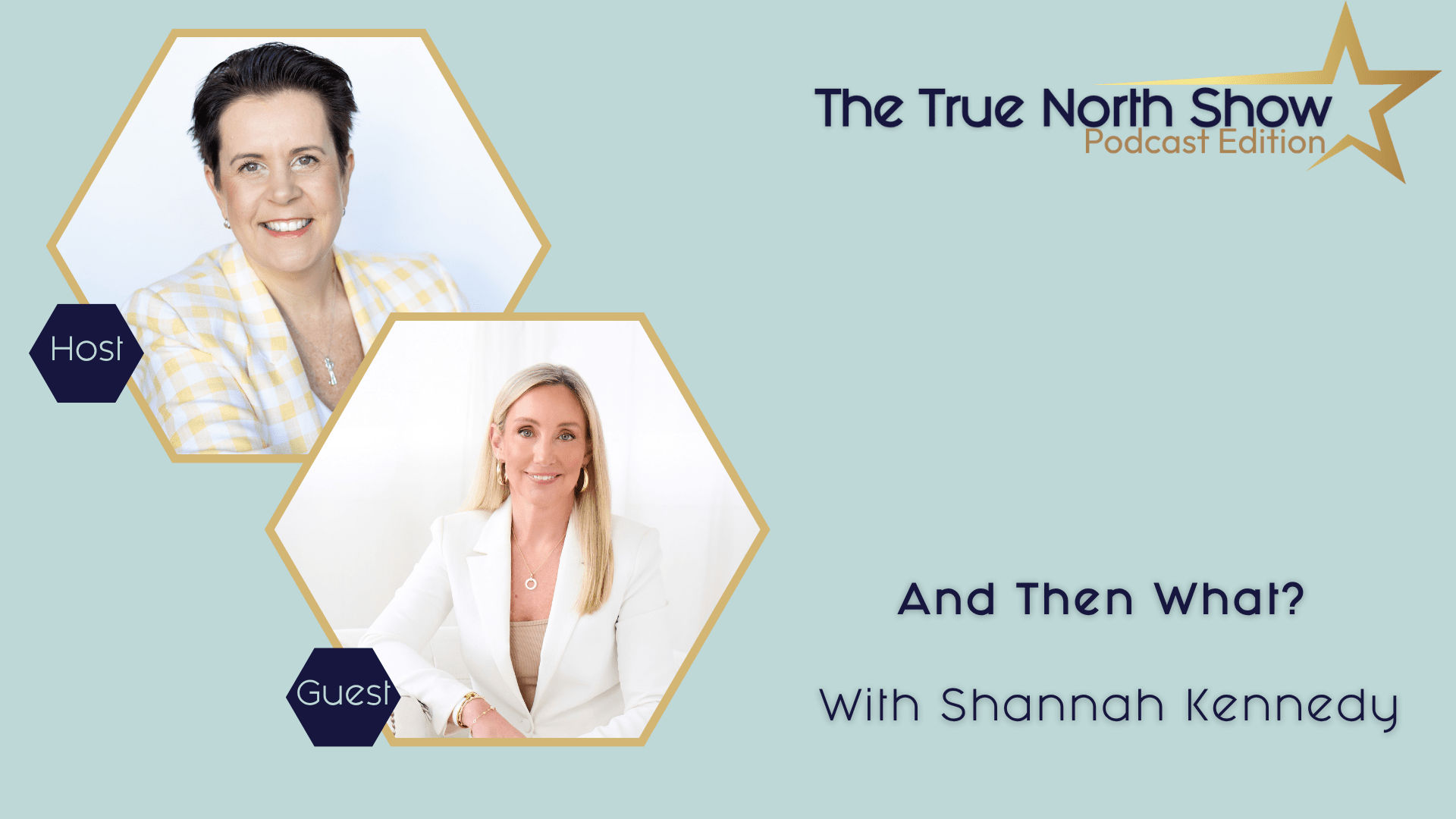
And Then What? with Shannah Kennedy | Ep. 59
On this week’s episode of The True North Show I am joined by a very special returning guest Shannah Kennedy. Shannah and I dive deeply into a conversation that I have no doubt hundreds of thousands of people are asking themselves in mid-life – and then what? Shannah shares with me the moment that it happened to her, how she has embraced it and how it has become the new body of work she is working on with her clients. Our conversation is filled with wisdom, paused energy and a deep understanding of how to continue to fill your cup, regardless of how old you are.
Bio:
Shannah Kennedy is a Strategic Life Coach, keynote speaker and eight-time bestselling author who has spent more than two decades helping people step back from the busyness of life and create a clear plan for how they want to live, work and feel. Her work is built around a simple philosophy: You are the asset, and you need to protect it.
Shannah began her career in the fast-paced world of stockbroking in the 1990s, before moving into sports sponsorship, where she managed relationships with more than 150 elite athletes across ten sports. It was here that she became fascinated by what happens when high-performing people have a clear strategy for their careers, but no personal strategy for their lives.
That insight led Shannah to train as a Master Life Coach and ultimately create “The Life Plan”, her internationally bestselling book and methodology for designing a purposeful life.
She has since written eight books with Penguin Random House, with her work published internationally and used by individuals, leaders and organisations around the world.
Over the past 20-plus years, Shannah has coached more than 1,000 people, including chief executives, senior leaders, entrepreneurs, elite athletes and people navigating significant life and career transitions. Her work combines self-awareness, self-leadership and self-management with practical tools for energy management, wellbeing, personal planning and sustainable high performance.
Now in her mid-fifties, Shannah is increasingly exploring one of life’s most important questions: “And then what?” As children leave home, careers evolve, relationships change, parents age and long-held identities begin to shift, Shannah believes the second half of life offers an extraordinary opportunity to consciously decide what comes next.
In 2026, she has been putting her own Life Plan into action through a series of intentional career gaps and experiences, including attending the Winter Olympics, walking approximately 800 kilometres across Spain on the Camino de Santiago and swimming with humpback whales in Tonga. These experiences are informing Shannah’s next body of work around midlife, longevity and designing the second half of life with greater clarity, purpose and direction.
At the heart of Shannah’s work is the belief that we do not need to wait for a crisis to rethink our lives. We can pause, ask better questions and intentionally design what comes next.
Social Media:
Website: www.shannahkennedy.com
Facebook: https://www.facebook.com/shannahkennedy
Instagram: https://www.instagram.com/shannahkennedy
LinkedIn: https://www.linkedin.com/in/shannah-kennedy-8a898b1/
Transcript:
[00:33] Megan North:
Hello and welcome to the True North Show. I am your host Megan North, and I’d like to start by thanking the sponsors of the show: Quantum Awakening, Beth Lewis, and Anne C. Clarke.
Today I am thrilled to be welcoming back to the show a very special and favourite guest, Shannah Kennedy. For those of you who are new here, Shannah is a strategic life coach, keynote speaker, and eight-time bestselling author who has spent more than two decades helping people step back from the busyness of life and design a clear plan for how they truly want to live, work, and feel.
She began her career in stockbroking before moving into sports sponsorship, managing relationships with more than 150 elite athletes across ten sports. That world led her to a profound realisation: that high-performing people can have a brilliant strategy for their career and absolutely no strategy for their life. That insight became the foundation of everything she has built.
With eight books published by Penguin Random House, more than a thousand people coached, and a methodology used by individuals, leaders, and organisations around the world, Shannah’s impact is nothing short of extraordinary.
But what excites me most about having Shannah back on the show is what she is currently working on. Now in her mid-fifties, she is asking one of life’s most powerful questions: and then what? Since the beginning of this year, she has been walking her own talk in the most incredible way: attending the Winter Olympics, walking 800 kilometres across Spain on the Camino de Santiago, and swimming with humpback whales in Tonga. And all of it is shaping her next body of work around midlife, longevity, and designing the second half of life with purpose and intention.
Shannah, it is so wonderful to have you back.
[02:40] Shannah Kennedy:
It is great to be here. It is such an exciting thing to talk about, isn’t it? Life can be so extraordinary when we create some vision and plan for ourselves.
[02:53] Megan North:
Absolutely. And I cannot stop smiling reading out your bio. This conversation is going to be amazing.
Shannah has spent over two decades helping some of the world’s highest performers design their lives with intention and purpose. And now she is turning that very same lens on the second half of life and asking one of the most important questions any of us will ever face. Stay with us because when we come back, we are going to get into what that question is and why Shannah believes we do not need to wait for a crisis to start redesigning our lives.
Welcome back. I am here with strategic life coach, bestselling author, and all-round extraordinary woman, Shannah Kennedy. This is a conversation I know is going to resonate deeply with many of you.
Shannah, last time you were here we talked about life planning and designing a life with intention. Since then, you have been living that out in the most extraordinary way. What has been happening for you in 2026?
[04:59] Shannah Kennedy:
Well, this is the power of having a life plan. Think of it as a GPS: you plot your next decade ahead and you move toward it intentionally.
We decided that this year would be a golden gap year, a mini sabbatical of sorts. Thirteen years ago we took six months and lived in an RV in the US with our kids, visited all the national parks, and got remarried in Vegas at the White Chapel. We came back and said: let’s do another ten years of great work, get the kids through school, and then pause again.
Now the kids have finished school. We are half empty nesters. My husband finished his twenty-three year career as CEO at the Winter Olympics, because that was always going to be his farewell, and we had planned for it a long time ago.
So we went as a family to the Winter Olympics in Italy. Then we walked the French Camino, 800 kilometres in forty days, just the two of us. And it was one of the most beautiful things we have ever done as a couple. You are stripped right back to just walking. No car for forty days. Same clothes every day. You have to look after each other.
Then we came home for three weeks and went to Tonga for a self-leadership course built around the hero’s journey, which included swimming with the humpback whales. You jump off the boat and there is a whale the size of a school bus next to you, looking at you, singing, twisting, sleeping. You are there to witness patience and perspective and presence.
Then we are going to Greece. My husband is studying and he graduates there, and we are going to live on Crete for a month. I want to talk to as many old people there as I can and do my research.
It is a beautiful year. And it was all planned. It is part of the life plan. And this is what I want to share with people: you get to design this. You can save for it, dream about it, and make it happen. You get to decide which years are your adventure years and which are your home years and which are your learning years. Last year I studied all year to become a breathwork facilitator. Some years are for different purposes. But we get to be the creator.
[09:05] Megan North:
I really love that perspective. And I think we are so hard on ourselves sometimes. We should be doing this, I should be achieving more. But the landscape of what a life can look like has changed so fundamentally.
[09:20] Shannah Kennedy:
Absolutely. If we are living longer, and we are living into our nineties now, and it is going to be hundreds, then we cannot just think in terms of retiring at sixty. We need to think about our sixties, seventies, eighties, nineties, and how we want to feel in each of those decades.
We have so much time now. We can take gaps and sabbaticals and go and study again. It does not have to be that linear path of university, career, retirement. The whole landscape has changed. It is a long marathon now. We need to pace, we need to stop, we need to refuel. And we can pivot completely. I know vets who are now earth movers. I know women who were school mums, studied in their fifties, and opened psychology practices at fifty-six because they had thirty years ahead of them.
It is a really exciting time when we think of the long run and what we are going to do with it.
[10:38] Megan North:
Yes. And the question that you are now asking: and then what? I think it is one of the most confronting but ultimately most exciting questions a person can sit with. When did it first land for you personally?
[11:02] Shannah Kennedy:
The and then what arrived for me a while ago, because I am always thinking ahead. What happens when the kids have finished school? What happens when we have no more parents left? What happens when my body changes through menopause and I get a new brain and a new body and a new way of thinking?
And after all of that, there is no societal tick list. Society gives us an amazing checklist all the way up to around fifty or fifty-five. Finish school, study, get a great job, buy a house, have a family, go on holidays, get the car. It is all there. But post fifty-five, there is nothing. A void. And into that void, people panic. They ask: is this it? Is this all there is? What do I do now?
So the and then what came from sitting with that question: once I have achieved all of these things, what do I want to become? Because I now have more time. I can be in charge of my body, my time, my thoughts. I am not managing children anymore, I am in the consultancy stage where my opinion is only given when asked for. And that creates this huge open space that, if we do not design it, becomes a void.
My response was to get a blank piece of paper and ask: if I could do anything and be very imaginative, what would I create for myself? I think my best work is yet to come. My best book has not been written yet. My best body is not there yet. When we can flip the script and see this as a creative project, it becomes genuinely exciting.
[14:26] Megan North:
Yes. I am fifty-two and in menopause now, and the way I think and approach things is completely different to five or ten years ago. I feel filled with more deep wisdom. And I find that genuinely exciting. I love that this is the new body of work you are stepping toward.
[15:22] Shannah Kennedy:
I think it takes courage. And when I look at my sixty-six-year-old self, I see such a vast range of role models. There is Train with Joan, who picked up weights at seventy and is the strongest she has ever been in her eighties. Louise Hay started Hay House Publishing at sixty and worked there until she was ninety.
We may have a whole career, maybe two careers, ahead of us. And we can choose because we have laid such a big foundation. We have incredible wisdom. We have had time to learn the lessons we needed to learn. And now we get to trim: what do we not want to take into the second half? What thoughts, what habits, what ways of being do we leave behind?
For me, menopause is closing the chapter on the first half and putting that book on the shelf. Starting a new book. And when we can give women that permission, and men too because they go through their own hormonal shift, to design their future rather than fear it, this is universal. It is for any human who is genuinely asking: and then what?
[17:37] Megan North:
And when you said some people do not know where to start, that resonates. Because now the world is the oyster and there are no other boxes to tick. That can feel overwhelming.
[18:03] Shannah Kennedy:
And it is frightening. So I always say to my clients: go back to childhood. What inspired you? I used to love colouring in. Now I do paint by numbers and I am painting butterflies, painting into my soul that my best years are yet to come.
Interestingly, the butterfly carries an imagineer gene from birth as a caterpillar. But the gene does not activate until the chrysalis. That is where the colour comes. So the butterfly was carrying it all the way through. And then it kicks in and out comes the butterfly.
I think we are the same. We have incredible imagination and creativity. And when we give ourselves the space in midlife to actually play, to be creative, to research, to study, to try different things, it opens everything up. We have access to the world’s experts at our fingertips now in a way no previous generation ever has. You might want to learn to grow tomatoes and bottle them and make your own tomato paste, and that passion might take you to Greece and Italy and become an obsession. It can start as small as that.
[20:07] Megan North:
Yes. I love that. Okay, a lot of people arrive into midlife feeling like they should have it all figured out. Why is that actually the biggest trap?
[20:36] Shannah Kennedy:
There is no should. There is only could. I don’t think we ever figure it out. If you have figured it out, you are finished. We are ever evolving. How you feel at fifty-five is different from forty-five, different from thirty-five. We have new skin, new hair, new everything every seven years. Our habits are what we need to look at. And our goalposts keep moving because we keep learning and having more life experience.
How you viewed things ten years ago is going to be different now because you have so much more experience. That is pretty exciting, not something to fear.
[21:40] Megan North:
Absolutely. And I find as I get older I am even stronger in who I am. I do trim the people in my life who are no longer aligned. That is sometimes a grief process though.
[22:08] Shannah Kennedy:
It is. It can be grief when we let go of family members who are toxic, or friendships that have run their course. We have to allow that shedding so we can evolve into a bigger, better version of ourselves.
And there is also comparasonitis, which we never had growing up in the same way. We can either use social media as a positive or as something that absolutely destroys our confidence. Be very careful with your feed. It can paralyse you or it can inspire you.
[22:59] Megan North:
Absolutely. Just doing you, having the courage and confidence to be yourself. Because at the end of the day, nobody is actually thinking about what you are doing. They are too busy thinking about themselves.
[23:19] Megan North:
So what would you say is the very first step for women whose children are leaving home, whose careers are shifting, whose identities are changing?
[23:35] Shannah Kennedy:
For me personally, the step I took was to sit still.
My daughter left home straight after year twelve, which I was not prepared for. She got an incredible opportunity in Queensland and she said to me: Mum, if you were eighteen, what would you do? Very clever girl. And of course I said: I would go.
So I sat with it and thought: healthy birds leave the nest. She is confident, independent, and wants to go and play in the world. But for me it was a huge grief. I was walking past her bedroom every day, sitting on the end of her bed, thinking: I am not ready for this.
Then my dog passed away. Then my mum passed away. And I was in this washing machine of change. And rather than try to fix everything and distract myself, I was taught by the Buddhist coaches I have worked with to sit in the stench of things. So I sat really still. I stopped any hustle. I stopped putting pressure on myself. I just did my breath work.
And the more I sat still, the more I felt: I am in the perfect place right now. I am in the chrysalis and everything is being moved around, ready for me to emerge as the butterfly. But you cannot force the butterfly. So I gave myself a couple of years. My least productive years in terms of output, but the most essential. The work kept coming in somehow. But I really sat in the grief of losing a parent, a fur baby who had sat at my feet through every single client call for years, and a child who was moving into her own life. That is a lot. And I thought carefully about the grief cycle, which we are never taught about either.
You do not move on. If you just move on, it keeps coming back at you. It is actually better to sit in it, honor it, and find the gift within it. And then the gold comes.
[27:26] Megan North:
I did not know you had lost your mum, and I am so sorry to hear that. I have lost both of my parents and nothing prepares you. When my mum passed away twelve years ago, I went into a very dark place with my mental health and I had recently stopped drinking, so several things were compounding. But I had the courage to sit with it, and I came through it a completely different person.
[28:34] Shannah Kennedy:
That is the word: courage to sit with it. Because it takes a lot of courage to sit still when everyone around you is moving forward. Not to feel like you are falling behind. To really honor that this is a chapter, a season, a window of your life. And to be able to sit in that.
That is where all the gold is. It is like filling a glass from a river. The water is cloudy with sediment. But when you put the glass down and let it settle, the water becomes crystal clear. That is what happens when you sit still and do not rush it. Giving yourself permission to do that is everything.
[29:24] Megan North:
Absolutely. And I feel like I gave my dad permission to do the same. He lasted two years and two months without my mum, after sixty-two years together. But because I had spent so much beautiful time with him in those years, my experience of losing him was different. More peaceful. I felt like he needed to be with her.
[29:55] Shannah Kennedy:
We have the same dad, in a way. Because my dad would always say: I’ll get your mother. And now he is stuck on the phone with me and we are learning about each other’s lives. I have spent three years building that relationship with him and it is so precious. A genuine gift.
[30:57] Shannah Kennedy:
My husband has just finished his twenty-three year career and I have said: you need to take a year off. And he is in heaven. Playing guitar, at the gym, having coffees. But it is fascinating to watch everyone else’s reaction. The whole community is asking: what are you going to do next? Well, what have you got lined up? As if not having an immediate plan is somehow dangerous.
And I am saying: we will not discuss it. He needs to make a decision about his next chapter from a full tank, not from desperation. He is resetting. His nervous system is being completely reprogrammed. He has taken up cooking, which is brilliant. And one of the most valuable things anyone can do is press pause. Take a breath. Look for what you are interested in. Give yourself the time to be very clear about what you want moving forward.
[33:03] Megan North:
And without feeling guilty about it either. Every now and then I just want a day on the lounge with a cup of tea watching the Bake Off. And I love it, particularly in winter. I actually feel more inspired afterward.
[33:32] Shannah Kennedy:
Absolutely. Sometimes I even go and have an afternoon nap. Not a moment of guilt. And I think the most useful question is always: what does my ten-years-older self say about this? My sixty-six-year-old self says: thank God you had that afternoon nap. There is no hurry. So always thinking about your ten-years-older self gives you a lot of permission. The decade has a lot of change and a lot can happen, but that wise future voice knows things our present-day anxiety does not.
[34:45] Megan North:
And there is real intention behind that. So can you give us a highlight from each of the three big experiences this year?
[35:34] Shannah Kennedy:
Yes. The Winter Olympics was a family experience. The highlight was our children finally seeing, for the very first time, what their dad has actually been doing their whole lives. He has taken winter sport in Australia from a tiny fringe activity to one of the country’s most medal-winning sports. He has an Order of Australia. So it was a beautiful family moment of: here is what dad has been building for you your whole life.
The Camino was for us to come back together and strip everything away. After about a week walking, I asked my husband what he was thinking about. Nothing, he said. What are you thinking about? Nothing. And for a man whose brain had held an entire organisation for twenty-three years, that emptiness was a gift. We walked in silence sometimes for hours. On the Meseta, the flat wheat fields with a dead straight path to the horizon, I was euphoric. Just our two footsteps. No music, no podcast. Just walking.
One of his friends had asked: what are you going to talk about for forty days? The answer was everything that had never quite found its way into an ordinary day at home. And the silence was equally extraordinary.
The whales were about patience. You hover in the water, still, and you wait. You do not chase the whale. You just stay present. And this creature the size of a school bus comes to you, looks at you, sings to you, and gives you a message that is unmistakable: everything is going to work out. Be patient. You are a dot in this ocean, but so am I, and we are both doing exactly what we are supposed to do.
I came back thinking: I do not need to rush the next body of work. I need to feel it and slowly move toward it.
[38:13] Megan North:
Yes. And I had the pleasure of seeing your photos and reading through your reflections. It was beautiful. And was it strategic, the sequencing? The Olympics, then the Camino, then Tonga?
[38:31] Shannah Kennedy:
Absolutely deliberate. If you tried to do them in a different order, it would not work. And this is why having a life plan matters so much. You sit with the things you are considering and you feel whether they are right. When we talked about going to the Maldives to celebrate, it did not feel right. Just sitting on a banana lounge felt too passive. The Camino felt right. Something that would strip us back completely. So when you have a life plan and you sit with the written word, you can feel whether something is aligned for you or not. It will either feel right or it will not.
[40:10] Megan North:
And I imagine those forty days walking also changed how you communicate. With your husband, and perhaps more broadly.
[40:47] Shannah Kennedy:
Yes. So many of his friends asked: what are you going to talk about for forty days? But you do not need to talk all the time. There were days we walked for an hour and a half without speaking. And then some random thought would surface and we would be off, talking for two or three hours about something. Your brain had the space to pull up memories it had not visited in years. And to suggest things for the future without all the noise pressing in from every side.
And the silence itself was almost euphoric. On the Meseta especially. Dead flat, dead straight, nothing but wheat fields and horizon and footsteps. People say it is boring. I was completely happy. My body kept wanting more. By the end, fifteen-kilometre days felt short. We had conditioned ourselves to walk six hours and were grateful for every step.
I think you crack yourself open on something like that. You get to a deeper part of your own soul. And you carry that back with you.
[44:02] Megan North:
Beautiful. And so with the new clients and new work you are shaping around midlife and longevity, what is the most surprising thing you have discovered about what designing the second half of life well actually looks like?
[45:15] Shannah Kennedy:
What I am finding is that the conversation is shifting. People used to think about ageing in terms of disease prevention, staying out of trouble, managing decline. But now, with wearables and access to our own data and so much more research available, people are thinking about feeling great at every stage until the end.
And what I am seeing is that people are not dreading the second half anymore. The language is changing. It is not doom and gloom. It is: what a playground. What a whole new set of things to try and learn and experience.
My dad is eighty-six and goes to the gym. My mother-in-law is eighty and still skiing. Louise Hay started her publishing company at sixty. The best is genuinely coming. And my job in this next body of work is to help people see that and design for it.
[46:34] Megan North:
Yes. And having fun. Laughing. My husband and I are always laughing and he says, stop it, we are married, we are not supposed to have this much fun. Jokingly of course.
[47:00] Shannah Kennedy:
We look at each other after our morning walk and just say: winning. We have made the bed, we have been for a beautiful walk, we have had our coffee. How good is that? It is luxury. The fact that we want to do it and we are motivated to do it.
And it is also about building the sanctuary of your home for the future. We have just put in a sauna. I use our pool as a cold plunge every day in Melbourne winter. Nobody else is using their pool. I am in there every day. Ten degrees. And it is about asking: what in my home environment is supporting the next thirty years of my life?
[48:14] Megan North:
Yes. And I am always reviewing my inner circle as well. Making sure I have the right people around me. People who love me, challenge me, and bring different things into what I need at different times.
[48:59] Shannah Kennedy:
Yes, and I do the same. If I have clients who are very draining, I do not renew them. It is about my energy and protecting it. I am actually quite introverted. My best days are often home alone, happy in my nest. I have been coaching from the same room for twenty-three years. I love it here.
And I always make sure I get coached myself. Probably every five years I employ a coach for a full year, someone completely different who challenges me in new ways. I am due for a new coach next year and I am genuinely excited. They crack me open. They ask me the hard questions I already know how to ask myself but sometimes avoid.
[50:34] Megan North:
Absolutely. And I always have someone I am working with too. Because I want to be the best version of myself for my clients. That walking the talk is so important.
So we only have a couple of minutes left. I would usually ask the same final question I ask all my guests, but you answered it last time. So I am going to tweak it slightly. You have coached over a thousand people and written eight books. Right now, in this chapter of your own life, what does your true north look like?
[51:12] Shannah Kennedy:
It looks like stillness. It looks like permission. Giving myself permission to sit still. To appreciate everything I have created. All the clients, all the work, all the books. And to press a little pause and slow down.
Because I think something big is brewing in me. And I need to be ready to jump when it arrives. The whales were a really interesting teacher here. You have to wait to see the plume. But when it comes, you get in the water within two seconds. So I want to be ready to jump when everything is locked in and clear.
In the meantime, it is a patience piece. Giving myself time to enjoy this beautiful and messy middle stage of life. Trusting that the butterfly is on its way.
[52:09] Megan North:
That is beautiful. Thank you. Thank you for sharing all of this today. I love your energy and your genuine excitement about all of this work. It is infectious and it makes me genuinely excited for my own next chapter.
[52:30] Shannah Kennedy:
It is great talking to you. I love it.
[52:33] Megan North:
And I would like to thank all of my amazing and dedicated audience, my sponsors, all the people who love and support this show. Thank you everyone. And again, Shannah, thank you. I hope everybody has a great week and I will see you all next week.
[52:52] Shannah Kennedy:
Brilliant.
![True North Show [podcast] - Season - Eli Brackenbury](https://megannorth.com/wp-content/uploads/2026/09/True-North-Show-podcast-Season-Eli-Brackenbury-768x432.png)
![True North Show [podcast] - Season 2, Ep 2 - Beth Lewis](https://megannorth.com/wp-content/uploads/2025/09/True-North-Show-podcast-Season-2-Ep-2-Beth-Lewis-768x432.png)
![True North Show [podcast] - Season - Yvette Timmins](https://megannorth.com/wp-content/uploads/2026/03/True-North-Show-podcast-Season-Yvette-Timmins-768x432.png)