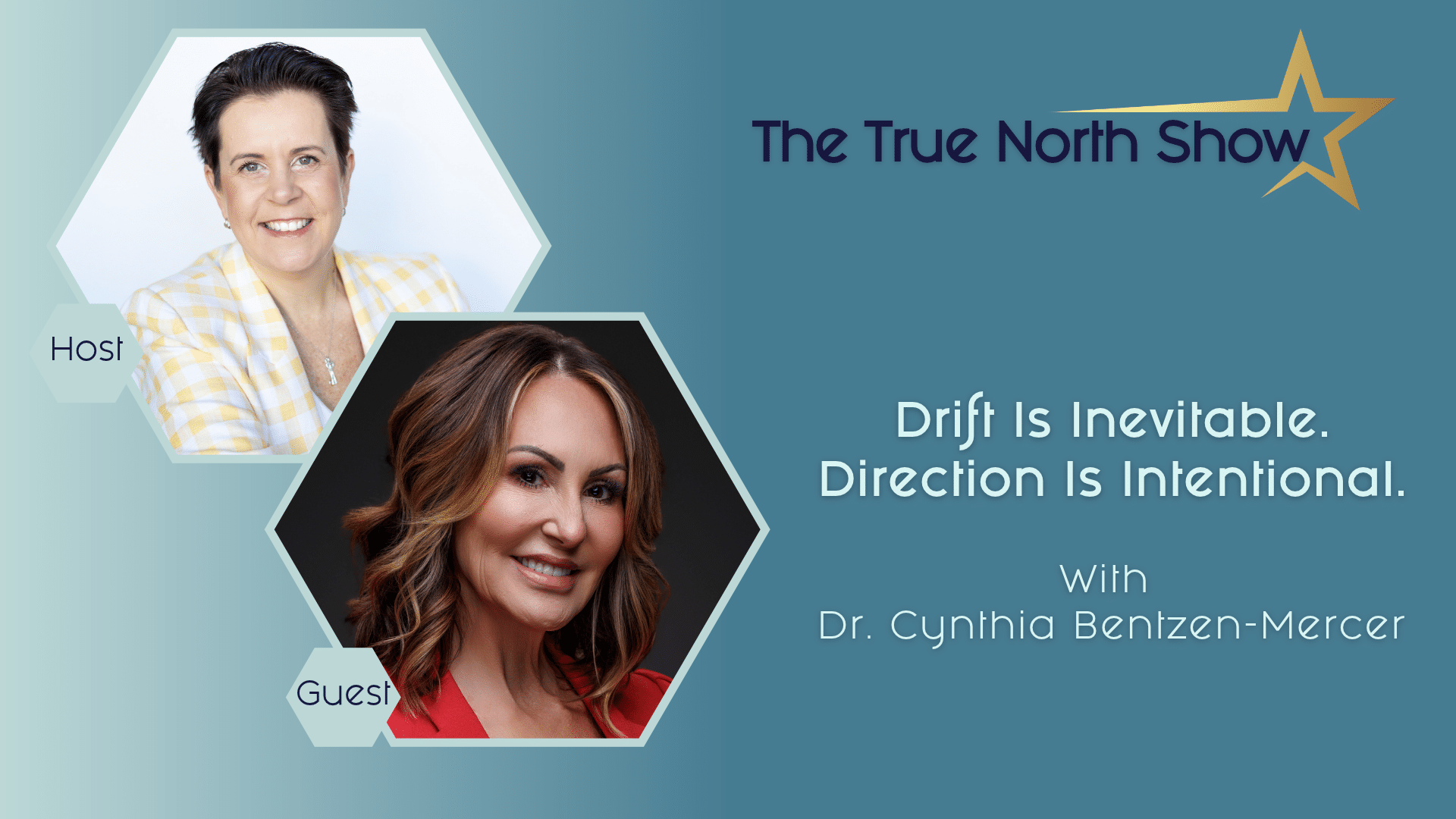
Drift Is Inevitable. Direction Is Intentional. With Dr. Cynthia Bentzen-Mercer | Ep. 69
On this week’s episode of The True North Show I am joined by Dr. Cynthia Bentzen-Mercer, an extraordinary woman who has a wonderful way of explaining something that we have all experienced in our lives in a very practical way. Cynthia shares her story of how certain areas of her life were drifting because she wasn’t paying attention to them and her intention was missing. She uses her experiences to help others who have drifted and gives them practical tools and processes to find the direction and intention that was either lost or forgotten about. It is a truly wonderful conversation and one you won’t want to miss.
Bio:
Dr. Cynthia Bentzen-Mercer is a human capital strategist, executive advisor, board-certified executive coach, international speaker, and bestselling author whose work explores what happens when successful people and organizations realize that the direction they are traveling may no longer be the direction they consciously chose.
After a 30-year corporate career, including 13 years as a C-suite executive, Cynthia experienced an unexpected career transition that forced her to confront a question many high achievers eventually face: What happens when the identity, success, and life you worked so hard to build no longer fully align with who you are becoming?
That experience helped shape her work around The Law of Drift and The Discipline of Direction™, grounded in a simple premise: every human system drifts. Individuals drift. Teams drift. Organizations drift. Direction requires intention.
Today, Cynthia advises CEOs, boards, family enterprises, and executive teams on human capital strategy, succession, leadership capability, and organizational alignment. She also coaches accomplished leaders navigating pivotal moments in their careers and lives.
Cynthia is the author of Human Capital Investment Strategy and a USA Today and LA Times bestselling co-author of Now, Near, Next.
She holds a PhD and MBA and spent much of her career studying and leading the human side of organizational performance. Her work now brings together decades of executive experience, research, coaching, and her own life transitions to help people recognize when they are operating on autopilot, reconnect with what matters, and intentionally choose what comes next.
Her guiding belief is simple: Drift is inevitable. Direction is intentional.
Visit Cynthia’s website to purchase one of her incredible books:
Social Media:
Website: https://www.dr-cynthia.com/
Facebook: https://www.facebook.com/drcynthiabentzenmercer/
Instagram: https://www.instagram.com/drcynthiabentzenmercer/
YouTube: https://www.youtube.com/@DrCynthiaBentzenMercer/
Transcript:
Megan North [00:00:34]
Hello and welcome to the True North Show. I’m your host, Megan North, and I’d like to start by thanking the sponsors of the show: Quantum Awakening, Beth Lewis, Anne C. Clark, and my guest who paid to be featured today.
Today I am thrilled to welcome Dr. Cynthia Bentzen-Mercer, human capital strategist, executive advisor, board certified executive coach, international speaker, and bestselling author whose work explores one of the most profound and universal experiences any of us will ever face: what happens when the life you have worked so hard to build no longer fully aligns with who you are becoming?
Cynthia spent 30 years in the corporate world, including 13 years as a C-suite executive, operating at the very highest levels of organisational leadership. And then, unexpectedly, she experienced a career transition that forced her to confront that very question herself. Out of that experience came the work she is now known for around the world: the law of drift and the discipline of direction. Built on a simple but extraordinarily powerful premise: every human system drifts. Individuals drift. Teams drift. Organisations drift. And direction requires intention.
Today, Cynthia advises CEOs, boards, family enterprises, and executive teams on human capital strategy, succession, leadership capability, and organisational alignment. She also coaches accomplished leaders navigating the pivotal moments that change everything.
She is the author of Human Capital Investment Strategy and a USA Today and LA Times bestselling co-author of Now Near Next.
At the heart of everything Cynthia does is a belief so simple and so profound: drift is inevitable, direction is intentional. Welcome to the True North Show, Cynthia.
Dr. Cynthia Bentzen-Mercer [00:02:53]
Megan, it’s so lovely to be with you. I’m so excited to be here today.
Megan North [00:02:58]
You are very welcome. When I was reading through your incredible accomplishments, do you have to pinch yourself sometimes?
Dr. Cynthia Bentzen-Mercer [00:03:07]
You know, it makes me feel really old. Like, gosh, I have lived a lot of life for all that to have happened.
Megan North [00:03:15]
There is so much for us to unpack today. I’m really, really looking forward to this conversation.
So Cynthia spent 30 years building an extraordinary corporate career, reached the very top of the C-suite, and then found herself facing a question that so many high achievers eventually come to: what happens when everything you worked so hard to build no longer feels like it truly belongs to you?
Stay with us, because when we come back, Cynthia is going to take us inside that moment and share what she discovered about drift, direction, and what it truly means to choose your life intentionally.
Megan North [00:04:43]
Welcome back to the True North Show. I’m here with human capital strategist, executive coach, and bestselling author, Dr. Cynthia Bentzen-Mercer. This is a conversation that will resonate with so many people, whether you’re leading a team, running a business, or simply sitting at home wondering how you ended up where you are.
So Cynthia, I’d love to explore the circumstances around your sudden career transition that had you pivoting in a new direction and following a new true north.
Dr. Cynthia Bentzen-Mercer [00:05:16]
What’s important as a backdrop is that I had never experienced any kind of career derailment. I had worked really hard. I had sacrificed a lot. I travelled a lot, even when my children were young. I missed a lot of school engagements. And I was a high performer. Someone who continued to grow and take on more titles and more responsibilities.
At 55 years old, we were going through a CEO transition. I knew the incoming person and we had a little bit of history, so I wasn’t sure it was going to be a great fit for either of us. I thought, I’ll either do this for three or four more years, and if it’s just not a great fit, I can manage three years and retire early at 58. Or if it’s going better than expected, I can stay longer. In my mind, I was already rationalising: I’ve got three to five years left here.
So when my position was eliminated as part of the transition, it was, effectively, my last day. Thank you so much for your almost 13 years of service. We’d like to get the communication out tomorrow.
I remember leaving and walking to my car, trying to hold it together, passing people I’d worked with for over a decade, just not knowing what to do with all of those feelings. My gosh, I’ve been knocked off my horse. I’ve never experienced anything like this. I’ve been through breast cancer, through divorce, I’ve had other messy things happen in my life, but my career was always the thing I could count on. That was the big moment: you have a lot to consider, a lot of figuring out to do, and where do you go from here?
Megan North [00:08:02]
I’ve been made redundant twice. The first time I didn’t see it coming; the second time I did. It’s such a strange feeling. Words can’t really describe it. Even when you’re expecting it, or you’re okay with it, the feelings still come up. It’s the same feeling. It’s a really strange place to be in your career.
Dr. Cynthia Bentzen-Mercer [00:08:44]
Very much. The pivot for me, my real aha moment, was that I had only ever known corporate. I had worked in one way or another since I was 14. I always loved working. So I’d never had time off. What do you do with yourself when suddenly you have no place to go?
I was defined by my big title and my big role and my success. That’s how I was known: the career mum or the career neighbour. Suddenly it was like, who am I in this new situation? Because I had only ever known corporate, initially my thought was: I have to go find another big job.
But there aren’t very many of those positions. I was the chief administrative officer, also over human resources. I had a non-compete, so I knew that finding that big job where I was living was unlikely. Single woman, empty nester. For the first three days, all I could think was: at 55 years old, I am going to have to move somewhere and start my life completely over by myself. It sounded exhausting and terrifying at the same time.
Megan North [00:10:26]
And it’s interesting, isn’t it, when you’ve worked in corporate for a long time, thinking outside of that box feels almost impossible. It’s like, I don’t know, is there a life outside of that box and what could I do?
Dr. Cynthia Bentzen-Mercer [00:11:04]
A hundred percent. And for me, what was really fortunate, and this really gets to the core of everything I talk about and coach around, is when Kimberly and I were researching and writing Now Near Next. That book is targeted to mid-career women. We think of mid-career not as an age or a title, but as that three to four decades a person spends in their career, past that early climb, just trying to get through the motions of raising a family, being married or having a significant other, and all the things.
Women get restless during that period. What we found when we studied women around the globe, five race and ethnicities, four countries, a 25-year age span, these very successful women, is that to a person they said they weren’t intentional in their career planning.
The through line of Now Near Next is: start working on your future today. Do your day job with excellence, but start working on your future today. The book is written in first person. I journey with the reader, working on my future today. I had envisioned that three to five years from when I was writing it, I wanted to be an author, a coach, a keynote speaker, an organisational consultant.
So in the book, we say: do little things over time. You don’t have to blow up your entire life. Just do little things over time.
By about day three of my transition, I thought: wait a minute. I have another option. My only option isn’t going back into corporate. I have the option of accelerating the plan I had already been working on for a year.
Dr. Cynthia Bentzen-Mercer [00:13:26]
By the grace of God, the universe, however you like to think about it, I had been working on it for a year. I already had my coaching certification. I already had my PhD. My book was getting ready to go to print. So I had another option.
But I promise you, Megan, I would not have considered entrepreneurship had I not been making those steps. It would have been much too overwhelming. It would have felt like starting from complete scratch.
Megan North [00:14:02]
And it isn’t it interesting that usually something happens and then people write a book about it. But the universe really stepped in for you and said: now that you’ve got this experience, here’s a perfect example of you putting it into practice.
Dr. Cynthia Bentzen-Mercer [00:14:33]
Well, and there’s a bit of a humorous part to it. Chapter nine is all about what happens when it all doesn’t go as planned. Eight chapters say here are all the things to do, how to do them, it’s very pragmatic, action items, you build a blueprint. But chapter nine was: life is messy, it doesn’t always go as planned, here’s what you do when you get knocked off the horse. That chapter was entirely theoretical when I wrote it. I hadn’t experienced it.
So I got home after being let go and I thought: I have to rewrite chapter nine, because this has now happened. This is now a real life experience. I reached out to the writing coach and the publisher and said, hey, guess what? This just happened. And my writing coach said, I don’t know how to say this to you, Cynthia, but I think it’s the best thing that could have happened. You have real life experience now to write that chapter from.
In the note in the book I say: well, plot twist. Here’s what’s just happened. And the timing was bizarre. But I’m so grateful that the research led me down that path.
Megan North [00:16:09]
And it’s really interesting what you talk about, having those little things you’re working on within a plan. That’s what I work on with my clients when uncovering their true north, their passion, their purpose. Particularly women in corporate. I’m not saying drop everything and blow up your life. But it’s those little things you can be doing while you’ve still got the job and the security. You could start something on the side. That’s how I started. I had a healing business, cards and tarot and angel cards. I was doing that while I was still in corporate. And then it started to creep in: hang on, I actually want more of this. I love that it doesn’t have to be one or the other.
Dr. Cynthia Bentzen-Mercer [00:17:06]
Exactly. I’m a huge fan of side hustles. Even if you’re not monetising them straight away.
I used to think a perfect world is one where everybody finds their joy and purpose and can exercise their natural gifts and talents in the work they get paid to do. I still would love that world, and I still work hard to help people get clear on where their gifts and talents are. But the harsh reality is there are a lot of people who have to work to earn a paycheck because of the price of groceries, or whatever stage of life they’re at. It’s not always practical to just find the job that makes your heart sing.
But that doesn’t mean you can’t find your purpose elsewhere. If you love knitting and making booties for a local hospital’s labour and delivery department, if you love making greeting cards, if you enjoy coaching, there are so many things you can do to start that process and feel that joy. And then ideally begin to monetise. At some point, that may turn into a full-time business.
Megan North [00:18:48]
Yes. Or it’s just bringing you the joy you need because the other part of your life is your work, because you need to make a living. It can exist in both ways at once. Beautiful. What was the most surprising thing you discovered about yourself during the transition? Something that genuinely caught you off guard.
Dr. Cynthia Bentzen-Mercer [00:19:21]
I’ll answer that a couple of ways.
What caught me off guard even before my transition, when we were doing the research, is that I had always been intentional. So here we were researching all of these very successful women, and to a person they were saying: I was kind of conditioned to put my head down, work hard, and wait to get tapped. They attributed their success to right place, right time, or having the best boss, or circumstance. None of them said they were super intentional about their journey.
And I was. I had been getting certifications, working on my PhD, because I knew I wanted to write a book someday. I was intentional.
Here’s what surprised me: when I was in transition, I realised all the places I had not been intentional aside from work.
Dr. Cynthia Bentzen-Mercer [00:20:42]
Suddenly I had this realisation that intentionality, which I had been studying and dedicating the prior two years of my life to for women in particular, is not only about careers. We can be unintentional in so many areas. And that’s when I came up with the concept of the law of drift: that individuals, teams, and organisations, when you’re not intentional and not paying attention to your direction, you drift. I found that we put various parts of our life on autopilot when we’re focused elsewhere.
I was focused on my career. I wasn’t as focused on my relationships. There was a period where I wasn’t as focused on my health. I don’t think it’s a surprise, in hindsight, that at 40 years old I was diagnosed with breast cancer. Raising two kids, married, great career, so much stress, going through a lot of transition in a very stressful work environment. But largely when I was in my job transition, I thought: gosh, I haven’t really invested in my friend groups as deeply.
Megan North [00:22:22]
Yeah.
Dr. Cynthia Bentzen-Mercer [00:22:24]
They showed up for me. I will say that. I give them so much credit for being such great friends. Because if I’m being truthful with myself, that was not a priority.
Megan North [00:22:39]
And that’s a perfect example of why I get really annoyed when people talk about work-life balance. To me it’s life balance. Work is a part of it, but it’s not all of it.
Dr. Cynthia Bentzen-Mercer [00:23:04]
It’s not all of it. I look at it through five dimensions of human flourishing.
There’s purpose: am I doing what I feel called to do on some greater level, whether full time, in a side hustle, in volunteer work, or somewhere in my life?
There’s prosperity: however you define success and financial wellbeing.
There’s physiological health: my mental and physical health.
There’s people: my relationships.
And there’s potential: am I self-actualised? Am I able to express the beautiful talents and gifts I hold?
I often think of it like a balance board, where there’s a ball underneath the board you’re standing on and you’re trying to maintain some form of balance. And to your point, all of that is life. Not one of those dimensions necessarily outweighs the other. If anything, I think physiological, mental, and physical health are so core to all of the rest. But the reality is we overindex somewhere. Or a couple of places. And other things we think: that’s fine for right now, I’ll focus my energy over here. And then until it’s not fine. Until we haven’t paid enough attention and we’ve let it drift, and we realise we’re not aligned anymore.
Megan North [00:24:48]
And so when you talk about the physiological, mind, body, spirit, mental health. At that pivotal moment, was mental health and wellbeing something you were working on, or has that become a really important part of your life since?
Dr. Cynthia Bentzen-Mercer [00:25:10]
I became more aware over time. I’ve always had a big focus on mental health. I’ve done a lot of volunteer and board governance work around mental health, because I don’t know a person who hasn’t been touched by it in some way, whether by suicide, a mental illness, addiction, or something else. That has been part of my lived experience. But when it became important to me for me, how I was actually showing up in my own mental health, was really at two distinct times.
One was when I went through a really difficult relationship post-divorce, a pretty emotionally abusive relationship for about five years. Coming out of that, I had to do a lot of internal work. How do you end up in a situation like that? What does this say about me? What am I seeking?
After the job transition, I had more of an awakening around the idea that what served me then is not going to serve me now. My kids say I’ve gotten very woo-woo. I went from this really buttoned-up corporate lady to manifesting and all of that. But I started to really pay much more attention to that side of things.
There was a woman who had worked two tiers below me on the org chart, in my department. I didn’t know her well. Twenty years had gone by since we worked together and she reached out for advice. We talked through her situation. Afterwards she asked about me and what I was doing. I had just launched my business post-transition. She is an intuitive. And she said: you know, there’s going to have to be a little death of the ego. What served you in corporate, having to be the most educated, having all the facts, all of those things, in this new space you’re going to have to really tap into your vulnerability and your authenticity and the heart side of things.
I remember just being awestruck. It just hit me in the face. It started the path. I followed up with her at one point and said: how did your situation work out? And she said: I felt fine the next day. I really think the calling was that I needed to talk to you for you.
Megan North [00:28:31]
Yeah, it’s really interesting. When we’re ex-corporate, we feel like we’ve got to have all the things. But honestly, no client has ever come to me for a reading or a healing or coaching and asked me what my qualifications are. They’re just drawn to you because there’s an energetic connection happening.
Dr. Cynthia Bentzen-Mercer [00:28:56]
It’s so true. And I think for the person listening who is in an organisation or a corporate environment, particularly for women, there’s often an extra layer of credibility we feel we need to project. Being the only woman on a leadership team, the more degrees I had, the more facts I had, the more data I had, the more I felt I could contribute and be taken seriously. And now, in so many cases, nobody cares about that. They want to know that I’m relatable, that there’s a connection, that I understand them, and that there’s a lived experience behind what I share.
In hindsight, I wish I hadn’t lost some of that earlier self, even in the corporate space. But the higher I went and the longer I was in an organisation, the further I was from my true self.
Megan North [00:30:24]
Yeah, because we’re in our heads and not in our hearts, not tuning into our bodies and our souls. It’s all head stuff, all credentials.
Dr. Cynthia Bentzen-Mercer [00:30:36]
Yes. And when my kids call me woo-woo, they’re teasing. I love it. I think it’s great.
Megan North [00:30:50]
So what is the law of drift, and how do you know when it is happening to you?
Dr. Cynthia Bentzen-Mercer [00:31:02]
That’s a really important question.
The law of drift simply is this: when we are not intentional, every human system will ultimately drift away from alignment, away from what we would choose the direction to be. Whether we would choose not to have gained the ten kilos, not to have overspent and gotten into credit card debt, or not to have our relationship with our significant other feel estranged. Anything in those parts of our human flourishing that we are not being mindful of, that we’re putting on autopilot, will eventually move in a direction that is not our choosing.
I live on a lake, and I often look out at the water and think of a boat with no captain and no anchor. Its destination is entirely subject to its environment. The current of the lake, the wind, the headwinds or the tailwinds, whatever obstructions are in the way. That’s essentially what we do when we put portions of our lives to drift.
The concerning thing is that high performing, ambitious, driven people are most vulnerable to drift. Because we’re not quitters. When we commit to something, we commit and we double down. We can only focus our energy in so many places at once. And so we muddle through even when something doesn’t feel good or right or aligned, because we’re not quitters, and we just keep muscling through.
Drift happens in three key ways.
One is complacency: we’re simply not paying attention. We’re oblivious to it. The person so focused on work that they’re not investing in their relationship and not even thinking about it, because they assume it’s fine.
Dr. Cynthia Bentzen-Mercer [00:34:00]
The second type is avoidant, almost the opposite end of the spectrum. When I was in that difficult five-year emotionally abusive relationship, there was a lot of avoidant drift. I knew it was messy. I knew it was wrong. I knew I deserved to be treated differently. But it was so hard to figure out how to handle it. What to do about it. There was shame. There was embarrassment. It was easier to just avoid it and focus my energy elsewhere. That’s how I got a PhD. I decided to use that time elsewhere. Something good came out of it. But that’s avoidant.
And here’s the reality: people think they’re stuck or stagnant. But time moves on. We are energetic beings and we don’t get time back. So even when we think we’re stuck, we’re still drifting. We are still in motion. Not making a choice is a choice. I don’t get those five years back.
The third is incremental. Because we don’t pull up to 50,000 feet and look at everything, we have one difficult interaction with our boss, we address it, we deal with it, we think it’s solved, we put it to bed and move on. And then three months later there’s another interaction, and we see each event as its own unique experience. We don’t tether together that this is the fifth time that’s happened.
Megan North [00:36:08]
Yeah.
Dr. Cynthia Bentzen-Mercer [00:36:09]
Or this is not the first time I’ve overdrawn my account. This is not the first time my pants have felt a little tight, or the scale isn’t saying the number I’d like, or my blood pressure is too high. That’s incremental: because we’re so busy doing life, we’re not pulling up and asking, is there a pattern here?
So a long way around to your question of do you know when it’s happening: oftentimes we don’t. Because it’s complacency or it’s incremental. Sometimes we do and we are actively avoiding what’s going on. And that all comes down to the discipline of direction: what do you do about it? How do you meaningfully create attention and intention before you slam into the rocks?
Megan North [00:37:13]
And that reflection piece is so important. I think that’s really interesting, and we talked about this before we started recording. I love having my guest on screen when I’m reading out their bio, because we often don’t actually sit and think about what we’ve achieved recently. It’s really nice to stop and reflect. And I think it’s interesting when someone else is reading it to you as well. Wow, I really am amazing. But that stopping and being intentional about reflecting is so important. We’re so busy getting the next degree and doing the next thing that we forget to stop and think: wow, what an amazing month I’ve had, look at all the things I’ve achieved. That intentional reflection.
Dr. Cynthia Bentzen-Mercer [00:38:13]
And to help people get intentional and prescriptive about it, it has to be simple and fit into everybody’s busy day. So it’s the seven-minute pivot. Seven minutes. And that wasn’t just picked out of the air. We know neurologically that seven minutes is enough time to get us out of that old part of our brain in fight-flight-freeze response. Our brain will tell us not to make a change that is better for us sometimes, because it feels scary and its job is to protect us. Seven minutes is enough time to engage the prefrontal cortex, the logical side of your brain.
Seven minutes is also enough for the person who likes to wallow in their mess. There’s a time for that. But at the end of seven minutes, you’ve got to wrap it up. You don’t get to sit there for an hour and lick your wounds. And for people like me, who don’t even want to deal with it to begin with, it forces me for seven minutes every day to just check in.
It’s three steps. You consider the five dimensions of human flourishing I mentioned and ask: which one do I feel I’m being least intentional about right now? In this moment. You pick one of the five.
The last couple of days mine has been physiological health. I’ve been working a lot and sitting down a lot, and I feel like I need to move. So that’s been mine.
Then it’s three questions. Set a timer, remove all distractions, get out a pen and paper.
Dr. Cynthia Bentzen-Mercer [00:40:29]
I just released a journal, but you don’t have to have it. A spiral bound notebook works. I would encourage you to have something that you use in the same place every day, because to your earlier point, you can look back and see all of your accomplishments. Seven minutes a day over an entire year is 2,555 minutes and 365 choices.
The three questions. First: recognise the signals. What is my body telling me? Our body tells on us first. I feel bloated. I feel achy, like I need to move. What is my body telling you? For the person listening, it could be more headaches, gut issues, feeling really anxious, a lot of negative self-talk, sleeping too much, not sleeping enough. What is your body telling you?
Second question: is there a pattern? Have I been feeling like this just today? Or has this been going on for a couple of weeks? This is that pulling up and saying, did that happen a month ago and two months ago as well? Is there a pattern here, or is this new?
Third and most important: what is one small thing, one tiny thing, that you’re going to do today? Not tomorrow. Not when the kids graduate. Not when you get your dream job. One tiny thing today to pivot in a slightly different direction. For me, it was put on my walking vest and take my dog for a walk.
Megan North [00:42:27]
Yeah.
Dr. Cynthia Bentzen-Mercer [00:42:29]
Every day you’re looking at those five dimensions, asking yourself those three questions, documenting it. Seven minutes, the alarm goes off, you’re done. It does not replace prayer, it does not replace meditation, it does not replace those other practices, because this is introspection and you choosing an action. Then do the thing.
I had someone I was coaching say: I’m going to start working out three days a week. I said: that’s not one small thing. Work out today. Tomorrow, choose your thing. Because the minute we commit to these big things, if we don’t do them, we feel very guilty. But when you do the little things, you’re like: I did that thing today.
Megan North [00:43:15]
Yeah. And then you get that energetic motivation, don’t you? Because you’ve done every intentional thing you set for yourself this week. You feel pride. You’re excited for yourself.
Dr. Cynthia Bentzen-Mercer [00:43:32]
Yes, you feel a sense of accomplishment. And every 90 days, at least in the journal, you look back and ask: what have I accomplished? The other thing, and I think this will align with your thought process, is you give yourself grace. If you didn’t do your seven-minute pivot today, you don’t beat yourself up. You do it tomorrow. If you didn’t do it in the morning but you have seven minutes at night, do it at night. It’s not about judgement. Every pivot you make is a positive thing. If you don’t have one that day, tomorrow’s a new day.
Megan North [00:44:18]
Yes. Being kind to yourself.
Dr. Cynthia Bentzen-Mercer [00:44:21]
Being kind to yourself. And it’s why I didn’t date the journal. I put 365 pages, but no dates. You can start whenever you want and pick up wherever you left off. I was intentional about that because I didn’t want to create the feeling of: look at these five pages I’ve missed.
Megan North [00:44:39]
Yes. Being kind to yourself. That’s really beautiful. And it’s quick. That’s the thing. We get so overwhelmed with social media saying you should be doing an hour of exercise a day, meditating for an hour, all these shoulds. It’s like, my gosh. Just doing one small thing, sitting for a couple of minutes and doing some deep breaths, seven minutes of journalling. It doesn’t have to be a huge thing. It just has to be intentional. One small thing. If that’s all you can do, do that, and be really kind to yourself.
Dr. Cynthia Bentzen-Mercer [00:45:17]
That’s right. I just posted this week: stop shoulding on yourself. Michelle Minnekin has a wonderful book called Good Girl Deprogramming, and she talks about shoulds. She says the moment it’s a should, it’s not yours. Ask yourself: is this my choice? Or am I doing this because somebody else, an influencer, a parent, somebody else, thinks it’s a good idea? The minute you’re shoulding, it’s somebody else’s agency. Your pivot is yours. It’s your choice.
Megan North [00:45:59]
Yes. And where does the intention word and energy and action come from, in relation to the work that you do?
Dr. Cynthia Bentzen-Mercer [00:46:15]
It started with Now Near Next. It started with the research of just understanding how many women leave their careers to other people’s decisions. There is so much conditioning around: put your head down, work hard, and wait to get tapped. We put all of our agency in someone else’s lap. We put it all into the idea that the company should see how hard I’m working, my boss should know I’m ambitious, I shouldn’t have to ask, I shouldn’t have to raise my hand.
When I was a little girl in school, if I sat still and crossed my legs and kept my mouth closed, I got gold stars. Well, it doesn’t work like that in organisations. And for women and people of colour in particular, there is a lot of social conditioning around the globe. The idea that my performance should be evidence enough, rather than being intentional. And intentional means putting your aspirations into the universe, telling somebody that you’d like to be considered for promotion, that you have aspirational goals.
For me, that then extended to my relationships. They are not going to foster themselves. I can’t put all of the responsibility for my friendships in the laps of the men and women in my friend group. I need to be intentional about those friendships. I can’t put my health and wellness into whatever fad is going on. I have to be mindful and intentional about how I’m showing up in my mental health journey and my physical health journey.
Megan North [00:48:06]
Yes. And for me, intention almost comes into the form of action. Because when we talk about manifesting, it’s all great to visualise and to feel it, but if you’re not taking action around it, the universe is going to say: well, what do you want? You’re saying you want this, but you’re not taking any steps toward it.
Dr. Cynthia Bentzen-Mercer [00:48:32]
Right. You can’t just say, I really am manifesting, I’m going to have a great job, but I’m not going to make a phone call or leave my office or update my resume. No one’s probably going to knock on your door. It gets so much back to agency and controlling your destination.
When we leave our destination to circumstance, to others, to anything or anyone else, we may not end up in the spot we chose. How did I end up here? Why am I not happier?
I had a gentleman recently who is in his sixties and has spent his whole career working around what his wife wanted in terms of geographic location. In the last several years, his career has not continued to flourish as he would like. He had this aha moment of: I have limited everything around what someone else wanted and desired, and not taken into consideration my own wants and desires at all. And now I wake up with more engine, more gas in the tank. But I’m in my sixties. Where could I have been had I been more intentional?
Megan North [00:50:33]
Yeah. And you’re right, time is just flying. You blink and it’s Monday, then it’s Friday, then it’s next month. We’re recording this in October and it’s like, where has this year gone?
Dr. Cynthia Bentzen-Mercer [00:50:48]
The holidays are just around the corner. It’s a race.
Megan North [00:50:52]
Exactly. So it’s that taking the action, because tomorrow is going to turn up and the next day is going to turn up. Wow. I can’t believe we’ve only got a couple of minutes left and there are so many things I haven’t asked you.
Wrapping up our conversation, I’m going to ask you the same question I ask all of my guests before we finish. Cynthia, what is one lesson or truth that you’ve learned on your journey that you wish you had known earlier?
Dr. Cynthia Bentzen-Mercer [00:51:37]
To invest in and be mindful of all aspects of your life.
To your point, it’s not work-life balance, it’s life balance. I tend not to be a person who lives in regret. I feel like my life has been filled with experiences that have shaped and moulded the person I am today, and I try to use each of them for positive intention and results.
But it’s the life balance. Wherever you’re over-indexing in terms of your time and energy, pull up for just a moment, assess, and ask: what part of my life could use a bit more of my attention?
Megan North [00:52:31]
Really beautiful. What a beautiful way to end this conversation. Thank you. I’m really grateful for the time we’ve spent together today. I knew our conversation would be filled with very useful information and would be inspiring. I have no doubt the audience is going to get a great deal out of this. So thank you. And thank you for being you, because I think you’re amazing.
Dr. Cynthia Bentzen-Mercer [00:52:55]
Thank you so much. Thank you for doing what you do and for giving me this platform. I appreciate it.
Megan North [00:53:00]
You’re so welcome. I’d also like to thank all of my amazing and dedicated audience, my supporters, and of course my sponsors. I hope everybody has an amazing rest of the week and I’ll see everybody again next week. Thank you so much, Cynthia.