
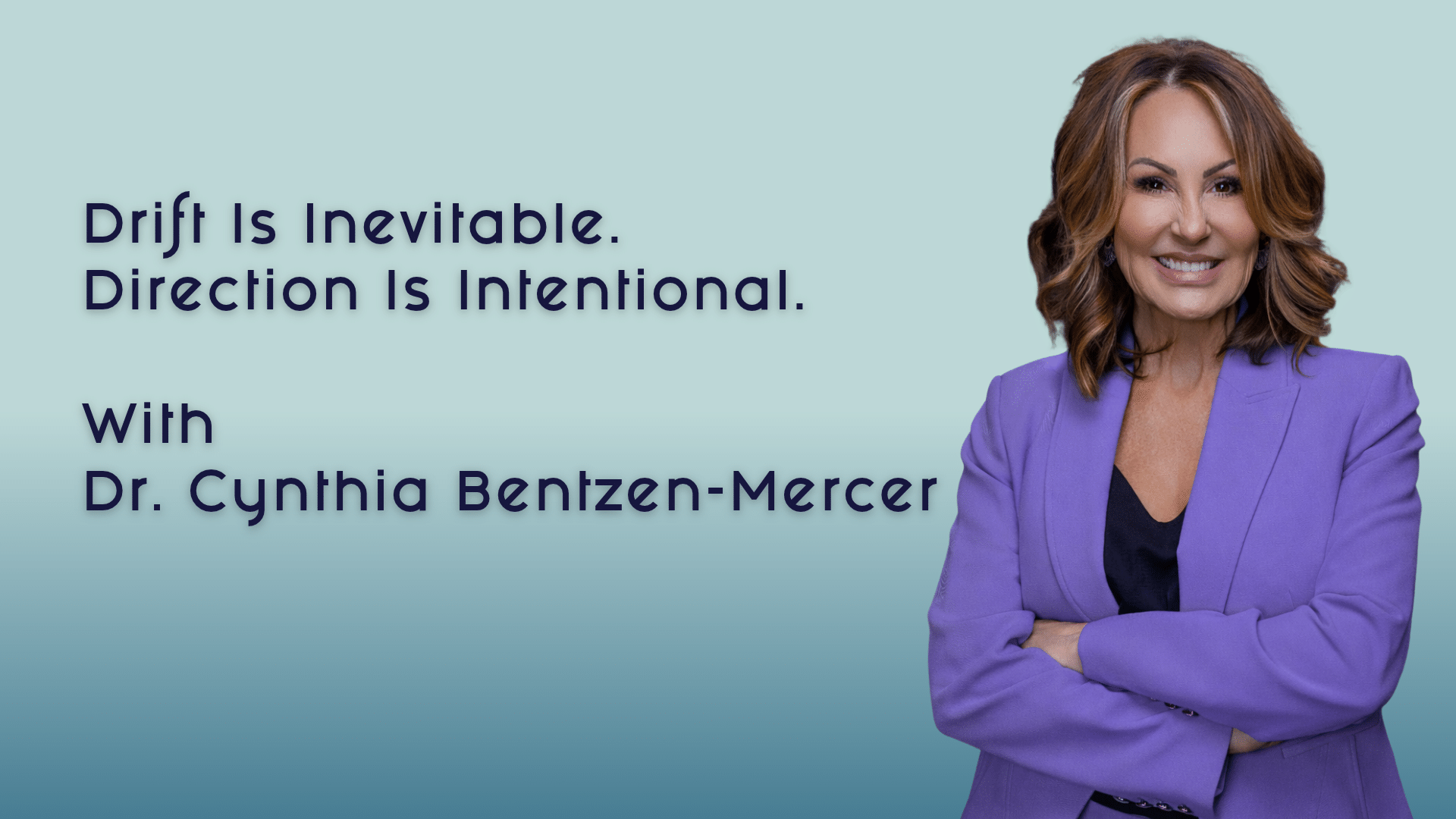
Drift Is Inevitable. Direction Is Intentional. with Dr. Cynthia Bentzen-Mercer
At 55 years old, Dr. Cynthia Bentzen-Mercer walked to her car on what had just become her last day of work after nearly 13 years in the same organisation. She passed colleagues she had worked alongside for over a decade. She tried to hold it together.
She had been through breast cancer. She had been through divorce. She had navigated all manner of messy, difficult, life-altering events. But through all of it, her career had been the constant. The thing she could count on. The place where she knew who she was.
And now it was gone.
“I was defined by my big title and my big role and my success,” she says. “Suddenly it was like, who am I in this new situation?”
What followed was one of the most significant periods of her life, one that ultimately led to the work she is now recognised for around the world: the law of drift and the discipline of direction.
A Career Built on Intention
To understand what made Cynthia’s transition so disorienting, you need to understand who she was before it. She had worked in one form or another since she was 14. She was, by her own account, someone who had always been intentional about her career. Getting certifications. Completing her PhD. Working toward goals she had set years in advance.
At the time she was let go, she had been researching and co-writing a book called Now Near Next, targeted at mid-career women, built on a single guiding principle: start working on your future today. The book was the product of global research: 30 qualitative interviews, 300 women surveyed, studied across five race and ethnic groups, four countries, and a 25-year age span. To a person, the women they studied said they had not been intentional in their career planning. They had put their heads down, worked hard, and waited to be tapped.
Cynthia had not made that mistake. Or so she thought.
On the day she was let go, she and her co-author sent the final copy of the book to the editor.
The Plot Twist
Chapter nine of Now Near Next was titled, effectively, what to do when it all doesn’t go to plan. At the time she wrote it, that chapter had been entirely theoretical. She had never been knocked off the horse. She did not know what it felt like from the inside.
She found out.
“I remember vividly reaching out to the writing coach and saying, hey, guess what? This happened.”
Her writing coach told her it was the best thing that could have happened. She now had real lived experience to write that chapter from. In the final version of the book, Cynthia added a note: “Plot twist. Here’s what’s just happened.”
By day three of her transition, something shifted. Instead of spiralling about having to relocate as a single empty nester with a non-compete clause, she remembered: she had already been building toward something else. She had her coaching certification. Her PhD. A book about to go to print. She had been doing the little things over time, just as the book instructed.
“I would not have considered entrepreneurship had I not been making those steps,” she says. “It would have been much too overwhelming. It would have felt like starting from complete scratch.”
The Law of Drift
The experience of transition did something unexpected. It showed Cynthia all the places in her life where she had not been intentional.
Her career had been the focus. Her relationships had drifted. There had been a period where her health had drifted. She had been through a five-year emotionally abusive relationship that she had spent years actively avoiding addressing, channelling her energy elsewhere, completing a PhD, staying busy, not looking directly at the problem.
Out of this reckoning came the concept that now anchors everything she does: the law of drift.
“When we are not intentional,” she explains, “every human system will ultimately drift away from alignment, away from what we would choose the direction to be.”
She uses the image of a boat with no captain and no anchor on a lake. Its destination is entirely subject to the environment. The current, the wind, the headwinds, the tailwinds, whatever obstructions lie in the way. That is what happens when we put portions of our lives on autopilot.
Crucially, she identifies three distinct forms of drift. The first is complacency: we are simply not paying attention. We assume things are fine and invest our focus elsewhere. The second is avoidant: we know something is wrong but find it easier, at least temporarily, not to look at it. The third is incremental: we experience each difficult moment as its own isolated event and never pull back far enough to see that it is part of a pattern.
“This is not the first time my pants have felt a little tight, or the scale isn’t saying the number I’d like,” she says. “That’s incremental, where because we’re so busy doing life, we’re not pulling up and asking: is there a pattern here?”
And high performers, she notes, are among the most vulnerable to all three types. Because they are not quitters. Because they double down. Because they muscle through. And because they can only focus their energy in so many places at once.
The Five Dimensions of Human Flourishing
When Cynthia rebuilt her understanding of what a well-lived life looked like, she landed on five dimensions of human flourishing. Purpose: am I doing what I feel called to do, in some part of my life? Prosperity: how am I showing up in terms of financial wellbeing and success? Physiological health: my mental and physical health. People: my relationships. And potential: am I self-actualised, able to express the gifts and talents I hold?
She thinks of these five dimensions as a balance board. The goal is not to have all five perfectly even at once, which is not realistic. The goal is to stay aware of where you are over-indexing, and what you have been quietly allowing to drift.
“The reality is we overindex somewhere,” she says. “Or a couple of places. And other things we’re like, that’s good for right now. Until it’s not.”
The Seven-Minute Pivot
The most practical tool Cynthia teaches is the seven-minute pivot. It emerged from a neurological insight: seven minutes is enough time to move out of the fight-flight-freeze response and engage the prefrontal cortex, the logical, forward-thinking part of the brain. Seven minutes is also enough for someone who tends to wallow to contain that tendency, and enough for someone who tends to avoid to show up for themselves, even briefly.
The practice is simple. Set a timer. Remove distractions. Pick up a pen and paper. Choose one of the five dimensions of human flourishing that feels least intentional right now. Then ask three questions.
First: what is my body telling me? The body signals misalignment before the conscious mind catches up. More headaches. Gut issues. Disrupted sleep. Negative self-talk. Restlessness. The body tells on us first.
Second: is there a pattern? Is this new, or has this been building for weeks, months, longer? This is the step that combats incremental drift, the pulling up to 50,000 feet to look honestly at what has been happening over time.
Third: what is one small thing I can do today? Not a resolution. Not a commitment to a three-day-a-week exercise routine. One thing. Today. Walk the dog. Call a friend. Go outside for ten minutes.
“The minute we commit to big things,” Cynthia explains, “if we don’t do them, we feel very guilty. But when you do the little things, you’re like: I did that thing today.”
She also deliberately did not date the journal she has published to accompany the practice. There are 365 pages, but no dates. You can start anywhere. You can pick up wherever you left off. The goal is not to create another list of failures. It is to build a record of small choices made intentionally.
The Ego That Had to Die
One moment in Cynthia’s journey stands out for its honesty. After her transition, a former colleague, someone two tiers below her on the old organisational chart, reached out for advice. After their conversation wrapped up, this woman, who is an intuitive, offered something back unprompted.
She told Cynthia that what had served her in corporate, the need to be the most educated, to have all the facts, to lead with credentials, was not going to serve her in the new space. There was going to have to be a little death of the ego. A shift toward vulnerability, authenticity, and the heart side of things.
“It just hit me in the face,” Cynthia says. “Wow. That is so provocative and intense.”
She now describes having gotten much more in tune with herself since leaving corporate life. Her children tease her about it. She has become what they call, with affection, “woo-woo.” She does not mind at all.
The Final Lesson
When asked what one lesson she would have wanted to know earlier, Cynthia’s answer is unhesitating.
Invest in and be mindful of all aspects of your life. Not just work. All of it. Life balance, not work-life balance. And wherever you are currently over-indexing your time and energy, pause for a moment, pull up, and ask honestly: what part of your life could use a little more of your attention?
It is a deceptively simple question. But it is, in the end, the only question that matters.
Drift is inevitable. Direction is intentional. And the choice, every single day, is always yours.