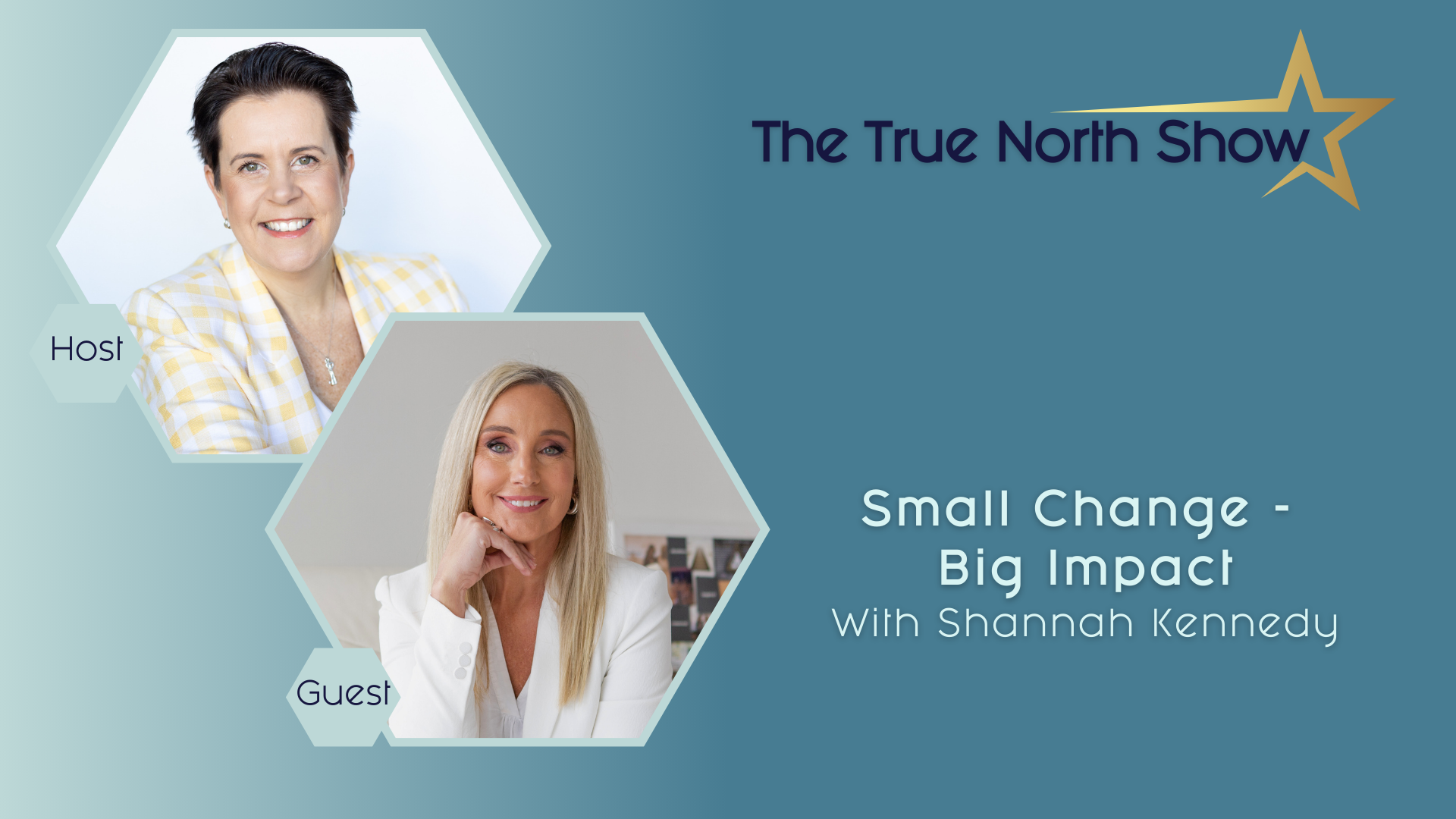
Small Change – Big Impact with Shannah Kennedy | Ep. 26
My guest on this week’s episode of The True North Show is Shannah Kennedy who consistently blows my mind every time I speak with her. Shannah has a very calm and beautiful way of getting you to think far beyond the day to day so you can put strategies and habits in place now so your 10 and 20 year old versions will thank you for it. Our conversation is filled with practical tools as well as mindful tips and her answer to my last question is absolutely incredible – you won’t want to miss it!
Bio:
Shannah Kennedy is one of Australia’s most respected strategic life coaches, keynote speakers, and best-selling authors. With over two decades of experience, she has built a reputation for guiding high performers, CEOs, executives, elite athletes, entrepreneurs, and individuals at crossroads—to live and lead with clarity, confidence, and calm.
A Master Life Coach (ICA) and certified Breathwork Instructor (Breathless Expeditions), Shannah’s work integrates evidence-based coaching frameworks with practical tools for self-awareness, self-leadership, and self-management. Her approach is grounded, holistic, and deeply human—helping people simplify, focus, and design a life they genuinely love.
Shannah is the author of eight best-selling books with Penguin Random House, including the global success The Life Plan, Plan B, Elevate, and Restore. Her books are trusted by readers around the world as practical guides to managing burnout, finding direction, and sustaining high performance without sacrifice.
As someone who lives with and manages chronic fatigue and depression, she embodies the principles she teaches. Her message is both professional and personal: success is unsustainable without self-care, structure, and intentional rest.
Based in Melbourne, Australia, Shannah lives a life she has consciously designed, anchored by family, community, and the daily practices that restore her energy and joy. Her legacy is one of clarity, compassion, and empowerment: helping others step into their fullest potential, one deliberate breath and one conscious choice at a time.
Social Media:
- Website: www.shannahkennedy.com
- Facebook: https://www.facebook.com/shannahkennedy
- Instagram: https://www.instagram.com/shannahkennedy
- LinkedIn: https://www.linkedin.com/in/shannah-kennedy-8a898b1/
Transcript:
Today, I am joined by an incredibly inspiring woman who I’ve had the pleasure of working with recently. Shannah Kennedy is one of Australia’s most respected strategic life coaches, keynote speakers and bestselling authors.
With over two decades of experience, she’s built a reputation for guiding high performers, CEOs, executives, elite athletes, entrepreneurs and individuals at crossroads to live and lead with clarity, confidence and calm. A master life coach and certified breathwork instructor, Shannah’s work integrates evidence-based coaching frameworks with practical tools for self-awareness, self-leadership and self-management.
Her approach is grounded, holistic and deeply human, helping people simplify, focus and design a life they genuinely love. Shannah is the author of eight, that’s right, eight bestselling books with Penguin Random House, including the global success The Life Plan, Plan B, Elevate and Restore. Her books are trusted by readers around the world as practical guides to managing burnout, finding direction and sustaining high performance without sacrifice.
As someone who lives with and manages chronic fatigue and depression, she embodies the principles she teaches. Her message is both professional and personal: success is unsustainable without self-care, structure and intentional rest. Based in Melbourne, Australia, Shannah lives a life she consciously designed, anchored by family, community and the daily practices that restore her energy and joy. Her legacy is one of clarity, compassion and empowerment, helping others step into their fullest potential, one deliberate breath and one conscious choice at a time.
Wow, Shannah. Welcome to the show. I’m so thrilled to be having this conversation with you today.
Shannah Kennedy (03:09)
I’m excited to be here, and especially seeing that we have worked together. It’s very exciting to be here to have a great conversation about all of these wonderful tools and tips.
Megan North (03:20)
Absolutely. How does it feel for you when I read out that incredible bio?
Shannah Kennedy (03:27)
Surreal. It’s like, is that me, you know? I’ve been working from home for 22 years, sitting in the same room. In this room. For 22 years. All alone, building this business. I’ve never had a staff member, nothing. And it feels a bit surreal to think I did create a lot of things out of this space, and I’ve coached over a thousand people through this space.
So it’s a very soulful room with a lot of stories in it, a lot of imagination in it and a lot of creativity in it, and yeah, when you read that out it’s quite mind-blowing. It sort of doesn’t sound like me.
Megan North (04:09)
I actually really love it, because it’s often a question I ask my guests, because we often write or read our own bio, but we don’t often hear it spoken about us, in front of us. And so I actually think it’s a really nice way to just have a moment to pause and to be present and to reflect on where you’ve been and what you’ve done.
Shannah Kennedy (04:33)
It really is actually, and you know, I’ve got a husband, I’ve got two kids at 19 and 21, and as they grew up, I’d write a book or I’d go on the stage or I’d go on television and they just didn’t care. They were just, “Mum.”
They weren’t impressed by “You sold ten thousand books today,” or “You went on TV today.” They just wanted a mum. They wanted a cuddle. They wanted a muffin. They wanted mum time. And it wasn’t impressive to them, and I think that’s what keeps you very grounded, because they bring you to earth pretty quickly. Like, “Mum, I don’t even like the colour of that book.”
So you know, they’ll just bring you to earth very quickly, and I think my number one thing is: you are not your job. I actually feel that I’m building my life. I am not my title. So I’ve done a huge amount of work on that and yes, to hear it is great, but that’s just a title.
Megan North (05:32)
Yeah, yeah. And I feel the same in that sense as well, in that I’m constantly looking and sort of tuning in to where am I with the work that I’m doing. As long as each day I’m making an impact on one person, that’s all I really care about. I don’t really take much notice of how many followers I’ve got on Instagram, what’s happening on LinkedIn.
And one of the people that I’ve just recently had on the show, he called me a couple of years ago and he actually said, “Megan, please just don’t stop what you’re doing, because you’re having a real impact.” And I loved that he picked up the phone. But when I looked back on all my social media, everything, he’d never liked, he’d never commented on anything.
Shannah Kennedy (06:23)
And the mother is watching.
Megan North (06:25)
And so for me, that was a very interesting perspective to have then, on moving forward, just trusting and having that inner knowing that you’re making a change with people, and that’s really all you do this work for.
Shannah Kennedy (06:41)
Yes, absolutely. It’s not doing it for likes. I don’t do it for likes. I’ve never written a newsletter in my life in the 22 years of business. I’ve really, you know, gone on my own path to do what feels right for me.
It was, “Hey, you should write a newsletter every week and you should post three times a day.” Well, some days I don’t post and some weeks I don’t post. And I just do what feels right on the day. And if that’s nothing, that’s nothing. And just being okay with that is really freeing.
Megan North (07:11)
Yeah, definitely. So you’ve been doing this, you mentioned, for 22 years in this room. Is that what you’ve done your whole career, or is this kind of your second career? How did you get into the work that you’re doing, and what led you to pursue this passion and purpose?
Shannah Kennedy (07:31)
Definitely my second career. So my first career was in my 20s. It’s actually when I left school. I decided that I didn’t want to go to university and I didn’t want to study. I wanted to go to work. I wanted to make some money. I wanted to work really hard. I wanted to learn the skills on the job, because I really didn’t like books or exams or things like that.
I didn’t do very well at English. You know, I loved going to school, but I just didn’t like the academic side too much. So I decided, yeah, stick with that and just start working. And I got very excited because I did work experience in the stockbroking market where they used to have the men on the ladders with the chalkboard, the old stock exchange, that’s how old I am.
And my job was to run the tickets through all the screaming men to give it to the front man, and the front man would then write the order up on the board. And I thought, “This beats university. I’m absolutely going to get a job here.”
So I just rang every single day, the HR lady, until she gave me a job, which was about 10 days later, because she knew I wasn’t going to stop ringing. And she said, “I’ll give you a job, but it’s in the dungeon in the filing department down with the old contract notes.” I’m like, okay, that sounds good, I’m going to get a paycheck.
And it was horrible. It was horrible. It was dusty. It was dirty. It was smelly. It was all the old print contracts and things like that. But within a couple of years, I was one of the first girls to ever sit up on the trading desk and be in that financial settlements market. And I was like, if you work hard, really lean in, you might not know everything and you might not have the skills, but you can learn the skills.
So that’s where it all started. And then I sort of had a good look around and thought, no, this is like The Wolf of Wall Street. This is not where I want to be. It’s against my own values. I didn’t know what my values were, but it was that feeling in your belly. I hadn’t put words to them because I didn’t know about them. They don’t teach you at school. But it just didn’t feel right.
So I went and travelled the world for a couple of years with a backpack, as you did in those days, and came back and got a job in sport, where this man, he was very passionate about golf, he was a lawyer, and he said, “I’ll teach you how to run the whole business if you’re up for it, but just starting as the secretary.” And I was like, okay, that sounds great.
So it was golf, it was looking after 10 of the country’s best golfers. It was learning how to run corporate golf days, negotiate contracts. I cried a lot because he just crossed out all my work in red pen and he said, “No, you need to think like me, speak like me.” So it was very small business and he trained me how to really step up. So that was incredible.
He then went to the US and Bollé sunglasses saw me at the golf and said, “We need a Jerry Maguire. We need a sponsorship manager. Would you be willing to learn?” So I was like, okay, I will learn. Again, didn’t have all the skills, didn’t have all the knowledge, did not have the degree. Thought maybe I’m a bit of an imposter here, a bit of a fake, because I haven’t gone to university.
But I really leant in and built relationships with the athletes, really cared about their sport, their mental health, their relationships with their families. I was in direct competition with Oakley. It was a very male-dominated space as well. So I was really particular about, how am I going to win people over? And that was caring, listening, providing a safe space for athletes, because they can’t talk to anybody.
So my office actually became like a therapist’s office, where they were talking to me about, “I’ve had a fight with my mum because she cooked a roast but I was out with the boys and I didn’t go home and I forgot to call her,” or “I’ve had a fight with my girlfriend,” and I’m sitting there thinking, wow.
And then I saw the dark side of sport, which is: who are they without their sport? All of them were 24, 25 year olds. Their sporting career was over and there was a big black hole. And this is 30 years ago. Nobody cared about mental health. It wasn’t even a word. It was burn and churn. It was, “You’re really great on the field, but don’t need to know you anymore.”
So I married the job. I loved the job. It was seven days a week. You know, sports on the weekend. So I always went to all the sporting events on the weekend. I’m in my twenties, it’s fast, it’s furious, I’ve got lots of money, I’ve got thousands of friends because I have free glasses to give away. So I was invited to the opening of an envelope, and I went and I did everything.
And I had no regard for myself. I had no regard for my health, my mental health. I had no boundaries at all. I didn’t know what my values were. I didn’t know who I was without my job. And that all ended in chronic fatigue syndrome, which put me in bed for a year. Completely flatlined.
Unbelievable pain. It’s like having the worst hangover of your life, but you’ve never had a drink. You can’t get your head off the pillow. My whole body and bones felt like they’d been hit with a baseball bat. It was incredibly painful. I couldn’t turn lights on. I couldn’t… I still can’t read a newspaper because the ink burns my nose, 25 years later.
And in that time I went into a really deep depression, because I’ve just gone from hero to zero overnight as well. And then I really thought about the athletes and what I witnessed over the ten years and I felt, wow, someone’s got to care for these people.
So I actually ended up getting myself a coach to get out of the depression. Not a therapist, but because I’d been around high performance, I thought the natural thing to do is get a coach. And setting goals like walking to the letterbox, setting more like maybe walking to the end of the street, setting a goal like maybe turning a light on for an hour and then turning it off, maybe turning the TV on but very, very softly.
So starting to set goals and also unpack my old narrative, which was, if you’re not working as hard as you can, you’re nothing. You’re lazy. So rest, for me, meant lazy. It wasn’t part of my high performance.
Megan North (14:15)
Yeah.
Shannah Kennedy (14:17)
So when you think about athletes and they do their high performance, they also have high performance recovery. I didn’t have that part. So that was the part for me that was incredibly exciting, to rewire myself, rebuild myself as a human for high performance, but with sustainability.
So I ended up studying life coaching, because I was so excited then, to coach my athletes into retirement and start a business from home that I could work around my health, because there was just no support for health back then.
Megan North (14:51)
Yeah, yeah. Wow. And that drive for you, of that belief system that you had of, if you’re not working hard, then you’re lazy, where did that come from? Is that something that you learned as a child or…?
Shannah Kennedy (15:05)
Yes, definitely. European parents who’d come out on the boat after the war and it was all about hard work. So if I ever sat on the couch it was like, “You’re lazy, what are you doing? Go out, mow the lawn, wash the car, wash the windows, we’ve got to be working.” So yeah, rest was not anywhere near us growing up.
Megan North (15:21)
Yeah. Wow, that’s just amazing.
Shannah Kennedy (15:31)
Yeah, so I decided to become a life coach 25 years ago. Nobody had heard of it. So everybody thought I was a complete idiot, if I can say. It was like, “Why would you leave your Jerry Maguire amazing job? You’re a life coach, whatever that is, never heard of it, sounds a bit woo-woo to me.”
But my husband was the one who said, he was also in sport, and he said, “No, you go. You go, because it’s needed. You can see it. You can see the gap in the market. You know what’s happening. You’ve had an insight into all sides and you should follow your passion.” So he gave me two years to build it.
Megan North (16:14)
Right. And so you saw that as well. There’s no other option, is what I mean. So yeah, yeah.
Shannah Kennedy (16:16)
Yeah, go to work.
So it was soul-destroying in the beginning. It was because people were saying, “I don’t know what a life coach is.” Sporting clubs were like, “No, do not mess with their heads.” So nobody really understood that it was about creating a life plan for high performers, where they could see life after sport. They could maybe throw some seeds along the way to support them and learn about their finances and really own their personal journey.
And I think for them it was a little scary, scary back then.
Megan North (17:00)
Yeah, definitely, definitely.
Shannah Kennedy (17:02)
A lot of athletes actually just came to me on their own accord without telling anybody, and that’s how the business took off.
Megan North (17:09)
Interesting. Isn’t that interesting? And that would have been, I would imagine, a very defining moment for you early on, that they were coming to you, but they’re not telling anyone, because in your mind then you’d be thinking, “Hmm, okay, quietly they actually really need this work that I’m doing.”
Shannah Kennedy (17:29)
Yes, absolutely. Absolutely. And then I went to a football function and sat next to a man who was in banking. And he said, “What do you do?” And I said, “I’m a life coach,” and I’m like, here we go.
Anyway, he was really interested because I’d worked with athletes. He said, “I want all the high performance tips into my team. Can you come over and do a talk?” And I’d never done any talks before, ever.
So that was a very big defining moment because that was facing a very big fear. And once that corporate door opened, it just took off. It took off because nobody had heard about life skills or wellness skills, and I was presenting them as a high performance skill set rather than “fire and bake.”
So because I came in as a high performance coach with life and wellness skills, the door opened before anyone else had even got in. So I was the first one in there. National tours. I’m like, my gosh, I still haven’t been to university. I’ve studied for three years to get my life coaching certification and become a master life coach, but I didn’t call that university. Very interesting what we do, isn’t it?
Megan North (18:33)
Thank you. And also how we can, I mean, this is The True North Show and this conversation is so rich with golden nuggets of information for people, because we all think, particularly if you’re coming from corporate and then wanting to do your own thing or pursuing a passion and purpose, “How many university degrees have I got? How many certifications have I got?”
At the end of the day, I’m sure that all the people that turned up at your door never even looked at what you were certified in. They were just connecting to you and the work that you were doing.
Shannah Kennedy (19:24)
And the whole business was built by referral. I didn’t want to write newsletters.
Megan North (19:29)
What is it with you and your newsletters?
Shannah Kennedy (19:32)
I just didn’t like writing them. I had this mental blank. And then one day, after coaching for about five years and speaking, I thought, I think I need to write a book because I’m saying the same thing over and over again, but I want a book that is like a Donna Hay quick cookbook.
So every time I went to the bookshop and looked at books, I was paralysed. I was like, I can’t read a whole big book on goals. I can’t read a whole book on values, a whole book on habits. It’s all too much for me, because I’m not a big reader.
So I decided I wanted a Donna Hay cookbook for life and wellness skills. I want pictures. I want it on the coffee table. I want it to look so nice. I want bullet points everywhere. I want summaries everywhere. I want every skill to be a maximum of two pages. It’s like, you know, the quick cookbook.
So I got knocked back a lot, a lot, from every publisher. And then I actually approached the cookbook department of Penguin and I said, “Would you take a really big risk on me?” And the lady there, Julie Gibbs is her name, was publishing all the amazing, beautiful Kylie Kwong cookbooks and all of these amazing things.
And she said, “I’ve never heard of it, but I think I’ll take a chance.” So it was the first self-help book on the shelf full of photos and beautiful imagery for people to go on a journey to create their own life plan. And it’s too pretty to put on the shelf; you have to have it on the coffee table.
So it became a bestseller. A bestseller is six thousand copies. It has sold over a hundred thousand copies now. That was, again, just sitting in here going, this is what I’d like to do, without thinking about all the obstacles, without thinking about what people would say, just following my passion.
And I think The True North Show, that’s what it’s about, isn’t it? You get the idea, come in, maybe just do it. Maybe just don’t even ask people what they think, because there’s a lot of dream stealers out there. Let’s just have a go.
And the same thing happened in lockdown. I’ve been doing vision boards ever since I was 20 years old, and I decided in lockdown in Melbourne here, people need new vision on their wall because they’re here every day. Maybe I’ll design some kits.
So everything is colour-matched, and I’ve chosen all the photos or the words or all of the quotes, because a lot of people get stuck on vision boarding because it looks messy. And they go, “Well, mine doesn’t look as nice as somebody else’s,” or, you know, they get paralysed. I thought, right, I’ll do that.
And I just approached, in lockdown, in private, a craft company and said, “I want a box and instead of all your craft things in it, I want a workbook and 80 cards.” And they said, “Oh, we’ve never done that.” I said, “Well, trust me, it will sell.” So they took a huge risk and they produced two kits and they sold 200,000. One hundred thousand of each.
Now they’re over at Target in the USA.
Megan North (22:56)
Wow!
Shannah Kennedy (22:58)
Here with no one, just saying, “Wouldn’t that be a nice creative project?”
A lot of people are coming up with amazing ideas, but they’re not taking action, or they’re doubting themselves, or “It’s going to be too hard,” and “Who’s going to listen to me?” Maybe just take the action and see what happens, because you’re creating something that you believe in, you’re passionate about.
And if you sell one kit or if I sell one book, as you said, if you change one person’s life by doing a post or doing this show, that’s enough. If I just sell one, that’s enough. If I write this book and it changes someone’s life, isn’t that a gift to the world?
So I sort of invite everybody to really open up. Open up and just play, and think of it as play rather than putting all that heaviness on them.
Megan North (23:55)
Yeah. And the other thing that I think, particularly with some of the clients that I work with as well, is that I talk about your inner circle. And so if you have an idea, you don’t need to tell the world about your idea. You can just quietly work at it in the back end.
If it works out, great. If it doesn’t, it doesn’t matter, because no one knew that you were going to do it anyway. And you might have to tell one or two people in your inner circle, but I’m always, I’m one of those people that, you know, keep these ideas quiet so that then you’re just chipping away and doing what you need to do.
And then I feel like there’s less fear because I haven’t told a hundred thousand people.
Shannah Kennedy (24:38)
Yes, there’s cheerleaders and dream stealers. We only need one cheerleader. And that’s it. So I would always just tell my husband, maybe my mum and say, “Here she goes again,” maybe one friend and that was it.
Because I learned when I wrote The Life Plan at a barbecue, I told a couple of my husband’s cousins and they said, “Nobody reads books anymore, so that’s a waste of time. Forget it. It’s just a podcast now. No one reads a book.” And I was so deflated, really deflated.
And I thought, no, I cannot tell people. I just need to play for myself and enjoy the process for myself. And if it sells, it sells. And if it doesn’t, that’s okay too.
Megan North (25:26)
Yeah, yeah, beautiful. Wow. And so what is it about the work that you do, like coaching people? What lights you up? What is it about this work that you really love? Why is it your passion and your purpose?
Shannah Kennedy (25:43)
Because I think it’s my calling. I’ve been doing it for 22 years, as I said, and I still feel like I’m beginning. So there’s no burnout, zero burnout. I love it.
I only coach really on the phone, so I don’t do Zooms. I do very many face-to-face because it keeps my energy where it needs to be. It also makes them listen properly. It allows them to take notes, and it allows me to listen to what they’re not saying. So we’re listening better than if we’re on the screen watching.
So some people say, “No, I need to see your face all the time,” and I say, “Well, you have to find another coach,” because I think it’s the most powerful way. All of the coaches I’ve had over my 20 years, I employ a coach every three or four years for myself, keep learning, evolving and remembering what it feels like to be on the other side.
And I insist, phone only, with them too, because I really get into their voice. Their voice then is embedded into my brain and I never forget what they’ve told me. If I was looking at them, I might be a little distracted.
So I’ve always just done it my way and I really invite people to do you. Don’t do someone else. Do you. Do what works for you. Stand by what is best for your energy and create it the way that is best for you, so that you sleep well at night and you’re not resentful and you’re not burnt out and you can continue to love it.
But what lights me up is being the lighthouse for people and just shining the light on where they could be going. And I see all the pennies drop. I can hear them dropping in their head and seeing what they do by just reframing things, learning their values, giving them really great tools and tips and sticky-note things and writing on mirrors and facing the mirror and becoming friends with their best friend, themselves, and changing their language and giving themselves permission to be great.
And, you know, going through how they manage their time and their energy and their health and really connecting with their 10-year-older self. Oh, it is so joyful. Incredibly joyful. When I say to someone, “How old are you in 10 years’ time?” they all get all funny, and then I say, “Now, that person’s already there and that’s who you work for.
That’s why you’re going for a walk today when you don’t feel like it, or that’s why you’re going to the gym to lift weights when you don’t feel like it, or not having that donut when you want it and you shouldn’t be having it. You’re serving this amazing human, which is yourself in 10 years’ time.” And once they connect with that person, they make incredible change.
Megan North (28:39)
Yeah, absolutely. And it’s one of the things that you and I worked on and it really lit a fire under me, definitely, and it really resonated very quickly. Very quickly. Yeah, I love that. I love that.
Shannah Kennedy (28:53)
Yeah, I think it’s about being practical and real and making it very easy for people to create change, by using sticky notes and vision boards, and the brain needs a map and signage. So if people are being coached but there’s no signage, well, it’s like someone told you the direction somewhere but you didn’t plug it in the GPS.
You know, we need visual stimulation. I think 80% of the population need visual stimulation. So when we have our sticky notes here all the time that remind us to breathe or remind us how we want to feel or remind us of our values… Mine’s been sitting here, this silly sticky note’s been sitting here for 20 years: “That’s the boss.”
So teaching them some of the basics that we don’t get taught at school really lights me up.
Megan North (29:44)
Yeah, wonderful. It’s beautiful.
Now, I’d love to explore a little bit more about one of the relatively new things that you’ve started in the work that you’re doing, in relation to the breathwork. But we need to take a break because I need to hear from our sponsors. So we’ll just take a short break, and then we’ll come back and we’ll explore that. And then I’d also love to just explore mental health and wellbeing and what it means for you, and tips and tricks that you may have as well. So, great. Thank you.
Shannah Kennedy (31:53)
Thank you.
Megan North (31:57)
Welcome back to the show. So breathwork seems to be a newish area that you’re working in at the moment. So how did that modality make its way into your busy schedule?
Shannah Kennedy (32:09)
Well, I started breathwork 25 years ago when I was in my full burnout. So the first thing that my coach said to me was, “You don’t breathe. You are running a hundred miles an hour, working seven days a week, and you don’t breathe. It’s like running a marathon every single day without stopping at any Gatorade stations.”
Megan North (32:33)
Right.
Shannah Kennedy (32:35)
Yeah, I think I held my breath. I think I hold my breath all day and just am addicted to achievement and addicted to going fast and being busy, and rest is over there. And that was really big for me.
So the first thing I had to learn how to do was go to the mirror, stand very close to the mirror, become friends with my best friend, which is myself, which I couldn’t stand looking at, and breathe. And I had to learn to breathe slowly and deeply, and it used to just make me fall asleep all the time.
I was that exhausted and that burnt out that even just doing breathing made me exhausted. So I knew the only way to connect with myself, get out of my head and into my body and become a human being instead of a human doing, was through breath.
And we breathe, you know, twenty to twenty-five thousand breaths a day. That’s a lot of breaths, often shallow, often fast, too fast, and usually through the mouth. We’re running around with our mouth open.
So for her it was, we need to retrain, you know, the fuel, because there’s no fuel going in. And when we’re stressed and when we’re holding our breath, our digestion is shot, our brain is shot, we can’t make great decisions. We’re not refuelling the body.
So breathwork is the practice of really using breath to influence how we feel, how we think and how we perform. And it’s the only system in the body that is automatic and under our control. The only system. It’s the remote control.
I didn’t know that at all. I just thought you just breathe. Breathing, what’s breathing, you know, as everybody does. So I learnt just three breaths. So in 25 years I’ve been taking three breaths. I don’t meditate. I don’t sit down for twenty minutes and breathe. I take three breaths every time I wash my hands, to stop, to ground myself. It’s the Gatorade station.
And just to take three deep, soul-nourishing, grounding breaths every time I wash my hands, which is about six times a day. All of a sudden I was sleeping better. I wasn’t waking up at two in the morning with a spinny brain. I felt really paced. I started to feel grounded.
I started to connect with self, because every time you wash your hands there’s a mirror right in front of you. While you’re breathing you could maybe look up and say hello to your best friend. That little ritual changed my life. Completely changed my life.
Because you know how people go to the bathroom, wash their hands as quick as possible and run out? It’s like running past the Gatorade station. So to be able to stop, to be able to press pause, to be able to open up the digestion, to open up the brain through breath, to deeply breathe, not just the shallow breath here, changed my complete outlook on life.
I was doing it in supermarket queues. I’d turn the shower on, do three breaths. I’d wake up, do three breaths. I would have a sticky note on my car, every time at the lights, “three breaths.” So it actually just became a ritual that was available to me all day, every day. It was the Kool-Aid for getting better.
So I’ve continued that my whole life. I’ve had it on the mirror for 20 years: “Take three breaths,” and sticky notes everywhere. I still have them now, like right here in front of me. And that’s the boss. That’s the boss, because if I’m calm, if I’m confident, if I’m grounded and if I’m breathing, I can make some really good decisions. Maybe I could shut down the inner critic a bit and maybe I could just enjoy today like it’s a play date on the planet.
I could find some lightness in everything. So fast forward to now, 25 years later, both my kids have finished school. After teaching them three breaths and my clients three breaths for the 20 years, I thought, this is a skill I’d really love to study. I am finally ready to do some study.
So I spent the whole year learning and studying the breath, to go and teach it to people who have got anxiety and overwhelm, maybe women of domestic violence that haven’t taken a breath for a very long time, a safe breath; corporate workshops, teaching people in the corporate world how to regulate their emotions and regulate themselves through breath during the marathon of the day.
And also for myself, I’ve really enjoyed learning how powerful it is.
Megan North (37:44)
And I’m a breather. I find taking what I call a conscious breath, I count in and then I hold it. So it’s not really a box, it’s kind of three-quarters of a box. So I count in, I don’t know, three or four, hold for three or four, and then out.
And what I find is that when I’m consciously breathing, my brain physically cannot think of anything else. So we just naturally… that just switches off. And it’s 12 seconds, isn’t it, of just that nothing, and that’s all I need.
Shannah Kennedy (38:19)
It’s the holding of the breath where all the goodness is. It’s in the breath hold. It’s like everything just went quiet. Quiet. And it’s like all the sediment dropped down and the clarity comes. So yeah, very, very powerful high-performance tool.
Megan North (38:33)
Yes, absolutely. And it’s free and you can do it as many times as you want in the day. Yes. And that’s what, you know, like I say, if I do a four-four-four, that’s 12 seconds.
If you can’t find 12 seconds, a few moments through your day, then you’ve got some serious problems.
Shannah Kennedy (38:42)
It is, isn’t it? Yes. Yes, you know. So with our addiction to technology and our addiction to distraction and our addiction to being busy, this is something that is quick enough for a reset. And maybe before you go to the bottle of wine or to some medication, you could try breath.
Megan North (39:17)
Yeah, yeah, absolutely. It is so incredible and I love just the instant power of it. Love that.
Shannah Kennedy (39:19)
Incredible too. You can also use it to wind yourself up. You know, it’s a remote control. You can go into “crazy FM.” Say you’re doing a presentation or something like that, you need to fire up, you can use those really big inhales and really big exhales and you can just really rev yourself up.
Then you can pick up your remote control at night-time and turn yourself down as well. So you could do the really slow diaphragmatic breathing. And there’s all different breath patterns for different things. So we’ve got a whole remote control at our fingertips when we learn the different styles of breath pattern and what it does to the body. So it’s pretty exciting.
Megan North (40:10)
Absolutely, absolutely. And so from a mental health and wellbeing point of view, is the breath the main thing? Because you said that you don’t meditate. Is there other things, I know that exercise is really important to you, what other things do you do from a mental health and wellbeing point of view?
Shannah Kennedy (40:28)
I think it’s about creating your own personal plan. That’s why I wrote The Life Plan. Everyone’s different. So what I do is not going to work for the person next door or for you and what you do, etc. So self-awareness is really important.
But there are a few things that I think are non-negotiable, which is how you start your day. Does it work for you? If you’re bringing the phone into the bed and doing TikTok and Instagram and breaking news, does it work for you? Because if it doesn’t give you energy, which it won’t, then you could swap it for something else.
So I always start the day with the three Ms, which is just: make your bed, move your body, some mindful breaths, and then open your phone, start the marathon of the day. We’re all athletes of life. All of us are running a marathon. So just starting your day with a couple of things that really serve you, to feel like you’re protecting the asset, which is yourself, before you let the world in.
So whatever that is for you. For me it’s definitely make bed, move body for an hour, whether it’s walking, going to the gym, yoga, pilates, doesn’t matter. With people, alone, it doesn’t matter, but just be a human being first.
When I come home, I do some mindful breathing, just a couple of minutes of, I get a playdate on planet Earth again today, and I’m going to approach it with lightness and joy and I am open to receiving, and do a bit of affirmation. And then bang, off we go, running the race.
The Gatorade stations are the three breaths, all the time. Even in between clients, three breaths. Washing hands, three breaths. Just three breaths. That’s it. That’s enough.
And then also we see athletes cooling down all the time. So if we want to be high performers that don’t burn out, we need to really honour recovery and what your recovery plan is. Like, what is that for you?
So for me it’s: brush my teeth after dinner, right after dinner. Otherwise I’m going to eat on the couch and then I’m going to go to bed and I’m going to feel like I just ate all that sugar and whatever. Shut that one down. You know, that’s what I do straight after dinner.
And then I lie down and watch TV with my legs up the wall, 15 minutes, because we’re sitting all day. We just need to invert a little bit. So lying down with my legs up the wall is a non-negotiable and then I don’t get restless legs in bed at night. That is part of chronic fatigue. I get very, very painful legs.
And then I do a bit of stretching, and then the couch. So I don’t just go from dinner to the couch. There’s a little planned pathway to earn the couch. I think over the years that’s been very instrumental in my mental health because I’m not scrolling on the couch. Phone’s gone away. I’m actually serving myself, coming home to self at night.
And I think that avoids all of that comparisonitis. It avoids us having to process all of those images again before we go to bed. It’s just too much.
Megan North (43:33)
Yeah, absolutely. Yeah.
Shannah Kennedy (43:35)
So creating a personal plan with morning, how you pace the day and how you finish the day, just a couple of non-negotiables for yourself to protect yourself. I think that’s mental health and wellbeing. It’s really caring for yourself and creating some boundaries.
Megan North (43:53)
And I love that you’ve reiterated as well that, you know, work out what works for you, because I think that that is so important. It is so… like, I’m very spiritual, I’m very woo, but I actually don’t meditate. The way I meditate is I pray. That’s my way that I meditate. It works for me.
But, you know, if I look at social media, it’s like, you should be doing this and you should be doing that and you’ve got to be doing this. It’s whatever works for you.
Shannah Kennedy (44:24)
You want to use social media to get ideas to bring into your plan that motivate or inspire you, not to compare. So I think that’s where people have to be careful who they’re following.
And yeah, everyone’s meditation is different. It could be walking meditation. For some people it’s journalling. For some people it’s going for a run. It’s just different for everybody. But know yourself. Get into that self-awareness piece.
Megan North (44:51)
Absolutely, absolutely. And so do you have a particular client story that really sticks with you? Over the last 22 years, what’s one person that you’ve worked with that really sticks with you?
Shannah Kennedy (45:05)
I’ve got so many. I think a very common one, which happens over and over again, is people starting their day the wrong way, and no signage, no signposts.
So tomorrow starts today. So tonight when they go to bed, it’s getting people to lay out their clothes for the morning, because they’re just not used to exercising in the morning. Laying their clothes out, putting a little sticky note on the basin in the bathroom that says, “Yep, get outside,” or, you know, the brain actually needs things, or you’ve set up the podcast that you’re going to listen to or the music.
Getting people really switched over into becoming the driver, not the passenger. The stories are incredible. People who have never moved in their life have started to move. Moving shifts your hormones. With a new hormonal shift, they can create a different narrative in the brain.
Change your state, change your story, change your life. It’s been enormous. From there they then can connect to themselves. And when we’re moving, we’re motivated. So that opens the door to a lot more conversation that we can have, because they’re inspired by themselves.
And then we look at the 10-year or 20-year-older self. And I think when people know their values and can put the words to it, actual words – I mean it’s health, family, achievement – I now know the exact words that everything has to fit into.
So if I took that sixth conference this week, how does that help my health? It doesn’t. Yes, it feeds my sense of achievement, but I’m not going to see my family. I’m actually going to say no. I’m going to say no.
It’s not actually adding to my values or my sense of self and it’s just going to burn me out. I think a lot of people have said to me, “Now that I know the words, I have clarity. Now that I have clarity, I can create direction. Once I’ve got direction, I can build a purpose.”
Purpose is to serve your values. So there are so many stories of people who were really down and out or quite depressed or quite anxiety-driven or just surviving, who got out of the passenger seat and went around and sat in the driver’s seat and kick-started the whole thing.
Megan North (47:34)
And when you get clear on your values, I think it is such a powerful way to live your life, because I find that values help you put boundaries in place. Because then, if you’re making a decision based on your value or values, then there’s naturally a boundary.
Shannah Kennedy (47:57)
I look back to my twenties, working seven days a week, because I didn’t know my values. I didn’t have the words. I couldn’t articulate. Nobody had taught me. I just kept saying yes. I got the disease to please. It was all about “yes.” I had the wrong narrative in my brain.
Unfortunately, we just don’t learn this stuff at school. So it’s usually later in life, when we have a life event or we fall over or something happens, that we do phone the coach and say, “I need some skills,” and then we can reset everything.
Megan North (48:33)
Yes, yeah. I feel like also that the values that we put in place and start to make these decisions on also helps our intuition. Because when you’re really strong on your values, that intuition kicks in. You know, like as you said, you could do the sixth conference, but actually you would feel it in your body because your intuition’s like, “No, this is against my values. This doesn’t feel right.” And that intuition gets really ignited.
Shannah Kennedy (49:02)
And you know, putting health first, which I invite everybody to do as their first value, because values are what’s most important to you.
And not it meaning, “Health: am I healthy?” but understanding what health really means, which is, you know, there’s four amazing buckets that you have to fill every day. The first one is your physical health: how you eat, how you move, how you sleep and how you breathe.
So every day you’ve got a job. For the rest of your life, to fine-tune it. Pop the lid, fine-tune it like in the car, and say, “Well, that doesn’t work for me anymore,” or “Eating on the couch doesn’t work for me anymore.” Just finely tune one habit at a time. You know, it’s a small change, big impact.
So how you eat, how you move, how you’re sleeping and how you’re breathing, you can finely tune. So there’s your purpose for life right there. The second bucket is your mental health, and that’s that computer in the brain. It’s what we’re telling ourselves. It’s the stories that we have that need to be retold in a better way or a better outcome.
So my story about being lazy if I ever sit down took a long time. And it did. It took a long time to rebuild without feeling unbelievable shame and guilt for sitting down. Now I love having an afternoon nap. It’s fantastic. You’re quite liberated.
And you know, that self-talk, that’s really important. Emotional health is a third bucket that people don’t talk about, which is your heart space, your feelings, your kindness, your empathy, your joy, your gratitude, your sadness, your compassion. That takes hits all the time.
So learning to fill it with your gratitude practice, which for me is the smallest things. It’s never anything big. It’s, “My gosh, I pressed that switch and the light came on. That’s just incredible,” or it could be, “I turned the key and I’ve got a car and I’ve got wheels and I’ve got a bed and I’ve got running water and I’ve got a shower and I’ve got soap.” I really go into the minutiae, and so my emotional health is very high.
And then there’s spiritual health, as you know, which is belonging to something bigger than yourself. And so when people say, “I don’t know what my purpose is,” you’ve got purpose for life right there. You’ve got a lot of topics to study. You’ve got a hundred thousand podcasts you can listen to on all of those topics. You can educate yourself. You have a job right there in the first value.
So I get very excited then because it’s like, yes, I can study, I can listen to things, I can read books. Now I have a purpose, which was completely missing before.
Megan North (51:46)
Yeah. Wow.
So we actually only have a couple of minutes left. I’m a bit shocked as well. I thought, oh my gosh, we’ve only got a few minutes left. I knew that we would dive into some beautiful things, so thank you.
So I’m going to ask you the same question that I love to ask all of my guests before we finish our conversation. What is one lesson or truth that you’ve learned on your journey that you wish you had known earlier?
Shannah Kennedy (52:19)
That it’s not a race.
Yeah. Embrace the pace. It’s not who gets it first. It’s actually just enjoying your journey and actually letting yourself enjoy the day rather than, “I’ve got to go as fast as I can,” but maybe embracing a bit of pace, and the breathing and the three breaths and the washing the hands. They’re my Gatorade stations. And I wish I’d learned that a lot earlier, but it has served me so well for 20 years.
Megan North (52:54)
Beautiful.
What a beautiful way to end our conversation. Thank you. Thank you for just sharing so much today: your time, your energy, everything that you have shared. I’m inspired and I have no doubt that everybody that’s watching and listening will be inspired too. So thank you so much.
Shannah Kennedy (53:16)
My pleasure. They’re all simple. They’re all achievable. They’re all practical and we only need to change one at a time. Just one thing. Even from our conversation, just one thing. If you write one sticky note, amazing. But implement it, and that’s success.
Megan North (53:33)
Yeah, beautiful. Thank you.
Shannah Kennedy (53:35)
Thank you for having me.
![True North Show [podcast] - Season - Jo Brooks](https://megannorth.com/wp-content/uploads/2026/07/True-North-Show-podcast-Season-Jo-Brooks-768x432.png)