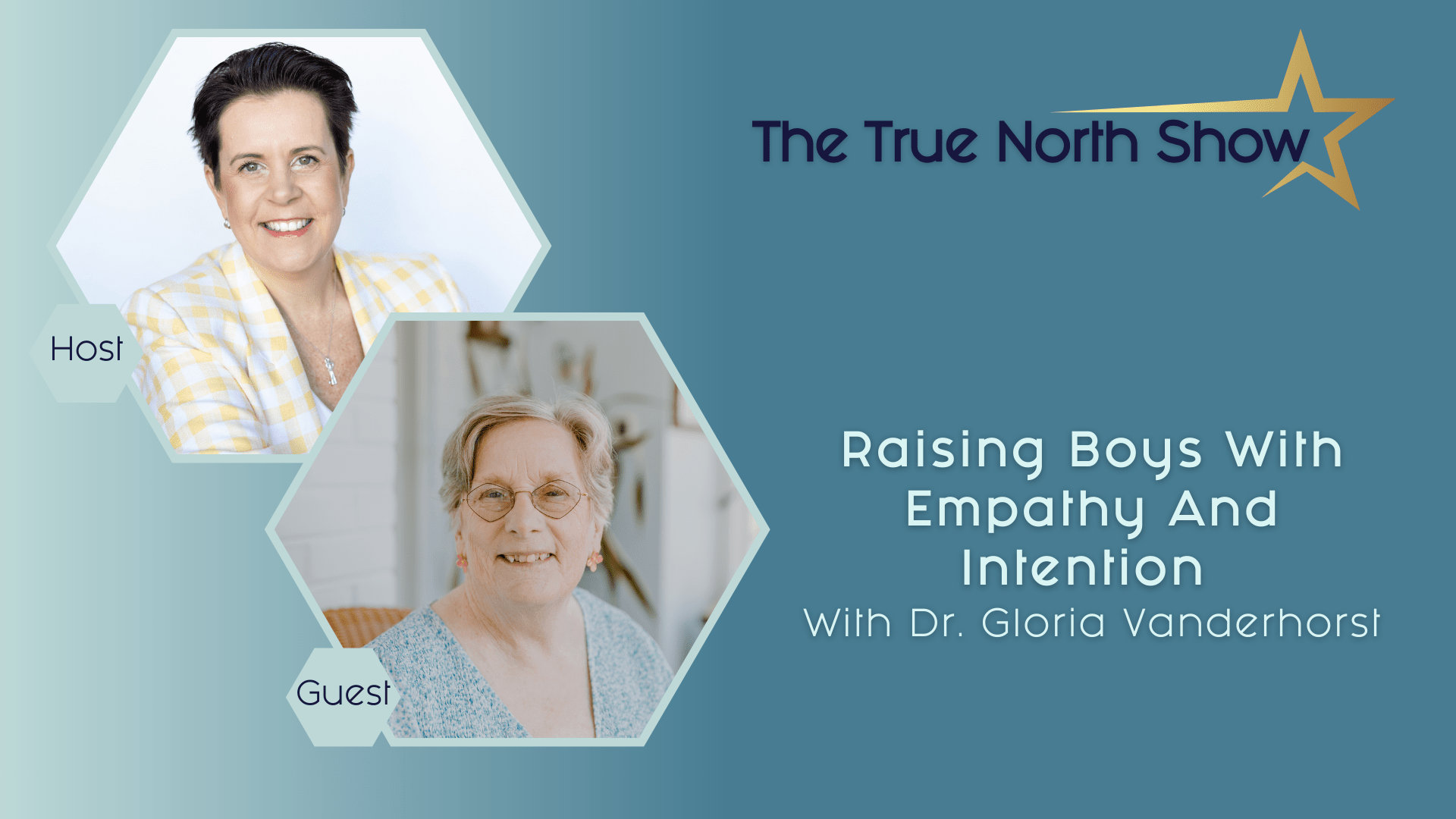
Raising Boys With Empathy And Intention with Dr Gloria Vanderhorst | Ep. 36
On this week’s episode of The True North Show I am joined by Dr Gloria Vanderhorst who shares with us in depth the work she is doing to help men and father’s raise their boys to be comfortable with showing emotion and to have empathy. This work is going to have a huge impact on the generations that follow and the research she has uncovered is incredible and gives insight into the fact that men and boys are taught to be tough and not to show emotion.
Bio:
Dr. Gloria Vanderhorst is a licensed psychologist in Maryland and Washington, DC, with over 50 years of experience helping individuals, couples, and families heal, grow, and thrive.
Her clinical work is rooted in neuroscience, attachment theory, and a deep respect for each person’s lived experience. Through secure online therapy, she provides evidence-based care for trauma, anxiety, life transitions, and relational challenges.
Dr. Vanderhorst began her career with children and adolescents, which sparked a lifelong interest in how early experiences shape emotional development and interpersonal patterns. She now works extensively with adults, couples, and families seeking meaningful change.
Her career includes influential roles such as Director of Child and Adolescent Services at the Chesapeake ADHD Center of Maryland and tenured Assistant Professor of Developmental Psychology at Towson University. She is also the founder of Vanderhorst & Associates.
Her best-selling book Read, Reflect, Respond: The 3 R’s of Growth and Change introduces readers to a practical framework for understanding and transforming personal narratives.
Her upcoming title, How Not to F$%! Up Being a Father, is a bold, insightful guide for raising emotionally intelligent boys with empathy and intention.
Dr. Vanderhorst brings specialized training in Internal Family Systems, Emotion Focused Therapy, neuro-cognitive therapy, ADHD and executive functioning support, and collaborative dispute resolution. Her dynamic expertise makes her a compelling voice for keynote engagements, expert panels, and educational workshops that bridge psychology, personal development, and emotional wellness.
Social Media:
- Website: www.drvanderhorst.com
- Instagram: https://www.instagram.com/gkvanderhorst/
Purchase Gloria’s book using this link: https://www.amazon.com.au/Read-Reflect-Respond-Growth-Change-ebook/dp/B0F1GCQGZB
Transcript:
Megan North (00:39)
Hello and welcome to The True North Show. I’m your host, Megan North, and I’d like to thank the sponsors of the show, Quantum Awakening, Beth Lewis, and C. Clarke, as well as our lovely guests who paid to be featured on this episode.Today, I am joined by an incredibly inspiring woman whose work will have an impact on many generations to come. Dr Gloria Vanderhorst is a licensed psychologist in Maryland and Washington, DC, with over 50 years of experience helping individuals, couples, and families heal, grow, and thrive.Her clinical work is rooted in neuroscience, attachment theory, and a deep respect for each person’s lived experience. Through secure online therapy, she provides evidence-based care for trauma, anxiety, life transitions, and relational challenges.Dr Vanderhorst began her career working with children and adolescents, which sparked a lifelong interest in how early experiences shape emotional development and interpersonal patterns. She now works extensively with adults, couples, and families seeking meaningful change.Her bestselling book, Read, Reflect, Respond: The Three R’s of Growth and Change, introduces readers to a practical framework for understanding and transforming personal narratives. Her upcoming title, How Not to F Up Being a Father, is a bold and insightful guide for raising emotionally intelligent boys with empathy and intention.Dr Vanderhorst’s dynamic expertise makes her a compelling voice for keynote engagements, expert panels, and educational workshops that bridge psychology, personal development, and emotional wellness.Welcome to the show, Gloria. I’m thrilled to be spending this time with you today.
Dr Gloria Vanderhorst (02:46)
Megan, I’m really looking forward to the conversation, and you did a lovely introduction. Thank you.
Megan North (02:53)
You’re very welcome. It was pretty easy to introduce you.We have so much to talk about today, but I’d love to start at the beginning of your career. What was the defining moment that led you to pursue your true passion and purpose?
Dr Gloria Vanderhorst (03:11)
There’s a very clear defining moment for me. Some people have defining moments that stand out, while others enter their professions through a gradual transition. Mine was a shock, and that shock was Calculus 2.
Megan North (03:31)
Calculus 2? Okay.
Dr Gloria Vanderhorst (03:34)
Right. I was a math major. I loved math as a child and as a high school student. I wanted to be a high school math teacher. My goal was to graduate from college in three years with straight A’s.About two and a half years into that process, I hit Calculus 2 and was completely lost. Everyone in the class was lost. We were trying to help each other because the professor faced the blackboard the entire time, wrote with her right hand, erased with her left, filled multiple boards, and spoke only to the blackboard.
I had to leave to go home for Christmas. I was on a bus about to leave campus when a friend ran across the parking lot shouting, “You got a D. You got a D.”I thought, “Yes. I don’t have to repeat Calculus 2.”I was thrilled. Over that break, I switched my major. My minor had been psychology. I had chosen it because it was a break from math and I found it interesting. What I didn’t realise at the time was that Calculus was a blessing. It put me exactly where I needed to be.I’ve never regretted it. I’ve never looked back. I’ve loved psychology ever since, and I still do.
Megan North (05:57)
Wow. I wonder if there was something unconscious there too, perhaps the experience of a teacher not even addressing the students. There must be some psychology in that.
Dr Gloria Vanderhorst (06:14)
There is. If you can’t engage the class, there’s something deeper going on.
Megan North (06:21)
That’s fascinating. I also love that you were excited about getting a D.
Dr Gloria Vanderhorst (06:32)
I really was. I was just happy I didn’t have to repeat the class.
Megan North (06:40)
I can relate. When I studied my business degree, one of the core subjects was statistics, and it was not my thing. I failed it the first time. The second time, I spent over a thousand dollars on tutoring and passed with the bare minimum. I was just relieved it was done.
Dr Gloria Vanderhorst (07:10)
Exactly. It’s done.
Megan North (07:13)
Those moments really redirect us.
Dr Gloria Vanderhorst (07:15)
They do. Some people experiment until they find what fits, like trying on clothes. I was lucky that my redirection was so clear. I’ve loved being a psychologist ever since.
Megan North (07:58)
Has your path evolved since then? What’s the work you’re stepping into now?
Dr Gloria Vanderhorst (08:17)
Right now, I’m doing a lot of writing. I publish a weekly blog and have done so for nearly three years. I’ve turned those into journal-style books designed to help people explore their inner world more deeply.The brain is an extraordinary storehouse. It keeps everything, including information from the last trimester in utero. We store memory through language, images, and bodily sensation. Language is the most practised, which makes it easiest to access, but visual and kinesthetic memory are just as important.
Megan North (12:35)
Is that why families remember the same event differently?
Dr Gloria Vanderhorst (13:03)
Yes. Memory is shaped by perspective. Two people can experience the same event and remember it differently depending on how they process information.
Megan North (14:29)
No wonder family conflict happens so easily.
Dr Gloria Vanderhorst (14:36)
Exactly. Most of the time, everyone is right.
Megan North (15:44)
Your books include practical exercises. Is that intentional?
Dr Gloria Vanderhorst (16:19)
Very much so. I want people to access memory beyond words. Blank pages allow for drawing, scribbling, movement, and expression, which opens parts of the brain language alone cannot reach.
Megan North (19:58)
Let’s take a short break, and when we return, I’d love to dive into your work around raising boys with empathy and intention.
Dr Gloria Vanderhorst (20:30)
Okay.
Megan North (22:11)
Welcome back. Gloria, your upcoming book How Not to F Up Being a Father focuses on raising emotionally intelligent boys. Why this work?
Dr Gloria Vanderhorst (22:37)
This work began decades ago when preschool boys were referred to my practice. Research shows boys are born with a broader emotional range than girls, but cultural conditioning quickly narrows what is considered acceptable for boys to express.
Megan North (33:11)
How do you maintain your own wellbeing while doing this work?
Dr Gloria Vanderhorst (33:55)
You need interests outside your profession. I play music, paint watercolours, and create with my hands. Therapy without outlets becomes stagnant. I also have a strong spiritual life that keeps me grounded.
Megan North (37:41)
What advice would you give someone entering this field?
Dr Gloria Vanderhorst (37:58)
This work must choose you. If you enter it to fix yourself, it will overwhelm you.
Megan North (42:34)
How do you hope this work impacts future generations?
Dr Gloria Vanderhorst (42:55)
I hope fathers become curious about raising boys differently, heal their own histories, and allow boys to retain emotional depth and genuine connection.
Megan North (51:44)
Before we close, what is one lesson you wish you had known earlier?
Dr Gloria Vanderhorst (51:47)
Your brain stored everything, and you can access it. If something shaped you harmfully, you can find it and change it.
Megan North (52:38)
That’s a beautiful way to end. Thank you so much, Gloria.
Dr Gloria Vanderhorst (53:07)
Thank you. I’ve really enjoyed this conversation.
Megan North (53:10)
Thank you to our audience and sponsors. I look forward to seeing you next week.