
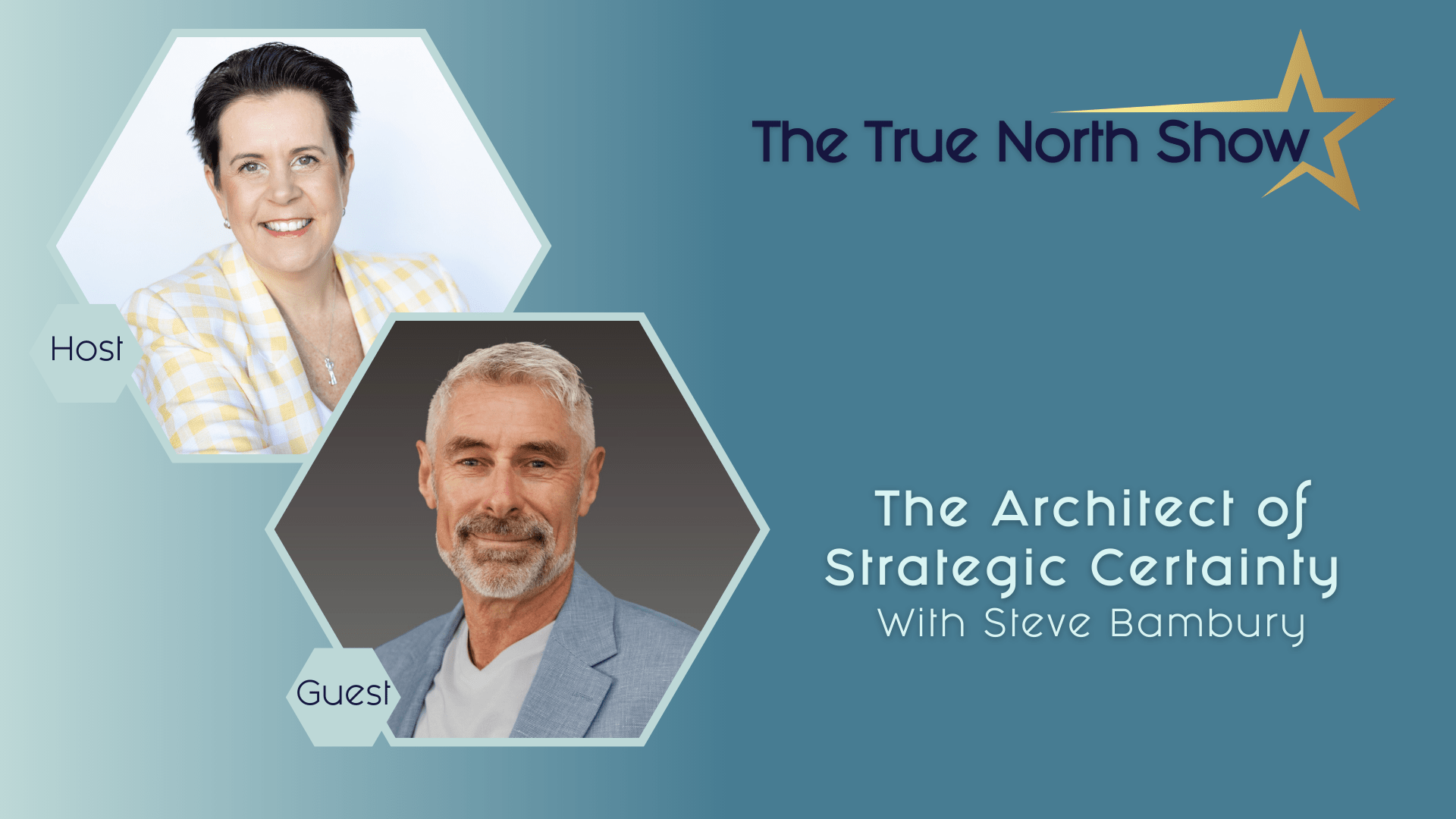
The Architect of Strategic Certainty with Steve Bambury | Ep. 36
On this week’s episode of The True North Show I am joined by Steve Bambury. We have an incredible conversation and explore Steve’s defining moment when he realised that happiness and purpose comes from within, not from external “things” or people and how that has stayed with him through his whole career and personal life. Steve shares with me an exciting and new adventure that he is stepping into and how this move re-iterates all the work he does with his clients, he truly is a leader who walks the talk.
Bio:
Steve Bambury is a Strategic Growth Catalyst and Associate Neuroplastician® who helps ambitious founders scale without chaos. With over 40 years building, growing, and leading companies, he brings hard-won experience as a veteran CEO, technology pioneer, and sales leader.
Steve specialises in helping founders who have “hit the ceiling” move from being essential operators to true board-level leaders, turning their companies into assets that can thrive without them.
His methodology blends commercial rigour, strategic governance, and disciplined execution to replace guesswork with predictable revenue, robust advisory boards, and accountable implementation.
Steve’s background in neuroplasticity gives him a deep understanding of human behaviour, shifting sales and leadership from hope and luck to clarity and results. Through structured frameworks, he enables businesses to professionalise operations, make better decisions, and build systems that consistently outperform their competitors. Ultimately, Steve’s work is about freedom: ensuring the business serves the life of the founder, not the other way around.
He is currently selecting a limited number of companies to work with for the upcoming 2026 year. If you are a business owner looking to scale without the chaos, now is a great time to connect.
Social Media:
- Website: https://touchstoneadvisory.com.au/
- LinkedIn: https://www.linkedin.com/in/steve-bambury/
Transcript:
Megan North (00:39)
Hello and welcome to the True North Show. I’m your host, Megan North, and I’d like to thank the sponsors of the show, Quantum Awakening, Beth Lewis, and C. Clarke, and our lovely guest who paid to be featured on this episode.
Today I am joined by a true leader, someone who you sit up and listen to whenever he speaks. Steve Bambury is a strategic growth catalyst and associate neuroplastician who helps ambitious founders scale without chaos.
With over 40 years of building, growing, and leading companies, he brings hard-won experience as a veteran CEO, technology pioneer, and sales leader. Steve specialises in helping founders who have hit the ceiling move from being essential operators to true board-level leaders, turning their companies into assets that can thrive without them.
His methodology blends commercial rigour, strategic governance, and disciplined execution to replace guesswork with predictable revenue, robust advisory boards, and accountable implementation.
Steve’s background in neuroplasticity gives him a deep understanding of human behaviour, shifting sales and leadership from hope and luck to clarity and results. Through structured frameworks, he enables businesses to professionalise operations, make better decisions, and build systems that consistently outperform their competitors.
Ultimately, Steve’s work is about freedom, ensuring the business serves the life of the founder, not the other way around. He is currently selecting a limited number of companies to work with for the upcoming 2026 year, so if you’re a business owner looking to scale without the chaos, now is a great time to connect.
Steve, thank you for joining me.
Steve Bambury (02:48)
Well, thanks, Megan. It’s lovely to be here. Privilege and a pleasure.
Megan North (02:52)
Thank you. So I’m going to go against my usual first question and I’m going to ask you about neuroplasticity. Can you explain what it is, and how you weave that into the work that you do with your clients?
Steve Bambury (03:08)
That’s a great question. Neuroplasticity is the practical application of neuroscience. Neuroscience is one of those new sciences that we’ve really started to understand, I guess, in the last 30 to 40 years, so much more about how the brain behaves and how it operates.
Understanding human behaviour is something I’ve been passionate about for a long time. A couple of years ago, I did a course in neuroplasticity and I was introduced to Professor Justin Kennedy, who is the founder and CEO of the International Organisation of Neuroscience.
We got on famously well. I became a certified neuroplastician and have been using what I’ve learned, not just in that course, but over the years, understanding human behaviour to be able to ethically influence consumer behaviour and help guide people in a direction that allows them to make better decisions.
Megan North (04:17)
Right. And I would imagine that would weave into helping the founder of a business, but also helping to attract clients and helping clients understand why they do the work that they do.
Steve Bambury (04:34)
Absolutely.
Megan North (04:37)
Okay, excellent. I practised the word a couple of times because I thought, “My gosh, I can’t stumble on that word.” It’s an incredible word as well. Thank you for that.
Now, I know there’s some change happening, and we’ll dive a little deeper into that later. But for the moment, what was the defining moment that led you to pursue your true passion and purpose?
Steve Bambury (05:17)
For a long time now, I’ve been aware that happiness doesn’t necessarily come from what we think society wants from us. We tend to place our happiness on how we think society will judge us: the car we drive, the clothes we wear, the house we live in.
The big moment for me was back in 1987. I was living in the UK at the time, and I joined a company. I was on a fast acceleration path and had been promoted a number of times. I was offered an international role down in the Channel Islands to set up a new operation. I was in my early 20s.
I had become very successful in my own sense of success. We were about to sell our home and buy a bigger home. I’d just purchased a new car. I was on that treadmill of what I thought success looked like. Then we had the crash of 1987, and I was made redundant. My whole world fell apart.
I used that as an opportunity to travel for a year. One place I wanted to go back to was Africa. We booked a trip to Kenya and Tanzania. We circumnavigated Lake Victoria, and there was a defining moment for me.
We were on a safari truck, getting up at five in the morning, driving for hours, then stopping to make a cup of tea. We were driving through the Serengeti and had not seen anyone for a couple of hours.
But within a short period of stopping, children appeared and surrounded the camp, watching what we were doing. These kids had absolutely nothing. They made little scooters out of food cans left over. Tanzania at the time was one of the poorest countries in the world.
I was travelling with another couple. Bryce and I had a frisbee, and we pulled it out. These kids had never seen a frisbee. We started throwing it around and they thought it was magical.
We showed them how to throw it between themselves. I remember the pure delight on their faces, the absolute joy they had from something so simple.
It made me realise happiness and joy isn’t determined by how much money we have in the bank. It’s determined by these little moments. You don’t have to have anything special to be happy.
Years later, I took my daughter back when she was 18 and we did a project with World Vision. Half my backpack was full of frisbees. We went to schools and had such a fun time with it.
Megan North (09:30)
I have a little tear running down my eye, because I really felt that moment with you. It’s a beautiful example of how happiness comes from within.
Steve Bambury (09:50)
Yeah.
Megan North (09:58)
Thank you. It’s really beautiful. When you came back after travelling, did you go back into the same work or did you shift gears?
Steve Bambury (10:33)
I came back to New Zealand and took a role as a sales engineer. I’m an engineer by trade. In the UK, I got involved in sales and I loved it. I loved helping people solve problems as opposed to selling them something.
It’s about understanding the problems your product or service solves and connecting the dots. If they don’t connect, don’t force an outcome.
Not long after, I set up my first business. That was a very different experience, but one I absolutely loved.
Megan North (11:22)
I imagine it would have been a beautiful process, going from working for someone to running your own race and being aligned with what you wanted to do. It’s the beauty of working for yourself, you get to pick and choose.
From a mental health and wellbeing point of view, do you think your wellbeing was different back then to what it is now?
Steve Bambury (11:54)
Very much so. It’s even different now compared to when I started my first business in my 20s. There was still that legacy of wanting to prove myself. But experiences like Africa reinforce the shift over time.
Megan North (12:44)
Has your work changed over the years? What’s different now?
Steve Bambury (13:01)
As we spend more time on the planet, we can become wiser if we stay curious. Curiosity is a word I absolutely love. I’m always trying to learn better ways, not being attached to one way or one point of view.
As I’ve got older, it’s about giving back. Sharing experiences, good and bad. Some of the greatest lessons are learning ways not to do things.
Megan North (13:55)
What do you do now to keep your mental state strong?
Steve Bambury (14:02)
I follow practices daily. I’m a big fan of Robin Sharma and the four interior empires: heartset, mindset, healthset, and soulset. I work on all of those.
At least 20 times a month, I start my day at five. I do gratitude journalling, breathwork, meditation, affirmations, and I’m selective about what I consume. I haven’t watched mainstream media for years.
I read sources like Fix the News. There’s always something good to find in the world.
Megan North (16:07)
You’ve got it all. I do two or three of those. And I love that your early mornings are mostly weekdays and you have flexibility on weekends. That balance matters.
Steve Bambury (16:26)
Yes. Fridays are for unwinding and celebrating the week. Sundays are for reflecting and gratitude. The more you look for things to be grateful for, the more they seem to come your way.
Megan North (17:25)
My husband and I do nightly gratitude. I can list endless things. People forget the small moments.
Steve Bambury (18:20)
It’s easy to take things for granted. A practice I love: when we cross at a pedestrian crossing and the cars stop, I teach my grandkids to make eye contact and wave thank you. Most people smile and wave back. It’s simple, but it gives you connection.
Megan North (19:45)
I love that. It’s a moment of acknowledging a complete stranger.
I think rituals should work for you, not what social media says. Finding rhythm matters.
Steve Bambury (21:00)
There was a time I’d beat myself up if I missed meditation or the gym. But every day is different. Always do your best, and your best changes day to day.
Megan North (21:56)
Does that come from neuroplasticity?
Steve Bambury (22:07)
Not specifically. It’s curiosity, mentors, sharing what we learn, taking what resonates and leaving the rest.
Megan North (23:11)
I do that with books too. I open them, read one page, get what I need, close them. No stress.
Let’s take a moment for sponsors, and when we’re back, I want to talk about something that has recently changed in your life.
Steve Bambury (23:45)
Yes, absolutely.
Megan North (25:52)
Welcome back. Steve, if you were speaking to someone just starting out, what advice would you give them?
Steve Bambury (26:10)
Follow your heart and passions. Be true to yourself, not what society expects. I love Steve Jobs’ Stanford speech: you can’t connect the dots looking forward, only looking back.
He talks about taking a calligraphy class that seemed pointless, but later influenced the Macintosh fonts. The message is: follow curiosity and intuition, even if it looks irrational to others.
Megan North (28:45)
I also tell people to keep their inner circle small. If you tell everyone, you get too many opinions.
Steve Bambury (29:31)
And you don’t have to do it on your own. Founders think they have to have all the answers. You don’t.
Megan North (30:12)
Admitting that builds trust. If you think you know everything, life gets boring.
Now, I’m going off script. You recently “fired yourself” from Growth Partners, a company you co-founded. What prompted that, and what’s next?
Steve Bambury (31:33)
It’s recent and tough. Growth Partners has achieved a lot. But I realised the biggest bottleneck for SMEs isn’t just marketing, it’s broader.
I have 33 years in my own business, and a wider experience I want to bring to business owners. I wanted Growth Partners in a place where I could hand it over to my business partner, who now leads the company.
I’m still involved as a non-executive director and shareholder, but I’m pursuing something I’m passionate about: helping SMEs set up advisory boards.
That means bringing experienced people around founders, helping them build governance, accountability, and systems so the business serves their life, not the other way around.
Megan North (34:23)
As a small business owner, you start doing everything yourself. That experience helps you outsource later with discernment.
Advisory boards allow owners to step back and see what to outsource next, and where to get the best advice.
Steve Bambury (35:49)
We don’t know what we don’t know. Business has many elements. Having people around you with experience fills gaps.
A mistake is hiring people just like you. We can’t see our own shadow. Advisory boards help reveal blind spots.
Dan Sullivan says “who, not how”. You don’t need to know how, just the right who.
Megan North (38:04)
Does this new direction feel like your true purpose?
Steve Bambury (38:22)
This morning I wrote in my journal that everything I’ve done has brought me to this moment. I feel born for this.
Megan North (39:09)
What will change personally for you?
Steve Bambury (39:31)
It will mean selecting companies that are the right fit. Not everyone will be. It’s about being courageously honest.
Selling is not pushing something. It’s understanding the person in front of you, whether you can help, and connecting them with someone else if you can’t.
I want to accelerate the impact of purpose-led organisations.
Megan North (41:13)
When you see people grow and achieve, how does that feel?
Steve Bambury (41:30)
Unbelievable. It’s like the joy of guiding grandkids. In business, helping leaders grow helps organisations grow.
Megan North (42:40)
Any one client that stands out?
Steve Bambury (43:30)
Hard to pick one. But helping people break through the ceiling they unknowingly place on themselves is always powerful.
Megan North (45:22)
Is that where neuroplasticity supports shifting belief ceilings?
Steve Bambury (45:44)
It adds a layer. The words we choose and how we frame things shapes outcomes.
Megan North (46:15)
Belief systems are fascinating. We carry them unconsciously.
In what ways do you hope your story impacts others?
Steve Bambury (46:52)
Recognising we don’t need all the answers. Not taking things personally. Not sacrificing family and relationships for work.
Success is not just the house or the car. It’s relationships, adventure, mentors, purpose, and values.
Megan North (49:01)
I love “what other people think of you is none of your business”.
We’ve only got a couple of minutes left. Steve, what is one truth you wish you had known earlier?
Steve Bambury (50:34)
Don’t get caught up in the opinions of others. Stop looking for external happiness. Be content with yourself.
Be willing to be vulnerable. That’s where real human connection is, especially in a world filled with AI and technology.
Megan North (52:20)
What a beautiful way to wrap up. Thank you for joining me today. I’m grateful for your time and your wisdom.
Steve Bambury (52:52)
Thanks for having me. Time has flown.
Megan North (52:57)
Thank you to our audience, sponsors, and supporters. Have a wonderful rest of the week, and I’ll see you next week. Thank you again, Steve.
Steve Bambury (53:18)
Thanks, Megan. It’s been a pleasure.
Megan North (53:20)
Thank you.

![True North Show [podcast] - Season 2, Ep 2 - Beth Lewis](https://megannorth.com/wp-content/uploads/2025/09/True-North-Show-podcast-Season-2-Ep-2-Beth-Lewis-768x432.png)