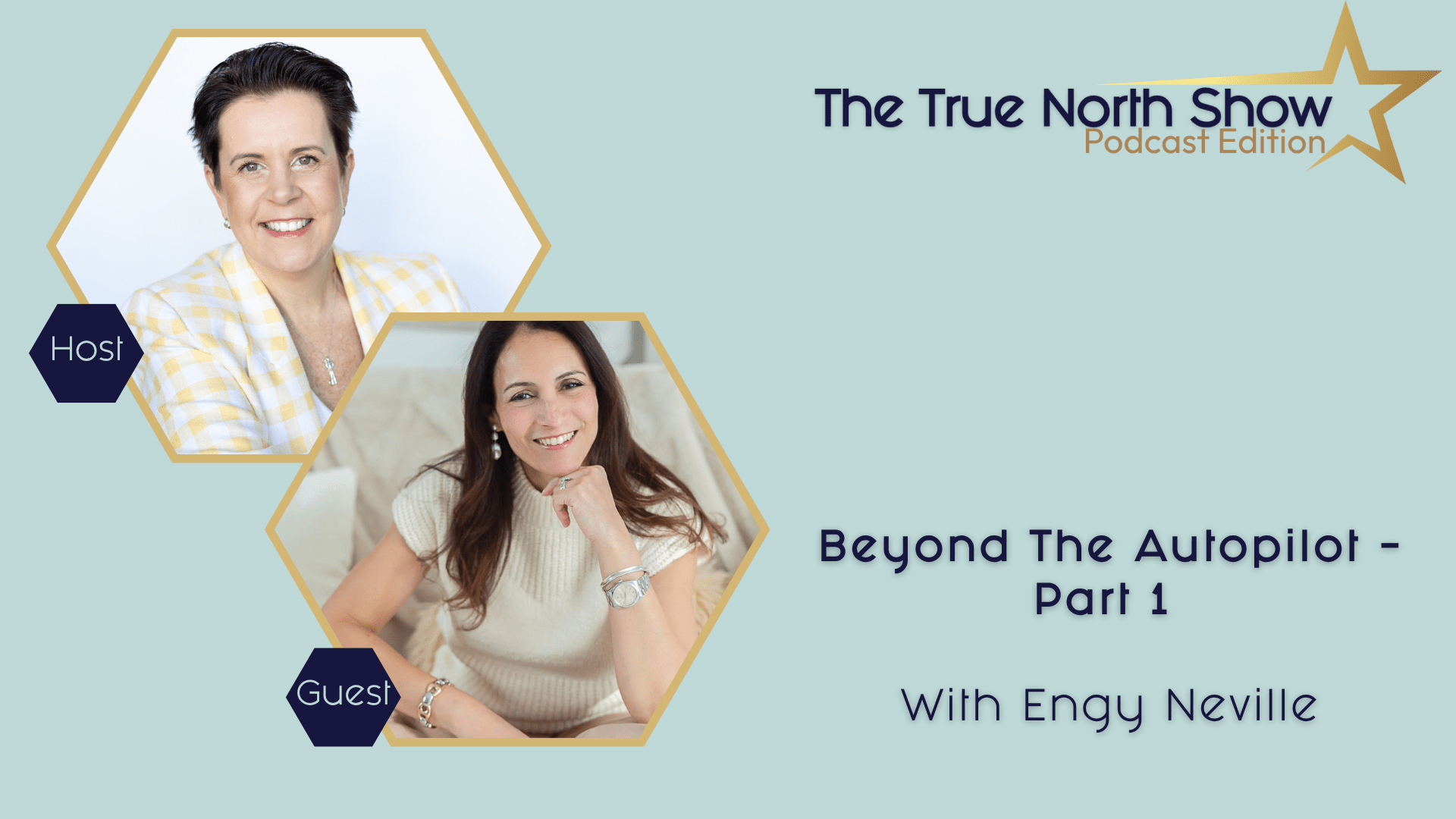
Beyond The Autopilot with Engy Neville | Ep. 61
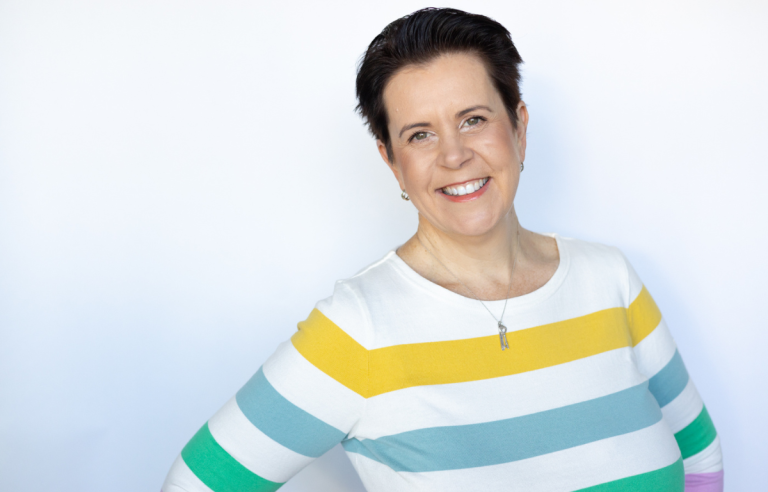
On this week’s episode of The True North Show I am joined by Engy Neville, and incredible woman who is so aligned to her centre, her inner compass and her true north that her clients have no choice but to shift, heal and uplevel. Engy shares with us the moment in her corporate career when she realised what her true north was and that it had been with her all along, she just didn’t know how to tune into it and feel it because she was on autopilot. Our conversation is grounded in deep gratitude for the work she does with her clients and the privilege she feels when someone asks her to walk beside them to do this work.
Bio:
Engy Neville is a Conscious Leadership Mentor, Emotional Intelligence Expert, and founder of Embracing Zen with Engy.
After 30 years in corporate marketing, brand strategy, and leadership, Engy now guides individuals who are ready to stop living on autopilot and reconnect with their inner wisdom, emotional clarity, and authentic sense of self.
This work bridges the practical with the intuitive, helping people understand their energetic blueprint, subconscious patterns, presence, and the unseen ways they communicate before they ever say a word.
Her work is especially resonant for high performers, entrepreneurs, and leaders who are moving beyond overperforming, burnout, and self-abandonment into greater clarity, confidence, and purpose-led success.
Engy is a certified Life & Career Coach, NLP Practitioner, ThetaHealing® Instructor, yoga teacher, meditation teacher, and quantum energy healing practitioner. She brings together lived experience in and out of high-performing environments with deep inner work to help others lead with more presence, make aligned decisions, and create lives that feel as successful on the inside as they look on the outside.
Social Media:
Website: www.embracingzenwithengy.com
Facebook: https://www.facebook.com/EngyNeville
Instagram: https://www.instagram.com/engy_neville
LinkedIn: https://www.linkedin.com/in/engy-neville
YouTube: https://www.youtube.com/@TheConsciousPauseWithEngy
Transcript:
[00:34] Megan North:
Hello and welcome to the True North Show. I’m your host Megan North, and I’d like to start by thanking the sponsors of the show: Quantum Awakening, Beth Lewis, and Anne C. Clarke, and my guests who paid to be featured today.
Today I am joined by Engy Neville, a conscious leadership mentor, emotional intelligence expert, and founder of Embracing Zen with Engy. After thirty years in corporate marketing, brand strategy, and leadership, Engy now guides individuals who are ready to stop living on autopilot and reconnect with their inner wisdom, emotional clarity, and authentic sense of self. This work bridges the practical with the intuitive, helping people understand their energetic blueprint, subconscious patterns, presence, and the unseen ways they communicate before they ever say a word.
Her work is especially resonant for high performers, entrepreneurs, and leaders who are moving beyond overperforming, burnout, and self-abandonment into greater clarity, confidence, and purpose-led success. Engy is a certified life and career coach, NLP practitioner, theta healing instructor, yoga teacher, meditation teacher, and quantum energy healing practitioner. Engy brings together lived experience in and out of high-performing environments with deep inner work to help others lead with more presence, make aligned decisions, and create lives that feel as successful on the inside as they look on the outside.
Welcome to the True North Show, Engy. I’m so excited that you’re here with me today.
[02:44] Engy Neville:
I am so excited to be here with you, Megan, and I’m very excited for our conversation today.
[02:50] Megan North:
Me too. And for anyone who wouldn’t know this, we did try this last week but I had been sick and it was a bit of a disaster. So we’ve rescheduled, and it’s actually really nice to be sitting and having this conversation with you without coughing and spluttering everywhere.
[03:07] Engy Neville:
Divine timing is everything.
[03:11] Megan North:
Exactly, exactly. After thirty years in the corporate world, Engy had built everything a successful career is supposed to look like. And then she walked away from it all to build something that felt true. So stay with us because when we come back, Engy is going to tell us exactly why, and what it truly means to lead from the inside out.
Welcome back to the True North Show. I’m here with conscious leadership mentor and emotional intelligence expert Engy Neville, and we’re about to explore what it truly means to lead from the inside out and what becomes possible when you stop living on autopilot and start reconnecting with who you really are.
So Engy, let’s start with your background and your thirty years in corporate. What was the moment that you realised that something had to change and that you needed to start following your true north?
[04:55] Engy Neville:
It’s a bit of a twofold for me. One is that I started to notice that we train leadership and we train team members as if they are all the same. When we have trainings for teams and trainings for leaders, we are training them on skills, we are training them on capabilities, we are training them how to negotiate and all of the skills that are required to succeed. But we’re not training them on understanding their patterns that ultimately inform how they lead, how they collaborate, how they negotiate, and how they work with other people.
[05:42] Megan North:
Yeah.
[05:43] Engy Neville:
So I started to notice this gap, and it’s a massive gap, and it’s a very missed gap. Not understanding the individual and not helping individuals understand themselves, in knowing what is the pattern that I am living, what is the thing that comes up for me when I am in an uncomfortable spot. Because you can have all the tools in the toolbox, but if you don’t understand your patterns and the beliefs and the habits and the identity you’re living, the tools become useless because you’re not able to utilise them in the moment it counts the most.
And for me personally, I started to feel this deep sense of gratification and fulfillment when I started to help team members recognise their gaps and then saw them begin to bring awareness into their work, bring real consciousness into decision making, into collaboration, into listening. And that really fuelled me. And that sort of nudged me in the direction of wanting to work with even more people, whether it be individuals, small business owners, or leaders, in truly succeeding from the inside out.
[07:12] Megan North:
I love that. And I think I would suspect that we probably have a similar view in the sense that not everyone in corporate wants to climb the ladder and be a senior leader. Not everyone wants to do that. But even if they don’t want to be a leader in the sense of leading a team or having a big team reporting to them, I think we can all still be a leader in our own way. And then it’s what is the essence of you and who you are that you can start to really connect in with to then help you be a leader in your own sense every day.
[08:01] Engy Neville:
A hundred percent. And you’ve nailed it on the head. That speaks to assuming that success looks the same for every single individual. Success for this individual, or somebody in mid-career, might look very different from success for somebody that’s been doing it for a long time. Two people on the same track might want and experience success in very different ways.
For some people, success feels like peace, inner peace. It’s knowing who they are. It’s coming home and having their own time. For others, success may feel like climbing the ladder because they have always aspired to lead a team or to lead a project. Success looks very different for every individual, which is why I believe that training the individual, and by leading I don’t mean leading people, it’s leading themselves, is really critical.
[09:11] Megan North:
Yeah, absolutely. I love that. What beautiful work you were doing with clients. I think there would be so many different things and examples you could share with us in relation to that. And I will get to that, but one of the things I’m curious about too is, for you, when you decided and made that final decision to step out of corporate, what was that? Were you really stepping into your divine feminine empowerment and leadership yourself to make the leap?
[09:47] Engy Neville:
Yes. It was definitely recognising my divine feminine, my sovereignty, and aligning to my soul purpose. And I get choked up talking about this.
Because I have spent most of my career trying to understand my purpose and trying to understand myself more deeply. Meanwhile, my purpose had been sitting there all along, had travelled with me in every chapter of my life. I just didn’t recognise it as my purpose until I started to do the self-work and I started to peel away the layers of expectations and what success needs to look like versus what it can actually be, the people pleasing, all of the things that shield us from understanding ourselves more deeply.
When I shed those things, and it was a shedding, my purpose became so clear. And then I thought: wow, how incredible is this universe, that it had my purpose with me through every chapter. I didn’t see it because I was blinded by all of these other patterns and habits and beliefs that I had carried that weren’t really mine to begin with.
[11:19] Megan North:
Yeah, yeah. I love that. But it’s also, and you and I do similar work in the sense of, it can also relate to divine timing as well. You know, it mightn’t have been right for you to know that exact purpose twenty years ago because you may not have been able to pursue it the way that you can pursue it now, with all the beautiful wisdom you have from experiencing things yourself.
[11:43] Engy Neville:
A hundred percent.
[11:45] Megan North:
A hundred percent. I love that. And I remember when I stepped out of corporate, it was over five years ago now. I just had this innate sense of: this is what I need to do, I know what I’m going to do, everything will be okay, everything will work out. I always have this innate trust. I just knew I was so aligned to who I was and what I needed to do.
But I remember a lot of people in the corporate space were saying: are you crazy? What are you doing? Aren’t you worried? Aren’t you scared? And I just kept saying no. Because when you get that pull, when you know that you’re one hundred percent aligned, you just know that you can conquer anything.
[12:33] Engy Neville:
That’s right. That’s right. And there is a peace that comes with that feeling. It’s this trust, this unwavering faith that by being true to my purpose, by being true to my authentic self, things will fall into place.
[12:57] Megan North:
Yes. Yes. I love that. It is peaceful because you just know. You just know.
[13:08] Engy Neville:
Yeah, the lack of peace comes from the internal friction, the internal battle of feeling that there is something else but not being willing to explore it more, being afraid to explore it more. All of the beliefs that you carry keep you from having the courage to explore it more. And so it creates friction. And with friction comes lack of peace. It’s that restlessness. And it creates anxiety.
You know, with some of my clients when I talk to them, because they don’t know themselves fully, they know themselves through the beliefs and the patterns and all of the things, and they believe for a long time this is who I am. When this isn’t who they are. The who they are, the authentic self that they are, is this beautiful, confident individual that knows exactly where they need to go. But all this other stuff brings about fear that makes you question what you know. And because the fear is so loud and intuition is often very quiet and calm, we override it.
[14:34] Megan North:
Yeah.
[14:35] Engy Neville:
Override it, because it’s not the loudest thing in the room.
[14:38] Megan North:
Exactly. And we often tend to look externally at what the external factor can be to help us, as opposed to going internal. It is definitely an inside job, not an external job.
[14:53] Engy Neville:
That’s right. That’s right.
[14:57] Megan North:
And so what about you, from when you were in corporate, from a mental health point of view? Mental health and wellbeing is, I’m going to say, a relatively new thing, because I worked in corporate for a long time and it wasn’t there until probably ten years ago that we started to really look at it. Was mental health a priority for you at the time, or is that something that has grown for you over time, particularly in the work you’re doing now to make sure that mentally and emotionally, for you and your clients and your family, your wellbeing is well looked after?
[15:38] Engy Neville:
It definitely didn’t start as something that I paid attention to. Because, to your point, it wasn’t something that was discussed. It wasn’t something that was prioritised. When I started in my career, I started in 1996. So I’m taking us all the way back. Back then there were very few mentors in the workforce, especially for women. The MeToo movement hadn’t happened. This is fairly new. Mental health was not discussed. It wasn’t even flagged as a thing to discuss. It wasn’t even on the agenda.
And so the world I grew up in, in corporate, was: you have to overperform to be recognised. You have to override what you need in order to succeed.
[16:40] Megan North:
Yeah.
[16:41] Engy Neville:
As a person who’s starting in their career, you don’t have a voice. You’re here to be quiet and learn, which I appreciate. There is a season of taking in information and there is a season of using that information to make decisions and get ahead.
But there was so much grinding without boundaries, so much expectation without balance, that mental health just didn’t exist. And so I was often very stressed. I often struggled sleeping at night. Because the thing is, I didn’t recognise those things as potential flags for being stressed or mentally exhausted or not being well.
I worked for leaders and I’ve had great leaders. I’ve also worked with terrible leaders, both men and women. When I worked for terrible leaders, it took such a toll on me physically, mentally, and emotionally that I often had a hard time sleeping at night in those early years of my career. I also didn’t pay attention to what I was consuming during the day. So I lived off Diet Coke. Because the hours were so long, I needed something to keep me up, to work longer, to be active, to be vibrant, to do all the things required. Because it is not normal to still be at that high energy at six, seven, eight, nine o’clock at night when your day starts at eight.
And so I wasn’t paying attention to any of that. I just knew that I was chronically tired, exhausted, stressed. And I was in my twenties at the time. And then in my thirties I started to pay more attention to those smaller things. I started to go to yoga more consistently. And I started to really pay attention to well, when I’m drinking this caffeine at such and such an hour, it’s causing X, Y, and Z in my body.
[19:19] Megan North:
Yeah.
[19:20] Engy Neville:
And that, along with a slew of things, inspired me to, and I will say divinely pushed me into, becoming a certified yoga teacher, even though I never taught yoga. I did here and there, but it wasn’t my job, it wasn’t my career. I took the certification because I wanted a deeper understanding of the philosophy of yoga. And that was the gateway to all the other things that came through afterwards, whether it’s self-development, NLP, quantum, so many different things.
By the time I reached my last chapter in corporate, mental health was a big discussion point and I didn’t struggle with it because I knew how to recognise the patterns within myself, recognise the things that were draining me versus fuelling me.
And I brought that knowledge to the team. And because I could, because I was in a leadership position, I started to create balance for the team. I started to pay attention to how many meetings could just be an email.
[20:33] Megan North:
Yeah.
[20:33] Engy Neville:
You know, sometimes it’s simple fixes that made such a big impact. And so in that last chapter I would say I was thriving in spite of the pressure at work. And in my early career I was suffering in spite of being a newbie in the corporate environment.
[20:55] Megan North:
Yeah. Wow. Thank you. I love that there are just so many components to how one thing, from you enjoying yoga to then doing your yoga teacher certification, really started you on that journey of deep inner work and recognising within the body. And from a mental health and wellbeing point of view, I don’t think it matters. I always say to people: it doesn’t matter what you do, do what works for you. What brings you back to that internal place? What brings you back to a space where you can actually feel, am I in alignment, am I out of alignment, does something feel wrong?
You and I were talking before and I said, and I’ve said this lots of times on the show, I love to really relax and have a cup of tea and watch the Bake Off or something. For me, that’s when I really get quiet. That’s when my body stops and tells me: hmm, okay, actually we need a little bit more of this, or I actually might need to move my body a bit more, or actually no, stop. And so it’s that, it’s taking those moments of what works for you. And I think that’s why I love that you’ve talked about that, because I think from a social media point of view, people feel very stressed and triggered from being told that they’ve got to meditate for an hour and do ice baths. And if you’re not doing all of those things, you’re not looking after yourself. And I think: my gosh, that’s what works for you, not for me.
[22:40] Engy Neville:
Right. And it’s exhausting just thinking about the expectation of what rest is supposed to look like.
[22:47] Megan North:
Yes, exactly. Is there anything quirky that you do from a mental health and wellbeing point of view that you’d like to share? Anything that’s a little bit different that people would be surprised to hear?
[23:03] Engy Neville:
I love starting my morning with a cup of tea in silence. I don’t check email, I don’t check my work calendar, I don’t do any of that. I sit on the sofa on the landing in our house where the sun just pours in, and I sit directly where the sun can hit my face and I can feel it warming me from the inside out. I love that. And when I miss those days, I miss it. I feel like I didn’t get the right start to my day.
That’s my quirky thing. Some people like to have a very dedicated routine. That’s my morning routine. I sit and I have my cup of tea in silence. I will confess I do love to listen to, not classical music, but different beats that are meant to be healing music.
[24:08] Megan North:
Yeah.
[24:09] Engy Neville:
I love listening to that. Sometimes it’s wind chimes, sometimes it’s singing bowls, sometimes it’s listening to rain in a rainforest. Something about that immediately sets my body into connectivity and I get such clear visions during that time. Sometimes it’s things I’ve been mulling over, sometimes it’s a clarification I need, and I find that it drops in much quicker during that time.
[24:45] Megan North:
Yeah.
[24:47] Engy Neville:
And then after that I meditate. So that’s my quirky thing. I get to have my warm cup of tea in the morning directly in the sun, and then I go into a deep meditation. And sometimes in that meditation it’s a deeper dive into something that dropped in while I was having my cup of tea. I just cherish that time. I really, truly do. I get up an hour earlier than everybody else to get it, and I’m happily doing it.
[25:17] Megan North:
Yeah, yeah. And it’s really interesting that you mentioned the music or the sounds, because I think some people do struggle when they think: okay, I’ve just got to sit and not think, which is really difficult to do. That’s why breathwork works, because when you’re consciously breathing in and counting and breathing out, you physically can’t think of something else. So even just a conscious breath helps you because your brain stops.
But I love that you talk about that too, because it almost gives your brain time to go: okay, I’m only going to be thinking about what I’m listening to right now. So then you’re naturally shutting out all the other noise, which then helps you to tune into what you need to hear. That might really resonate with some people who struggle to just sit in silence. I’m hopeless at meditating in silence. It just doesn’t work for me.
[26:18] Engy Neville:
Yeah. You know, there is so much expectation put on what meditation is supposed to look like. And just this week, or last week, I started to see people posting these interesting reels of: if your meditation looks like this. And the reel that’s playing is these flashing lights and silhouettes of what we perceive to be the higher self and what that looks like. And I thought to myself: what if it doesn’t look like that?
[26:57] Megan North:
Yeah.
[26:58] Engy Neville:
That doesn’t mean you didn’t meditate. It doesn’t mean that you’re not in a deep state of theta. Everyone’s meditation will look different. And I’ve been seeing quite a bit of those videos, and it really irks me.
[27:11] Megan North:
Yes.
[27:12] Engy Neville:
Because I feel it’s a disservice to what meditation is truly supposed to be. And it’s a very individual practice.
[27:20] Megan North:
Yes, absolutely. And I love that you’ve shared that because I’m the same. It’s what works for you. If it’s just sitting for five minutes and listening to some music, or just sitting quietly for five minutes, if that works for you then fantastic. It’s what works for you. I don’t meditate in a traditional sense. I pray. When I pray, that’s my way of meditating. I connect to creator of all that is. Both my parents have passed away. I hear my mum all the time. So I chat to my mum and I have conversations with her. But that’s my meditation because that’s what works for me. It might be five minutes in the evening, it could be in the morning, whenever the time feels right. But definitely I love that you’ve talked about that because there is no should. Whatever works for you, do what works for you.
[28:22] Engy Neville:
That’s right. And I love that you said sometimes it’s five minutes because sometimes it is five minutes.
[28:28] Megan North:
Yeah. Right. It doesn’t
[28:30] Engy Neville:
make it any less valuable as five minutes.
[28:33] Megan North:
No, exactly. Yeah. And so from a, because you do a lot of healing work and a lot of energetic work with your clients, what do you do to ground yourself? What sorts of things really help you to bring yourself back into the present and back into our three-dimensional world, as we call it?
[28:53] Engy Neville:
Do you mean before or after the session with clients?
[28:57] Megan North:
Any time, I suppose.
[29:00] Engy Neville:
Yeah. So I’ve gotten into the practice of doing, I wouldn’t call it a full meditation, but it’s connecting to the energy of creation before sessions. And that helps me ground and it helps me shelve whatever chaos, stress, and things I need to do for myself or for the kids on the side. Because what I honour is this highest form of energy coming into the space with clients. And I really take that very seriously in bringing the highest energy into that virtual space or the in-person space. Because somebody is trusting you with their energy. Somebody is trusting you to help them gain clarity. And so I take that to heart in ensuring that I am only bringing in the highest form of energy into the space, to allow us to have the conversations that are needed and the clarity that we’re looking to have.
After a client session, I do the same thing to clear the energy from what I have just taken in. Even with work that is less energetic in nature, such as guiding a leader into something they’re dealing with at work, after the session I clear myself of all that has transpired in the virtual or in-person space.
[30:52] Megan North:
Okay. Wow. I love that. And I think grounding ourselves can also be really easy and not as complicated either. It doesn’t need to be another ten, fifteen, or thirty minutes. It can also just be saying: I am now grounded, and believing that you are. It can be as simple as that. Yes. I love that.
[31:15] Engy Neville:
Seconds. Yeah. For me it’s seconds before and it’s seconds after. Creator knows what to do. We don’t need a manual to tell creator how to connect us and how to clear us.
[31:29] Megan North:
Exactly, exactly. And so you often talk about growth as something we have to be supported through, not something we simply think our way into. I love this. So what kind of support helped you to evolve while you were still in corporate? And how has that shaped the work you do and the work you offer with your clients now?
[31:54] Engy Neville:
Yeah. So for me, I consider myself a student of life. You will find me on a semi-regular basis in a mastermind, in a coaching engagement, reading a book, being part of a book club, going to a session or a class. And it’s something I’ve learned to really cherish and appreciate because in the first part of my own growth and awakening, I didn’t have any of that. And so it was learning by error, and it was difficult. It was quite difficult. And it started to get easier when I had somebody to say: here’s another perspective, how about we look at it this way, try this approach. And that was incredibly helpful for me to know that someone besides me was feeling these things, had been through something similar, and was able to guide me from experience, to guide me from wisdom that they had gleaned throughout their own experience. And it awakened my own wisdom faster.
They say, when the student is ready, the teacher appears.
[33:26] Megan North:
Yeah.
[33:28] Engy Neville:
Isn’t that such a beautiful saying? And when the student is really ready, the teacher disappears. And that’s when the inner master is awakened. And for me, I’ve been blessed to have many teachers that have guided my growth, guided my spiritual awakening, and reminded me of who I am.
And so now that I am on the other side of this and have become the teacher for my own self, I feel it is a privilege to be that teacher for others who are either just starting to awaken, just starting to be curious, or well on their journey. And I support that sharing of knowledge through very different ways because everyone’s learning looks very different.
Some of it is through coursework that I developed that meets individuals where they’re at. It’s working with them one on one. It is having sessions where they are able to collaborate and discuss with others who might be in the same exact space as they are. And so I allow for the learning to happen very naturally at different touchpoints because for me it happened that way as well. Some things I enjoyed more in a classroom type seminar or mastermind. Some things I needed a one-on-one coach to guide me. And some things it was self-paced guided learning. And I thrived in all of those depending on the chapter I was in of my own life.
[35:19] Megan North:
Yeah, yeah. I love that. And I love that you have the ability to mould yourself into what the client needs as well, because I think that’s really important. I’ve often been asked if I’m ever going to do group coaching. But for me, because my coaching is so bespoke and every session is different with an individual, they might need a reading or they might need a healing or they might need very strategic coaching, I just feel like the group format would be too diluted. And so sometimes we do have to mould into what the client needs at that time. What would work? What’s the best thing for them? So I love that you’re constantly reaching into your toolkit and asking: what do they need, what wisdom can I draw on to help them? So yeah, really beautiful. And I also loved that you said it’s the privilege of working with clients. I feel the same. When someone engages us to work with them and be beside them, it feels very privileged.
[36:35] Engy Neville:
It is. It is. When I was a leader in corporate, I felt it was a privilege to lead a team. I felt it was a privilege to stand in for somebody, to support them, and to be the person in their corner. And so it’s never been lost on me that the thing I yearned for most in the early years of my career were the things I was able to deliver for other people in later chapters of my career in corporate. And now I get to do that again and again, with my own business to support that. Now I’m not held back by other demands that were within the role I had. I get to do this full time. And it is a privilege to be in a position where your own awakening can be a light for somebody else.
[37:43] Megan North:
Yes. Yes, absolutely. Yeah, I love that. And so are there any common themes you see with your clients and the work you do with them?
[37:54] Engy Neville:
There are a few common themes I see. And a lot of it starts with being reactive. Many people don’t have the self-awareness to recognise what is driving their behaviour, what is driving that reaction. And it’s because they are automatically, on autopilot, responding to something versus being conscious and present and aware of what is actually happening in real time.
[38:28] Megan North:
Yeah.
[38:28] Engy Neville:
And so a common theme with them is exactly that. Being reactive, being unconsciously in the spaces that they’re in. And I call it autopilot. Because if you are responding before you think, if you are reacting to something and later you’re like: that was disproportionate with what actually happened, that’s all subconscious behaviour. That’s autopilot behaviour. You’ve not really thought through what is happening in real time.
So the first thing I teach all of my clients and students that come into my courses is the conscious pause. Pause. Pause before you respond. Pause before you react. Pausing allows you to develop the awareness to recognise what is actually happening right now, what is being asked of me right now, and whether the reaction I was going to have is really the reaction warranted for this moment in time, or whether it’s a reaction to an old wound I haven’t addressed yet. And most of the time that’s where people are at. And that’s why we see so many conflicts and so many people feeling defeated. The list goes on and on.
But a lot of that can be course-corrected if you just pause. Pause with intention, pause consciously, for the purpose of raising awareness within yourself around what is happening and what your natural reaction is going to be and what the reaction you actually want to have is. And then do that. Don’t just do the thing you were going to do. React from the space of understanding, from wanting this to work.
[40:21] Megan North:
Yeah.
[40:21] Engy Neville:
Wanting a common understanding to be reached between the two people or the group of people that you’re with. It changes the game. Choice as a result of awareness changes everything.
[40:38] Megan North:
What was that? Choice as a result of awareness…
[40:41] Engy Neville:
Changes everything.
[40:43] Megan North:
Changes everything. Wow. That is really profound. That is very, very profound. Yeah. And that moment of the pause can really change everything.
[41:00] Engy Neville:
Yeah, it really can. When we think of the beautiful subconscious brain that we all have and how it actually operates ninety-five percent of our behaviour, and that ninety-five percent of behaviour is informed by beliefs and by patterns, we’re hardly ever operating from a conscious state. So it’s a training, a diligent conscious training of the brain, to take a back seat for the subconscious brain and invite the conscious brain to step forward and actually be the one that is leading, deciding, negotiating. And it’s going to be really uncomfortable in the beginning. It’s going to feel completely unsafe. But that is actually the way we need to be operating.
[41:54] Megan North:
Yeah, I love that. And so when we first met, we realised how many things we had in common in relation to the modalities that we work in. So NLP, which is neurolinguistic programming, and also theta healing. For anyone that’s listening, can you share with the audience what the difference is? What is NLP and what is theta healing? And then how do you use those in the work you do with your clients?
[42:26] Engy Neville:
Yeah. I like to think of modalities as, while some of them are very different, they are different ways in to the subconscious mind. They are different ways in to highlight and show what is the pattern beneath the behaviour.
So with NLP, it is understanding communication. And when we think of communication, we tend to think of verbal communication. It is that, plus much more. Most people don’t associate nonverbal communication as communication, and yet it is. And so NLP teaches us to understand written communication, spoken communication, and all the lines in between that are not spoken. It is understanding the energy in which somebody works without saying a word, whether it’s body language or a reaction that is nonverbal. It is reading the room.
NLP is a beautiful modality that teaches awareness, that heightens emotional intelligence, that allows people to see how their own map, their own way of thinking about their current situation or their future situation, is really always a shifting map. It is not a forever map. What is happening today is not the blueprint for what’s to happen a year from today.
[44:18] Megan North:
Okay.
[44:19] Engy Neville:
And I love NLP for that reason. I love that it teaches how to read an individual completely. What is the best way to communicate with an introvert versus an extrovert? Somebody that responds better to visuals versus somebody that needs to really feel what the right direction is. We all work and think and make decisions in such different ways. Understanding each other and what is best for us to work together is a strength that I think everybody could benefit from improving in order to have more successful engagements.
[45:05] Megan North:
Yeah.
[45:06] Engy Neville:
Theta healing is the study of so much. I love theta healing because it allowed me to truly understand the connectivity between the individual and their entire timeline from birth and even before, and understanding the synergies that inform the individual’s belief systems, habits, and patterns. Theta healing is truly about understanding those beliefs and digging all the way, with courage and with self-love, into understanding where they actually come from.
[45:51] Megan North:
Yeah.
[45:52] Engy Neville:
What experience created that belief? And where did that belief actually
[46:01] Megan North:
Yeah.
[46:02] Engy Neville:
really come from. And for those curious and inquisitive about belief systems and how they formed, it’s a beautiful way to investigate. I like to think of it as being a curious investigator in your own life. What did your grandmother pass down, and why did she pass it down? We don’t get to think of it in those terms sometimes. But sometimes it’s just knowing that this thing isn’t yours, and you got it from someone in your bloodline, and the reason you got it was because of XYZ. And I think that’s a beautiful way of quickly summarising theta healing. It’s understanding the whole world that is linked to you and what it means for you.
[46:56] Megan North:
Yeah. And also, I think one of the biggest things for me when I was learning it was discovering how many unconscious belief systems we have that can really shape and map our lives, that actually aren’t even our own belief systems. So sometimes when those things come up and you think: actually, because we test it, is this my belief or is it someone else’s belief? If it’s not your belief, it’s actually even quicker to release and heal, if it’s not working for you. Because it then helps you get out of your head in the sense of: why is this pattern always showing up? Why do I always react this way? Or why does this always happen to me? And sometimes we can uncover that you’ve taken on an ancestor’s belief system that doesn’t really resonate with you in 2026, whereas in the 1800s that was a belief system they had. And when you understand that, it just completely changes so many things in your life.
[48:02] Engy Neville:
Yeah, it’s very empowering. It’s very empowering to recognise that just because it’s a belief you have doesn’t mean you have to keep it. And just because it’s a belief that carries wisdom, and it carries the wisdom from somebody you have cared about, it still doesn’t mean it’s yours to carry onward.
And something I really say to my clients is: wisdom and carrying all this stuff forward from the past are very different things. You can carry the wisdom and leave behind everything else. You don’t need everything else. You just need the wisdom.
[48:53] Megan North:
Yes.
[48:53] Engy Neville:
Once you crack the code on the wisdom, that’s it. Now
[48:58] Megan North:
Yeah.
[48:59] Engy Neville:
you just have to live in it and embody it.
[49:01] Megan North:
Yeah. Yes. Beautiful, beautiful way to look at it as well. I think that it is that wisdom. And some of the things I also work with my clients on is having forgiveness for the person whose belief system you’ve taken on. You know, there are some things I grew up with in a Catholic household where my parents had some very interesting beliefs around money and those sorts of things. It’s work and belief systems I’ve worked on myself. But I’ve done it with a lot of forgiveness and love for my parents, because they were just raising me the way they thought I was to be raised, because that was how they were raised. And so I find that when I work with clients as well, it’s: don’t have resentment about the wisdom you’ve been imparted with. Take that as a gift, and then you can release everything else that’s connected with that.
[50:01] Engy Neville:
That’s right. That’s right.
[50:03] Megan North:
Yeah. Yeah. Yeah.
[50:05] Engy Neville:
That’s good.
[50:06] Megan North:
So we’re coming to the end of our conversation, but I just want to get one quick question in before we start to wrap up. It’s about the energetic blueprint that you work with with your clients. Can you share a little bit about that, maybe in a minute or so? I know we’re running out of time, but what is the energetic blueprint?
[50:30] Engy Neville:
So when I think of the energetic blueprint, it is all of the codes that are your beliefs, your patterns, your purpose, your destiny, all of the things that are within you that we work together, clients and I, in understanding. It’s a different way of saying: we’re going to understand the patterns that are yours.
And why they exist. What is the purpose of their existence in your life? What are the things that have stayed with you that have actually served you and are now ready to be released? And all of that is encoded. We all have a blueprint, we all have an energetic coding that is in our auric field that includes everything that is about us. And by everything I mean the beliefs, the patterns from our lifetime and all the lifetimes we’ve had before, and all of the things we’ve got genetically and all the things our ancestors passed down. They all serve a purpose, but they are not all required to take you to the next version, chapter, or timeline that you want to be on.
But it starts with understanding what they are in the first place, why they exist, before deciding what stays and what can be released with
[52:02] Megan North:
Yeah.
[52:02] Engy Neville:
love and with kindness and with deep gratitude for the role that it has served.
[52:08] Megan North:
Yeah. Okay. Wow. And that feels like the first step into that real inner work, really going internally to have an understanding of why I operate the way that I do.
[52:23] Engy Neville:
Right. And it starts with the conscious pause. It starts with the conscious pause of understanding how you react, why you react that way, why do you believe the things that you believe? If we’re not pausing to assess what is actually happening in our body, what we’re actually saying and doing, then we’re going to have a really hard time knowing what is serving us, what has served us and can be completed, and what can be carried forward into this next chapter, the next timeline, or the next venture that individual is looking to do.
[53:05] Megan North:
Yeah.
[53:05] Engy Neville:
It starts with pausing first. Conscious pause, awareness, choice. In order for us to know what the choice is for our highest good, we have to know what is there in the first place.
[53:21] Megan North:
Yeah.
[53:22] Engy Neville:
So that we’re not on autopilot making a choice that we’ve made before, that is keeping us in a loop, that is keeping us limited, that is keeping us from actually expanding into the world and into the version of ourselves that we are wanting to be.
[53:39] Megan North:
Wow, beautiful. Beautiful way to wrap up our conversation. And this is the normal last question. We literally only have a couple of minutes left. So Engy, what is one lesson or truth that you’ve learned on your journey that you wish you had known earlier?
[54:12] Engy Neville:
That is a great question. I would say that my beliefs are not who I am. When I fully understood that, I felt this awakening in a different way than we typically describe awakening spiritually. It was an aha moment of: wow, all these years of believing this is who I am, it was actually a belief that wasn’t even mine, that I took on from my parents or from whoever. But it’s not actually who I am.
So that was incredibly empowering and freeing. And once that happened, I started to be able to listen to my intuition a lot more clearly and my discernment went up. It’s incredible. I feel like understanding ourselves is like building blocks. Because when one thing clicks into place, other things start to click into place. And for me, recognising that the beliefs I have were not who I am, and they certainly were not an indication of what I am meant to do next, was phenomenal for me. And I was gifted with channelling a course that I created after that recognition came in.
And so I feel like truly, when we recognise that beliefs are not who we are, and I’m not unique in this, it is the same for all of us. It is a light bulb moment that is worth celebrating.
[56:01] Megan North:
Yeah.
[56:03] Engy Neville:
However important it is in that person’s journey.
[56:06] Megan North:
Wow. That’s really beautiful. What a beautiful way to wrap up our conversation. Thank you so much for your time today. I have really enjoyed spending this time with you. And I’m really grateful that we’ve been able to meet and truly discuss all of the amazing work that you do. So thank you so much.
[56:27] Engy Neville:
Thank you so much, Megan. It was an absolute pleasure to be here.
[56:31] Megan North:
And I’d like to thank all of my amazing and dedicated audience, all of my sponsors, and again everyone who comes and watches this episode each week. I’m very grateful for you. So I hope that you all have an amazing rest of the week. I look forward to seeing you all again next week. And again, thank you so much, Engy.
[56:49] Engy Neville:
Thank you so much, Megan.