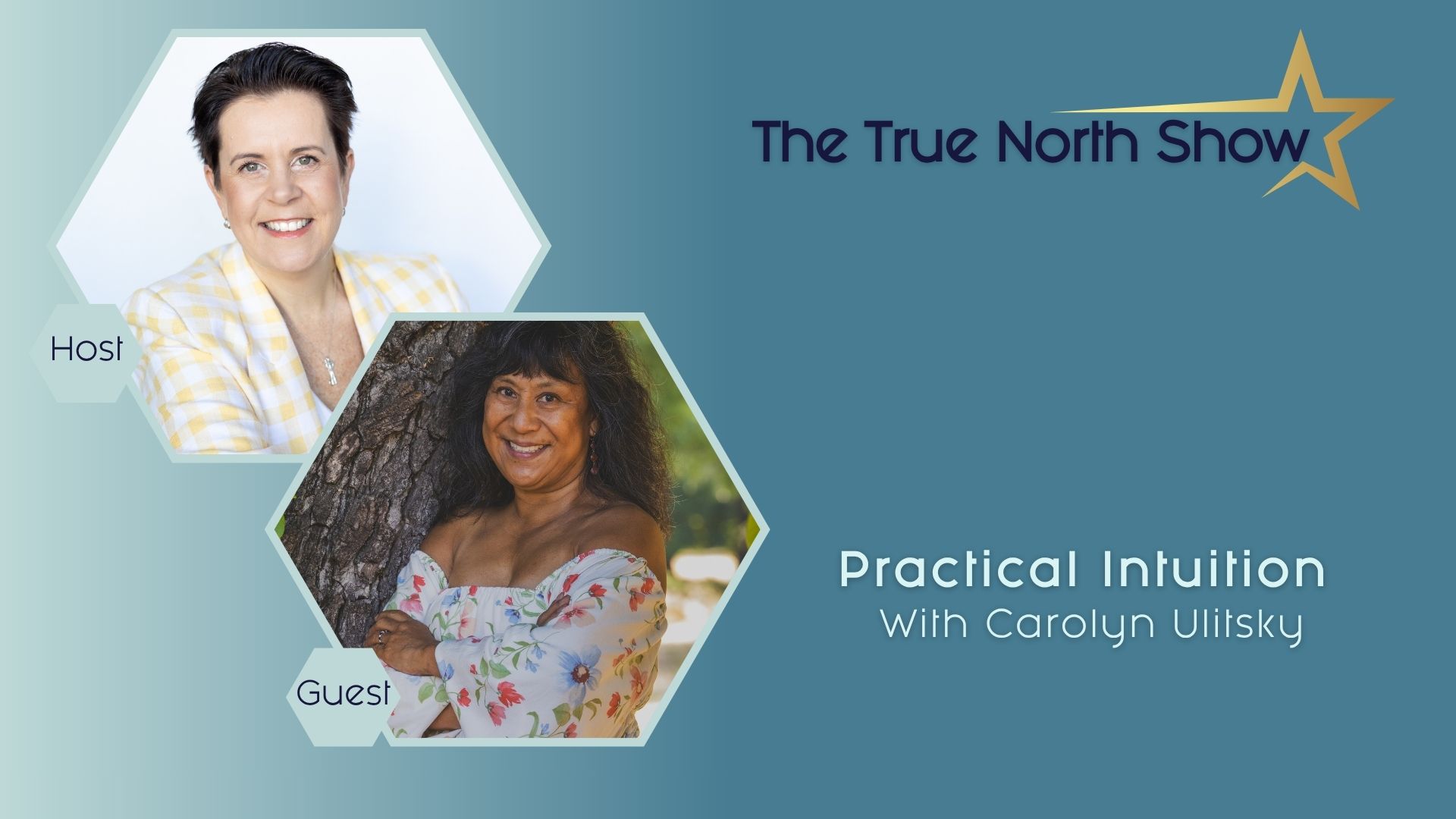
Practical Intuition with Carolyn Ulitsky | Ep. 63
On this week’s episode of The True North Show I am joined by Carolyn Ulitsky, an incredibly woman who has introduced me to the concept of practical intuition. Carolyn works with clients to identify the physical pain in their bodies and then tune in to what the body is actually trying to say. Her work is grounded in personal experiences and events that has seen her work evolve with her over the last three decades. There is so much that we cover in this conversation, be sure to grab something that you can take notes on, you are definitely going to need it!
Bio:
Carolyn Ulitsky, founder of SomaWise Muscle Therapy, BodyMind practitioner, Certified Master BodyMind Coach, and author whose work explores one of the most fascinating and profound relationships any of us will ever encounter, the one between our body and our lived experience.
For more than three decades, Carolyn has worked with the body through hands on muscle therapy, movement, somatic awareness, conversation, and what she beautifully describes as practical intuition. Her work began with the physical helping people experiencing pain, tension, and muscular dysfunction. But over time, she began noticing something far deeper.
The body, as Carolyn discovered, was communicating well beyond where it hurt. A tight jaw, guarded shoulders, a breath that could never quite fully release. These were not just physical symptoms, they were the body’s way of telling a story.
That curiosity shaped everything and today, at the heart of Carolyn’s philosophy sits a simple but powerful idea – the body is not the problem. The body is part of the conversation.
Through SomaWise, Carolyn works with people both in person and virtually guiding them through physical discomfort, life transitions, identity shifts, grief, and that deeply uncomfortable space between who they have been and who they are becoming. Her MIAA framework (Mindful, Intuitive, Aligned, Action) invites people to slow down, listen inward and allow their next step to come from a place of genuine alignment rather than force.
Carolyn’s work has also evolved beautifully beyond the treatment room into writing, speaking, retreats and immersive experiences including BodyMind Italy bringing together place, embodiment, reflection and community in the most extraordinary way.
Underlying it all is the belief that we don’t have to abandon ourselves in order to change our lives. Sometimes the next chapter isn’t about becoming someone entirely new, sometimes it’s about creating enough space to receive ourselves, trust what we already know, and come home forward.
Social Media:
Website: https://somawisemt.co/
Facebook: https://www.facebook.com/SomaWiseMuscleTherapy
Instagram: https://www.instagram.com/somawisemt
LinkedIn: https://www.linkedin.com/in/carolynulitsky
YouTube: https://www.youtube.com/@somawisemuscletherapybodym271
Transcript:
[00:00] Megan North:
Hello and welcome to the True North Show. I’m your host Megan North, and I’d like to start by thanking the sponsors of the show: Quantum Awakening, Beth Lewis, Anne C. Clarke, and my guests who paid to be featured.
Today I am thrilled to welcome to the show Carolyn Ulitsky, founder of Soma Wise Muscle Therapy, Body Mind Practitioner, Certified Master Body Mind Coach, and author whose work explores one of the most fascinating and profound relationships any of us will ever encounter: the one between our body and our lived experience.
For more than three decades, Carolyn has worked with the body through hands-on muscle therapy, movement, somatic awareness, conversation, and what she beautifully describes as practical intuition. Her work began with the physical, helping people experiencing pain, tension, and muscular dysfunction, but over time she began noticing something far deeper. The body, as Carolyn discovered, was communicating well beyond where it hurt. A tight jaw, guarded shoulders, a breath that could never quite fully release. These were not just physical symptoms. They were the body’s way of telling a story.
That curiosity shaped everything. Today at the heart of Carolyn’s philosophy sits a simple but powerful idea: the body is not the problem, the body is part of the conversation.
Through Soma Wise, Carolyn works with people both in person and virtually, guiding them through physical discomfort, life transitions, identity shifts, grief, and that deeply uncomfortable space between who they have been and who they are becoming. Her MIAA framework invites people to slow down, listen inward, and allow their next step to come from a place of genuine alignment rather than force. Underlying it all is the belief that we do not have to abandon ourselves in order to change our lives.
Carolyn, welcome to the True North Show.
[02:34] Carolyn Ulitsky:
So happy to be here.
[02:35] Megan North:
How does it feel when I read out that bio?
[02:39] Carolyn Ulitsky:
That’s a lot of work there. You just do your work, but to slow down enough to write it out.
[02:49] Megan North:
Yeah, it’s beautiful. I love that. I always love looking at my guest’s reaction when I am reading it out, because it feels like there’s this recognition of: yeah, yeah, yeah. So it’s really nice to also ask how you feel about it.
[03:05] Carolyn Ulitsky:
Yes, thank you for asking.
[03:09] Megan North:
Carolyn has spent more than three decades listening to what the body is trying to tell us. And what she’s discovered goes far deeper than any of us have ever imagined. Stay with us because when we come back, Carolyn is going to share why she believes the body is not the problem but part of the conversation, and what that actually means for every single one of us.
Welcome back to the True North Show. I am here with Body Mind Practitioner, author, and founder of Soma Wise Muscle Therapy, Carolyn Ulitsky. This is a conversation I think is going to completely shift the way you relate to your own body.
So let’s start at the very beginning. Given that you’ve been doing this for over thirty years, was your true north and purpose something you knew early on?
[04:49] Carolyn Ulitsky:
No. The answer is no. It truly was a journey to get to this place, or even just deciding to take massage school and then take it even deeper. I had a previous career in corporate. I served in many different capacities, and my last position was mergers and acquisitions from an HR perspective. Not the most fun part of my life.
[05:15] Megan North:
No, no.
[05:16] Carolyn Ulitsky:
No.
[05:16] Megan North:
And was that experience in corporate something that led you into this work? Was there something happening with you particularly?
[05:25] Carolyn Ulitsky:
Yes, lots of stress. I would get a lot of massages and not get a whole lot of relief. I mean, I enjoyed going in and being zen like and thinking: I really like that. And I come from a family in the medical field. My mum’s a retired nurse, my dad’s a retired respiratory therapist. So as a Filipino daughter, the expectation was to be a nurse if I wasn’t going to do what I was doing. So I went in hopes of gaining that zen and touching base with myself and allowing myself to be there for other people, as opposed to being in a clinic or hospital setting.
[06:05] Megan North:
And was there a particular moment where you just went: I just don’t want to be in the corporate world anymore, this is what I need to do? Or was there a journey in between?
[06:17] Carolyn Ulitsky:
No, I think it was all of the uncertainty around mergers and acquisitions and being ready to just go when they needed me. Having three small children wasn’t conducive to that. So it was more of: I needed to find something completely different, which is exactly what I found with massage.
[06:34] Megan North:
Wow. And it’s not an easy thing to do. I stepped out of corporate five years ago, twenty-five years in HR, very similar background. Thinking: this is just not what I want to do anymore. It didn’t light me up, I didn’t feel fulfilled. And it takes courage, but also confidence.
[07:00] Carolyn Ulitsky:
I didn’t have a firm understanding of what was going to come next. But when I took my first massage class, it was like I got lit up. And that’s when my intuition actually took flight. Let me just put it that way.
[07:12] Megan North:
Interesting. So was the intuitive piece of you sort of laying dormant through the corporate times, until you stepped out of it and allowed it to really come in?
[07:24] Carolyn Ulitsky:
Yes, definitely. Because doing massage, even in that first hundred hours I took, it was amazing. I could feel things under my hands and recognise what was going on with the person in front of me. Some of my classmates, I’d be sitting there and say: you’re feeling sad. And they’d ask: how do you know that? And I’d say: I can feel that. Can’t you feel that? And some of them could not. They got a little scared and I got a little unsettled too. We’re in the same class, why can’t you feel the same things I feel? Not all of them could.
[07:56] Megan North:
Wow. And so from an intuitive point of view, your touch is very intuitive for you. What other things come through? Are you clairvoyant? Do you hear, do you see? What other things come through?
[08:12] Carolyn Ulitsky:
Mostly the hands. That’s the feeling and the touch. But the other senses will fill in the gaps if I’m not too stressed about it. When I first started doing massages, I was trying so hard to find answers. Working really hard. And it’s like: stop, relax. But I didn’t know that back then. The harder you work, the less you get in tune. Making it happen doesn’t work when making it happen doesn’t work.
[08:42] Megan North:
Yeah. And it’s really interesting when people talk about intuition because it really is your journey, what works for you. But also it’s about surrendering to it. It’s that trust, right?
[08:57] Carolyn Ulitsky:
That is exactly right. And I didn’t trust myself at the beginning. I always had people in my pocket. If I couldn’t solve the problem or at least support the client at my table, I had mentors I trusted that I could pass clients on to. It took quite a while for me to go: wait a second, I’ve got answers too. I don’t need to go and understand what their techniques are. I just need to own my technique. It took a long while to understand that for myself.
[09:23] Megan North:
Beautiful. Really beautiful. And I love that. I think that sometimes when we are going on that journey of uncovering and unleashing our intuitive gifts, it’s not the same for everybody. It looks different, feels different. It’s all of those things.
[09:43] Carolyn Ulitsky:
Exactly. Most people take it off what they see from others: I want it to be like that. But it may not be that way for you. For me, things just drop in. That’s the only way I can put it. All of a sudden it drops in and I don’t know where it came from. I just have to go with it.
[09:59] Megan North:
Yeah. And trust, right? It’s the trust.
[10:05] Carolyn Ulitsky:
That’s the thing you have to learn. That trust.
[10:07] Megan North:
So from a mental health and wellbeing perspective, when you were working in the corporate space three decades ago, it probably wasn’t a big thing, particularly in HR. What has your mental health and wellbeing journey looked like over the last thirty years? Is it something you’ve prioritised or has it become more important as you’ve gotten older?
[10:45] Carolyn Ulitsky:
I’m laughing. Yes, it was always a priority. For me it was either finding a therapist. Even back then therapy was not looked upon readily, but I needed someone outside of myself to help me see what I could not see. So I had to seek it out.
And in HR, because it was so loud, especially when you’re acquiring and divesting companies, my mind was going constantly. I had thirteen people reporting to me. How do you do that? I couldn’t hear myself. So I finally went into a church close by the office and just sat there. It took me nearly an hour before I could actually hear the baptismal font running water. And it’s like: wow, that’s how long it took. I need to do more of that.
So it was about learning to meditate, finding quiet, because that quiet allowed me to have space to figure out what was next.
[11:44] Megan North:
Yeah. And that quietness, I think that’s where a lot of people get really stressed about meditating. It’s just about stopping, pausing, being quiet, having some quiet space. Even when I stop, I’ve still got lots of things going through my mind. But then I just ask them to leave for the moment.
[12:17] Carolyn Ulitsky:
You don’t need to do anything with that at the moment. It’s just the pause. It truly is just the pause.
[12:23] Megan North:
Yeah. And how do you actually prioritise your mental health now? What does a day look like? Have you got rituals, routines?
[12:36] Carolyn Ulitsky:
Definitely routines. In the morning I don’t look at my phone right away, at least for the first thirty to forty-five minutes. Because sometimes in the middle of the night people are pinging me for appointments. That is not the first thing I look at. So I sit down, grab my coffee, and typically I’m outside meditating. Bill and I go out and meditate, about ten minutes. That’s just enough to reset, communicate what’s going on in our day, and decide how we’d like the day to be. The quiet, just before the sun is peeking through the mountains up here, it’s arriving in the day in the quiet.
It is only recently that I don’t just run out of the house and start working at seven-thirty or eight o’clock. There is more space now. I can start a little later. It doesn’t mean the day isn’t back to back with people, but I can arrive and then we can start.
[13:49] Megan North:
And in between clients, have you got little things you do? Even just a breath or a moment?
[13:58] Carolyn Ulitsky:
It’s one moment. The door closes. I take a deep breath and just ask my body to clear whatever was here, reset, and then turn right around. It’s that quick. It doesn’t have to be long. It’s just recognising I’m done with that client, releasing their energy, pulling my energy back in, and regrounding. That’s what I do.
[14:21] Megan North:
I love that. And your routine is quite simple, because it doesn’t need to be overly complicated. It doesn’t need to be long. If you want to meditate for an hour in the morning, great. But if that doesn’t work for you, don’t push it. That constant pushing is not surrendering and not listening to what works for you.
[14:45] Carolyn Ulitsky:
Exactly. I did long meditations for a long time early on and it was great to get into that space, to at least be quiet. I learned to recognise I don’t have to be there for forty-five minutes. I’ve got kids waiting. What works for me? Even a walking meditation works. You don’t have to be sitting still.
[15:15] Megan North:
Yeah. And meditation can be different forms too. It doesn’t need to be sitting in zen going hmm. For me the way I meditate is I pray. I connect in with my mum and dad, with the creator, I have a conversation with them. That’s my way. So it doesn’t need to be in a box. It can be whatever works for you.
[15:39] Carolyn Ulitsky:
Exactly. And funny enough, I can meditate when I’m at the table with clients. When I start, we have a conversation in the chair, but when we get to the table, things start to drop in. Because I’m very focused in that moment. Nothing else is coming in other than what’s in front of me.
[16:01] Megan North:
Yeah. And from a grounding perspective, when we’re talking about meditating and working with clients, often our brain is in a theta state. What about grounding yourself and bringing you back to earth and the three-dimensional space of being human?
[16:24] Carolyn Ulitsky:
Grounding is always number one for me, funny enough, because I am a Capricorn. Always. With my clients it’s: feel your feet, feel where you’re sitting, be grounded in the moment. Most people aren’t. They’re always up here. The reminder is: we’ve got to occupy the entire body, including myself. When I’m with a client or just by myself, I’ve got to feel my feet. When I do that, then I’m grounded.
[16:52] Megan North:
And that sounds very intentional.
[16:56] Carolyn Ulitsky:
It’s always intentional. Because I need to be grounded enough to hold my own energy and then perceive what’s coming through. If I’m not grounded, I can’t sense. It needs to come from a much more grounded place.
[17:15] Megan North:
Yeah. One of the things I think is really interesting that I’ve started to explore a little more is the theory that when we’re grounded, that’s just true presence. Being completely present.
[17:31] Carolyn Ulitsky:
Agreed. Absolutely. My best example: I just learned to play golf five years ago. When I’m very present, I can hit the ball and it goes where I want it to go. But if I’m not present to the ball, it’s flying all over the place. That always tells me: I’m not here. I need to shut my phone off, reground, feel my feet, and be present to the people here and to myself.
[18:12] Megan North:
Wow. And the clients you work with now, have the things people come to you for evolved over time, or is it essentially the same energy?
[18:32] Carolyn Ulitsky:
A little bit of both. I think people are becoming more sensitive because there’s so much coming through on social media platforms. They come in more informed: I’ve done this, this, and this but I still feel this way. But it’s typically similar patterns, jaw, neck, and shoulders, though what’s behind it for each person is different. That’s where the practical intuition comes in. I have the framework from the schooling, but then I have to put that down and see the person in front of me. Allow myself to connect with what’s going on, ask the questions so they can soften in what they’re experiencing, and access the parts of themselves that are tight. Because when you’re tight, you’re armoured. There’s no space to get in.
My comment to clients is: where you’re feeling the pain is not where it’s coming from. So we go where you feel it, but then we trace backwards to where it actually came from. How are you standing? What are you thinking? What was happening when this came on? We work backwards to understand the root.
[19:52] Megan North:
And is that why you call it practical intuition? Because for people who are not super woo woo…
[20:02] Carolyn Ulitsky:
Yes. Because if you say intuition, people just look at you. But it is practical, because you’re present to what’s available. You soften in that space and you don’t interpret it, you just see what comes up. Because then I’m not imposing a story. I’m just paying attention, listening, and asking the question. And sometimes I don’t even know where the questions come from. I’ll just ask: so what was happening ten years ago? And they’ll say: ten years ago? And I’ll look to the next spot, and pretty soon they’ll remember some piece of it. And then it goes: oh, I had an injury, and actually it was up here instead of here. Great, that’s good to know. So now we need to work more into that space.
[20:46] Megan North:
Wow. Can you give us an example of someone you’ve worked with recently who had a real my-goodness moment?
[21:02] Carolyn Ulitsky:
Yes. I had one particular client who has been working on her jaw, neck, and shoulders and constant migraines. She’s very intellectual, very book smart, and she came from a very cognitive place. She told me: this work project happened, I’m working really hard, I love what I do, so I just get consumed by it.
Big flag: I love what I do, so I just get consumed by it. Step back for a second. Why were you so in it that you didn’t take a breath? Because when she’s telling the story, there’s no breathing. It’s all in one breath. And I said: do you notice you’re not breathing? She goes: what? I’m not breathing? I said: yeah, take a breath. See what happens when you take a breath.
Then the neck and jaw start to soften a little bit. And I said: you’re holding so tight you need to say everything, and you forget to even breathe and pause for yourself. She goes: I didn’t even know I was doing that. I’ve always got all these check marks I need to get through every day.
And I said: but are you really that important that all of it needs to be done? From your own value system, what really needs to be completed today? You’re not a machine. How much can you get done? And taking a thirty-minute break doesn’t mean you get up and go to the water cooler and come back. That means get up, take five minutes, stretch, take that deep breath you haven’t been doing.
So that was the chair conversation. Then she asked if we had time to work on her shoulders and neck. I got her wrapped up in a blanket. This is all with clothes on. I get to that spot at the base of her skull. She says: that’s right there. And I say: yeah, now just take a deep breath and be with it. She says: but it really hurts. And I said: okay. What are you thinking about right now? She said: how much it hurts. And I said: okay. And what else? She said: does it mean I haven’t worked enough on myself because the migraines are coming faster?
And I said: why would you think that? What if these migraines are on their way out? And this is just the intensity for you to feel how you’re feeling, which is stressed, constantly on the go, and not giving yourself the space. She said: I didn’t think about it that way.
As soon as she took that deep breath, involuntarily, her neck started to relax. Without me having to push really hard. It’s just recognising that it’s her thoughts keeping her running hard when she really needs to take a step back and go: why am I running hard? I need to breathe for me first.
[24:32] Megan North:
That’s a fantastic example. And it ties into something we were talking about before we started recording: why do we feel guilty if we’re not well and we need to move things? That ties in here too, right? The expectations we put on ourselves.
[24:54] Carolyn Ulitsky:
Absolutely. And for her it was also not wanting to disappoint work, making sure she’s available. But you have to be available to yourself first. It really is the unlearning of everyone first instead of us first. You, the person.
[25:21] Megan North:
And I love the term practical intuition, because for someone like her who is in her mind, putting the word practical in front of intuition almost gives it a logical meaning. It feels logical.
[25:42] Carolyn Ulitsky:
Exactly. So if it’s practical: where are your thoughts? We can follow the thoughts. And then: now let’s pull those thoughts off and set them down, or pause them for a moment. And it’s like: I can do that. As opposed to this airy fairy thing dropping in. Because the mind is overriding everything else and filling in the gaps when we really don’t want it to.
[26:09] Megan North:
Yeah. Because it’s the reasoning. We need to give it a reason. We need to create a story or connect it to a story.
[26:19] Carolyn Ulitsky:
Exactly. And uncertainty creates that level of discomfort: the anxiety, the breathing. It’s like: okay, but I don’t know. Well, we don’t need to know everything in this moment. That’s the practical piece: let’s be right here. Let’s see what shows up next before we start anticipating something that doesn’t need to show up.
[26:51] Megan North:
And it’s not about being hard on ourselves for where we think from. Naturally our body is in that fight, flight, or freeze. That is how our DNA runs. For her, those migraines become her identity for a moment. So her body goes: okay, we can deal with this, we know this. But what does it mean if she releases that? And her body goes: no, no, no, because I don’t know what that would mean.
[27:30] Carolyn Ulitsky:
Because we don’t know what’s on the other side of that. We haven’t developed enough of a bridge between how it’s been and what we would really like it to be, which is to be pain free. Most of us just want to be pain free. And that’s why pain is an indicator that needs to be part of the conversation. What is it trying to tell me?
The best example I can give you is: I had a rash earlier in the year, all over my face and all over my hands. I work with my hands and people see my face. The more I tried to manage it and keep working, the worse it got. So I had to take a little bit of space, reduce my work schedule, and ask: what are you trying to tell me?
Of course I was afraid to hear the answer. It was: we want you to slow down. You’re in the middle of doing something new now and adding some new pieces to your practice. You can’t do it all. When I actually sat with it long enough, it started to recede. It’s not the first time.
[28:55] Megan North:
And that’s a great example. It’s also like how many people go on holidays and then they get sick. They’ve surrendered and their body goes: thank goodness, now I can actually release all of this.
[29:03] Carolyn Ulitsky:
Yes, exactly. But if we can make taking space more of a priority throughout the week, throughout the weekend, even an hour, the body will go: thank you. It needs rest too.
[29:31] Megan North:
I love that. And it doesn’t have to be a week off every month. It can be an hour. And there’s intention in it. I am intentionally going to have an hour to myself. I’m going to go and sit in a coffee shop, or walk and put my feet in the water on the beach. And it might just be an hour, but there’s intention there and also permission that you’re giving yourself.
[30:13] Carolyn Ulitsky:
Yes. And if you do that for yourself intentionally, put the phone down and just be present to it. Sometime last week I was so exhausted. I just said: I need to take two hours. We sat and watched a show. Funny enough, I had energy afterwards. I didn’t think I would. I just needed to put everything down and be present. By the time it was done, I had time to do a sixty-minute work sprint and I was done. But I wasn’t dragging myself.
[30:48] Megan North:
Yeah. And the world didn’t end and your business didn’t fall over because you took two hours for yourself.
[30:57] Carolyn Ulitsky:
Yes. And if I don’t do that, I can’t be present to clients and what they need. It’s better that I take this for myself. It’s the oxygen mask on first. When it drops from the airplane, you do you first. Because if you do the other person first, you pass out.
[31:16] Megan North:
Absolutely. And if you’re working with someone who gets really annoyed or mad at you for taking time for yourself, then maybe they’re not the right client or it’s not aligned anyway.
[31:31] Carolyn Ulitsky:
Yes.
[31:32] Megan North:
So when you say the body is not the problem, it’s part of the conversation, for someone who has spent their whole life trying to fix or push through their body rather than listening to it, where do they even begin?
[31:57] Carolyn Ulitsky:
It really is just recognising: I’ve been pushing. And some people don’t even realise they’re doing it. The classic case is someone booking massages, booking appointments, but not being able to get there. But when you are there, recognise: you need space without your phone. Shut everything off. You have to be in the equation.
Whether it’s work, the kids, dinner, your partner, whatever it may be, you’re not out here outside of it. You’re in it and you have to add yourself into that piece. If you can’t be fully present, how are you really functioning? When you have young children it’s a different story, you’re operating in deficit and that’s just the way it is. But over time, that’s not the way you want to operate.
[32:50] Megan North:
And we’ve got so many tools at our fingertips now. With AI and even a normal Google search, people can put in: I’ve been doing massages, I’ve been doing this, but this is what I’m feeling. What other modalities could help me?
[33:19] Carolyn Ulitsky:
Absolutely. And I’ve had people do that, search and find me that way. For somatic pieces like: I’ve done traditional therapy, I’ve done everything else, I work out three to five times a week, and I’m not getting anywhere. You can use all the tools, whether it’s Gemini, ChatGPT, Claude. They’ll at least point you in a direction. It’s just one spot, but it’s another place to begin and then explore all the other modalities that are out there.
[33:45] Megan North:
Yeah. I love that. And I’m very much about the puzzle. I’m a theta healer, but I’m part of a client’s puzzle because then they’ve got a psychologist, a doctor, a therapist, and so on. It’s that holistic approach. I’m not saying I can do all of this for you, because that is definitely not my place, and you would be the same. But it is part of the puzzle, isn’t it? It’s exploring, having a go.
[34:36] Carolyn Ulitsky:
Yes, having a good go at it. People say three or four times and I’m like: how long have you had this problem? Well, it’s been a couple of years. It’s going to take more than two or three times. You have to work the pieces. You’ll work with me, you’ll go to physical therapy, see your chiropractor, see your doctor. Between all of us, you need to communicate. You’re in your body twenty-four-seven. Share with us what you’re experiencing. And if you can’t do that, then we need to understand what’s holding you back from being able to feel what’s going on.
[35:10] Megan North:
And so for people who would not know anything about somatic work, can you explain that a little bit more?
[35:21] Carolyn Ulitsky:
Sure. Soma means inner body. Wise is wisdom. So our bodies are extremely wise. We just need to give them enough space to tell us what they mean, whether that’s going to the ER, going to a physical therapist, or coming to see me. Most people find me after having tried physical therapy, acupuncture, talk therapy, but it’s not enough. So then: let’s go tune into the body.
Tuning in is just being quiet enough to hear where that pain is. And instead of judging the pain, whether it’s elbow pain, neck pain, jaw pain, it’s: what are you holding back? That’s when I bring in my other tools, like traditional Chinese medicine: where are the meridians, what does that connect to? And it’s like: have you been experiencing not being able to speak your words? And they say: well yeah, I can’t speak them out loud. So: ask yourself, what is it that you want to say? You’re safe in this space to share, even if you have to write it down.
I had one client who was trying to get pregnant, had been trying for a year, tried all kinds of things. Her friend steered her my way. I said: no guarantees other than the fact that you’re stressed because you’re trying to get pregnant and doing all the things. So I spent about ninety minutes with her. It was the only time I worked with her.
There were things popping up in her body that were so tight. And I said: you don’t need to share with me what that tightness is. Just recognise it for yourself. And see it unwind and dissolve, wherever it is in the body. Watch it dissolve with the intention of it going out your feet and into the earth. Just follow it. Tell me where it goes.
And then she dropped out, meaning she got so relaxed. After all of that. I don’t know what the stories were. I just knew where the tension was. I just asked questions and asked her to be present to it. Nothing to fix, nothing to figure out, just be present. By the time we were done, she sat up and said: I feel like I’m drunk. Because she was so relaxed. She’d never been there before. And I think by getting that relaxed, everything she’d been working on allowed her to get pregnant. Because she was relaxed instead of tense.
[37:49] Megan North:
Yeah. And I love that you mentioned the story. It doesn’t matter about the story. And sometimes that’s where we really get caught up in our mind as well. Sometimes it just doesn’t matter about the story. Sometimes it’s just surrender and release, because that’s all you need.
[38:17] Carolyn Ulitsky:
That’s right. People go: how do you release? If you’re tug-of-warring with someone, how do you let go? You just open your hands. There’s nothing to think about. It’s in the past, whatever that was, your body’s holding.
Dr Peter Levine, Dr van der Kolk, all those individuals talk about how it’s not in the brain. All that information is stored somewhere in the body because we weren’t ready at that moment to process it, with the hopes of going back and completing it. As human beings, most of the time we don’t. Until it’s time. You can’t hold everything for the whole of your life. Something’s going to give. So instead of making it wrong, get really curious. What is that? No different with my hands: what are you trying to tell me?
I’ve been pushing through because I was in survival mode for so many years. But then it was like: it won’t work the same anymore because now it needs to just dissolve, be set down, and put to rest.
[39:34] Megan North:
Beautiful example. So when I introduced you, I referred to your MIAA framework: mindful, intuitive, aligned action. This framework turns the way most of us approach change completely upside down. Can you walk us through what that looks like and feels like in practice?
[40:03] Carolyn Ulitsky:
My best example is getting married, which I did four weeks ago on the ninth. All the things that needed to be done. It was a small, simple ceremony here in our backyard, but my goodness. I was going too far out into the future. Not present to what was really happening in the moment.
The flowers. I love this one. I want these flowers. But how am I going to get these flowers if they’re not in season? If they’re not in season, they’re coming from somewhere else and will cost far more than they would have if I just stayed within season. I was going so far out. And it’s like: stop, this is not about the flowers. This is about the beautiful backyard. Everything is to be natural. So I had to come back from being way out here back to the present moment.
It’s August. Let’s find out what’s available at our local farmers market. I don’t need to go to a large flower company. There were beautiful flowers I could incorporate. So I could take a breath. The person I spoke to at the farmers market said: these are perfect, you’ll have plenty of them, and it’ll be beautiful and match the colours. It didn’t have to be the exact flower.
So I was in a tizzy trying to figure it out. When really there was nothing to figure out. Where are we right now? I was trying to make something happen that didn’t need to happen. Be mindful. Find out what’s aligned for the moment. And intuitively it’s like: get real with yourself. Is it really about the flowers, or about spending time with our family and getting married to Bill and sharing it with our family?
And the next aligned action was: yeah, I don’t need to do it that way. I can do it this way. Boy, did that take a load off my mind and my heart and my pocketbook on top of that. Instead of forcing an outcome, I just got really practical and real with what’s available right now.
[42:19] Megan North:
We can always have a vision, but if we hold on so tight, the magic can’t happen.
[42:20] Carolyn Ulitsky:
Yeah. Into that: we can always have a vision, but if we hold so tight, then the magic can’t happen.
[42:27] Megan North:
Yeah. Because we’re so focused on the outcome that we forget what the purpose of it was in the first place.
[42:38] Carolyn Ulitsky:
Exactly. And then we create more stress that way. Because we’re gunning for that outcome when really what is the outcome? It’s the feeling. Not the picture. It’s the feeling. And that was achieved. The whole feeling was just about being connected with our family and our community. No matter how hot it got, it didn’t bother us. It was a beautiful afternoon and evening.
[43:03] Megan North:
And the interesting thing is, you push and force, and you would have spent so much money on getting those particular flowers that meant a lot to you. And guaranteed everybody probably would have walked outside and said: aren’t the flowers beautiful. They probably wouldn’t have known specifically.
[43:35] Carolyn Ulitsky:
And that’s the point. But even so I danced the hula for the family. They didn’t know I was doing it. I was slipping all over my dress, but I did it. Nobody noticed I was doing it. It was just: wow, she’s standing up here doing this. So yeah, it was that piece.
[43:51] Megan North:
Yeah, isn’t it interesting? And that’s that moment of presence as well. It’s that practical intuition of being present. What is the most important? What am I trying to achieve and what’s the most important thing here?
[44:07] Carolyn Ulitsky:
Exactly.
[44:09] Megan North:
So with your MIAA program, is that something you do individually with your clients, or do you do it online or in person? How can people access that?
[44:23] Carolyn Ulitsky:
People can access it usually through one on one because it gives them a base to start from. We have a base and then we can springboard from there. Or when they’re here with my backyard experience, they’ll get introduced to what that means and we do it in the workshop. It’s my in-home workshop. And then my Body Mind Italy trip will do that too as well.
[44:45] Megan North:
Right, okay. And if someone subscribes through your website, can they get updates?
[44:55] Carolyn Ulitsky:
Easily there, yes.
[44:56] Megan North:
Fantastic. And I’d like to ask this question word for word because I feel like it’s really important. How have you learned to listen to the body as a source of information, and what have you discovered about creating the conditions for something new to emerge?
[45:26] Carolyn Ulitsky:
I can start with myself. Because in order for me to tune into somebody else, I actually need to hear what’s going on with me. It is really that quietness. And sometimes I have to be tapped really hard before I go: something’s here. When I do, it’s like: why am I pushing? I need to pause for a second. And I go back to MIAA: mindful, intuitive, aligned action. Stop. I’m pushing. Why am I pushing?
It’s the same with my clients. At the very beginning, I was pushing. I was being mindful, but I was like: I need to get this outcome for them. They really want it. Wow, that’s a lot of pressure. It took more than one session to realise that. They don’t teach you all this in certification class. You have to learn some of these pieces unless you have a mentor helping you, which I did. I invested in enough mentors to support me to understand that. But it’s like: wow, you are pushing hard, Carolyn. Why are you doing that?
[46:50] Megan North:
Yeah. And I love when we can reflect on that and think: okay, well, if I wasn’t doing that, maybe that wisdom would have come to me a lot later in life, or it wouldn’t have been something you became expert in. Yeah.
My goodness. I feel like we’ve really only scratched the surface of everything that you do, but unfortunately we’re limited with time.
[47:20] Carolyn Ulitsky:
I would definitely come back.
[47:24] Megan North:
We actually only have a few minutes left. So I would love to ask you the same question I ask all of my guests. Carolyn, what is one lesson or truth that you’ve learned on your journey that you wish you had known earlier?
[47:44] Carolyn Ulitsky:
I’ve had time to think about this one. And it morphed all week to exactly what we’ve been talking about. Not pushing.
If I had learned to listen better instead of pushing, I’d have been there a little sooner. I wouldn’t have experienced so much, dare I say, agony and stress over it. Instead of just being present to it, I was trying to impose the answer. Just pausing and listening.
[48:15] Megan North:
Beautiful. What a beautiful way for us to wrap up this beautiful conversation. I’ve loved spending this time with you. I knew as soon as we met that there’d be a hundred things we could talk about, and that it would be a really beautiful, open conversation. And I’m really grateful that you’ve shared so much, because I suspect the audience will have taken lots of notes, and I think a lot of people will come back to this conversation. So thank you so much for spending the time today.
[48:47] Carolyn Ulitsky:
No, thank you. I appreciate the space and time. You made it very easy, so thank you.
[48:52] Megan North:
You’re welcome. And I’d also like to thank all of my amazing and dedicated audience, the supporters of the show, and again to my sponsors. I hope that everybody has a wonderful rest of the week. I’ll see everybody again next week. And Carolyn, again, thank you so much.
![True North Show [podcast] - Season - Kelly Allison](https://megannorth.com/wp-content/uploads/2026/08/True-North-Show-podcast-Season-Kelly-Allison-768x432.png)