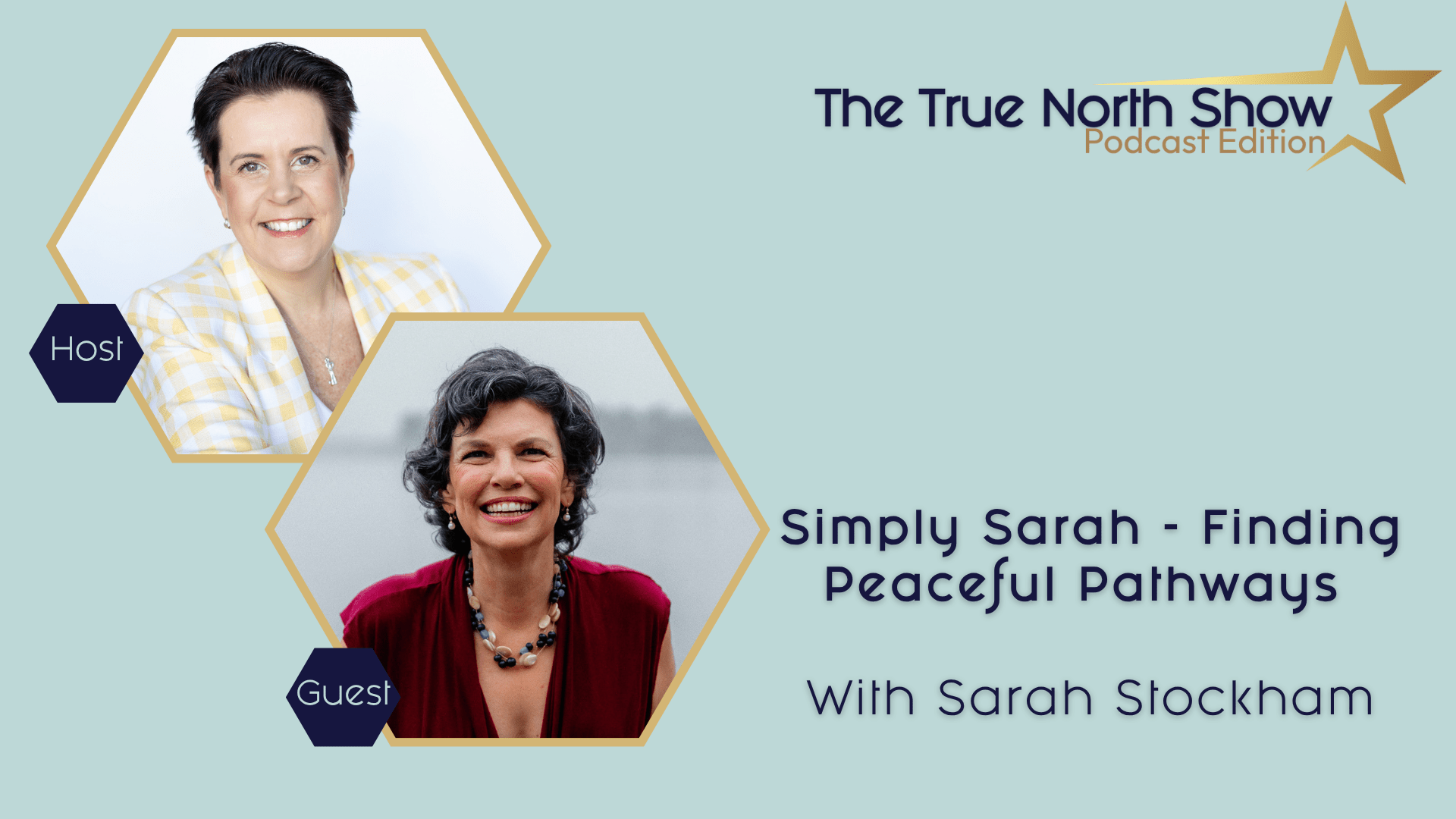
Simply Sarah – Finding Peaceful Pathways with Sarah Stockham | Ep. 47
On this week’s episode of The True North Show I am joined by Sarah Stockham, an incredible woman who shares with us the various “chapters” of her life that were filled with passion and purpose. Sarah’s journey, wisdom and experience has not only helped herself throughout her life, but also every person she has come in contact with. The effect she has on others is both comforting and healing and your life is just that little bit better once you know her. Our conversation is so beautifully deep and insightful, you will not want to miss this.
Sarah Stockham is a #1 Amazon Bestselling Author and the host of ‘Simply Sarah’, a dynamic TV show designed to enlighten, empower, and inspire service-focused leaders.
With her energetic toolbox of practical techniques and a touch of mystical insight, Sarah elevates leaders’ skills and mindsets, offering engaging discussions, valuable insights, and transformative moments.
Sarah is also the creator of Peaceful Pathways: Stress Relief for Women Teachers Approaching Retirement, a community that helps busy, tired, and stressed women, especially women teachers nearing retirement, break stress cycles, rediscover purpose, and embrace lasting peace.
A respected Reiki Master, Author, Teacher, and Speaker, Sarah facilitates profound healing sessions, leads group guided meditations, and brings the principles of self-care to life through her company, Reiki Claremont.
With over 35 years of experience in education, Sarah has been recognized as both a Master Teacher and Mentor Teacher, earning prestigious awards for excellence in teaching. She holds a Master’s Degree in Education and an Administrative Certificate, cementing her expertise and leadership in the field.
Social Media:
Website: https://sarahstockham.com/
Facebook: https://www.facebook.com/sarah.stockham.2025/
Instagram: https://instagram.com/sarahstockham
Transcript:
[00:34] Megan North: Hello and welcome to the True North Show. I’m your host Megan North, and I’d like to start by thanking the sponsors of the show: Quantum Awakening, Beth Lewis, and Anne C. Clarke.
Today I am joined by another amazing female TV show host who I had the pleasure of being a guest on her show a couple of years ago. Sarah Stockham is a number one Amazon bestselling author and the host of Simply Sarah, a dynamic TV show designed to enlighten, empower, and inspire service-focused leaders. With her energetic toolbox of practical techniques and a touch of mystical insight, Sarah elevates leaders’ skills and mindsets, offering engaging discussions, valuable insights, and transformative moments.
Sarah is also the creator of Peaceful Pathways, a community that helps busy, tired, and stressed women, especially women teachers nearing retirement, break stress cycles, rediscover purpose, and embrace lasting peace. A respected Reiki master, author, teacher, and speaker, Sarah facilitates profound healing sessions, leads group guided meditations, and brings the principles of self-care to life through her company, Reiki Claremont.
With over 35 years of experience in education, Sarah has been recognised as both a master teacher and mentor teacher, earning prestigious awards for excellence in teaching. She holds a master’s degree in education and an administrative certificate, cementing her expertise and leadership in the field.
Sarah, welcome to the True North Show. I am so happy that you’re joining me today.
[02:30] Sarah Stockham: It is such a delight to be with you, Megan. Thank you so much for the invite.
[02:35] Megan North: You are very welcome. Sarah is truly someone who has dedicated her life to lifting others up, and today she’s here to do the same for you. So don’t go anywhere, because right after the break, Sarah and I are diving into a conversation that you are not going to want to miss.
Welcome back to the True North Show. I’m here with the incredible Sarah Stockham, number one Amazon bestselling author, TV host, Reiki master, and a woman who has spent over 35 years transforming lives through education and healing.
Sarah, I would love to start by learning more about that defining moment when you decided to step into the passion and purpose that was calling you.
[04:14] Sarah Stockham: Megan, that’s such a profound question. And for me, it comes in chapters rather than a single defining moment.
I was born and raised in the Democratic Republic of Congo. My parents worked there. My very first memories are of dancing barefoot in a cotton dress to African drums. Just that incredible vibration. When I close my eyes, I can still be there.
We lived one degree south of the equator, which meant we could see different stars than those visible in the Northern Hemisphere. We literally lived in the jungle, next to a dirt airstrip. Dignitaries would come and visit because of the work my parents and others from different nations were doing. Small planes would arrive in the morning and leave in the late afternoon so the pilots could clear the forest and reach a larger place to spend the night.
Our dining room table was actually two sawhorses with a door placed across them. If you put an African panya cloth over it, you had a beautiful table ready to go. People from around the world would sit at that table. We served them what we ate most days: rice, greens we called Jessie with palm oil, chicken, and always an abundance of fruit for a fruit salad.
One of my defining moments came when a favourite visitor came to see us. I hadn’t seen him for months, and four or five-year-old Sarah wanted to catch him up on everything. The lizards, all the things. I felt a hand on my knee and kept going. And then the squeeze came, and I knew I needed to be quiet.
I go back to that moment because I think there are times in every one of our lives when we are right on the edge of sharing our excitement, and something pulls us back and says: not the right space, not the right time, not the right energy. That was one of my first lessons about finding my voice.
A few years later, we moved back to the States. My parents wisely would do four years overseas and one year in America so we could have a full school year here. Coming back to the States, I looked like I was supposed to fit in and yet had none of the cultural understanding of how to do that.
My sisters both went into medicine. I just didn’t like the sight of blood. So I went back to what had always brought me joy, which was music. We had a piano that had made its way from South Africa before one of the revolutions. Every time we moved, that piano came with us. Music became my outlet, my way of finding words and fitting in. I played for high school musicals, church gatherings, weddings, and funerals all through high school and into college, where I chose to become a music major.
One of the defining moments in that chapter was marrying young, believing I had made the right decision, and realising a few years in that it was actually a very harmful one. I found a weapon in the house and eventually discovered that the person I was married to was involved with the number one drug runner into Southern California at the time. I had never been near that world.
Suddenly I was in the birth canal of needing to grow up. Needing to figure out if I was safe. Trying to answer the question: who am I?
I found an incredible therapist, still quite new in her practice but extraordinarily gifted. I was seeing her twice a week and spending more on therapy than on groceries. I took a second job to pay for it. She walked this life with me, helping me figure out who I was and who I was not. She was not interested in me being in her office for years. She wanted to give me tools so I could move forward. That was one of the early chapters of beginning to say: this is who I am.
A few years later, I met the person who is my life partner and husband. We have a daughter together. Another chapter came in the form of miscarriages. Laying on the bathroom floor on the cold tile, knowing that this would be the last time because of my age and my husband’s circumstances. Going through that immense grief while also being so grateful for the daughter we had, and navigating the well-meaning questions from others about why we didn’t have more children.
I took our summers with Morgan very seriously. Part of every day was spent playing with words, concepts, and ideas. She defended her doctorate at 23 and has gone on to have an extraordinary career. But that chapter was another moment of identifying my own path rather than the one others said I should take.
Fast forward to 35 years in the classroom. We had schools closed due to declining enrollment. I became a music teacher moving between five different schools. I had over 400 students and was trying to carry something I had built with 20 kids into an entirely new and more complex context.
During all of this, I was aware of a clock ticking. We had made a commitment as children that when our mother needed someone to come and live with her, we would be the ones to do that. I could feel that time approaching faster than I felt ready to leave the classroom. That created a real tension inside me.
And then a student attacked me. That began a deep road into PTSD, into EMDR therapy, and back to the same therapist who had helped me decades before, now trained in EMDR. As I finished working through the PTSD, we began the EMDR work of allowing my subconscious to release what it had been holding onto in order to protect me.
Those were the thresholds, the doorways, the chapters that ultimately shoehorned me out of the classroom after 35 years. And as I was grieving that, Julie Meyer, a network president for Ari on TV, reached out and said she had been following my work on YouTube and wanted me to have my own show.
My first response was that what I do is not business. She said she knew, and she wanted me anyway. I spoke with my husband Mike, and he said: let’s try it for a year. We are now past three years, with over a million views last year across long and short form combined. Our audience is global. And I am so grateful that I still get to teach.
[19:05] Megan North: One thing that really struck me in what you shared is that when you started the therapy work after your first marriage, you had previously used music to express yourself. Was it an adjustment to suddenly sit and talk through things, or was it a relief?
[19:46] Sarah Stockham: Growing up with friends outside who spoke a dialect alongside my English education, I really struggled to find words that fit the emotion. My therapist Carol became my thesaurus. I would go in, mumble around with what I was experiencing, do the ugly crying, and she would have the words. I would leave feeling that somebody had truly heard me.
Later, during a course in the shutdown period, we were asked to go at least seven levels deep into what we were feeling. I found a website called Word Hippo and would put in different words, searching for the one that actually named what I was experiencing. I still do this. Sometimes I will call my daughter and say: I think the word might be this, and she will find the right one for me.
Part of why I use many words is that the tribe I grew up with communicated in the long way. That is genuinely in me. And there are faster ways to say things, yes.
[21:41] Megan North: Yes, it’s that real balance, isn’t it? Honouring the culture you grew up in while also learning to be more concise when the context calls for it.
[22:03] Sarah Stockham: Exactly. And honouring the energy of what I’m trying to express.
[22:12] Megan North: Sometimes we need to keep talking something through just to arrive at where we need to get to.
[22:28] Sarah Stockham: When I was mentoring new teachers, we had a sign on the wall that spoke to this. People need to hear themselves speak in order to process where they are. And that’s not only true for extroverts. It is true for anyone working through something new. They need to see the information, understand the expectations, and talk through how it makes them feel, where they are getting stuck, what feels sticky.
We need community. One of the gifts of the shutdown for me was recognising, really for the first time in my life, how utterly important in-person community is.
[23:26] Megan North: That’s really beautiful. And it’s interesting that you said that about needing to hear your own voice. I use a similar technique with coaching clients. If someone is getting too much into their head, I suggest they go somewhere quiet at lunch and record a voice message to themselves. Then listen back an hour or two later. Often they will hear themselves and think: I’m massively overthinking this. Because something about your own voice has a kind of healing quality to it.
[24:19] Sarah Stockham: I was interviewing Eric Collette recently. His business is called A Mind for All Seasons and he helps people who have been diagnosed with Alzheimer’s, including early onset. It’s not a cure, he is very clear about that, but they have found over a hundred different practices that can make a real difference. Some people who were institutionalised have been able to move back home.
In our conversation I was sharing something similar to what you’re describing. I had told a client who was overwhelmed with all the minutiae of life to simply get it written down. Eric said: you’re talking about the open loop. When the brain is circling unresolved thoughts without closure, it creates a higher level of stress. It is doing things to the brain that are genuinely unhealthy.
When we do what he called a brain dump, whether through voice memo, writing, or drawing, it closes the loop. It gives the brain permission to rest. And then you get to look at what is on the list and ask: what on here actually aligns with me? What is just something I’ve been carrying because someone else’s expectation got inside me and I mistook it for my own?
[26:35] Megan North: I love that. What a perfect conversation to be having, especially after your interview with him yesterday. And I love how you call things chapters. I have never referred to my own experiences that way before, and I think I will start. It’s such a beautiful way to speak about the different parts of a life and how each one leads to the next.
[27:21] Sarah Stockham: Part of that framing comes from my own nature. I like closure. When I reach the point where I can talk about something, even if there is still emotion attached to it, in a way that might gift someone else a different perspective on their own circumstances, that is when I know it might be a chapter. There are absolutely pieces of my life right now that I’m still in the middle of. Still figuring out how to hold. And that is okay too.
[28:06] Megan North: Yes, beautiful. So from a mental health and wellbeing point of view, has that always been at the forefront for you, or has it evolved over time?
[28:32] Sarah Stockham: I want to share some things that may be triggering, so I name that first.
When my mother was pregnant with me, my father was taken hostage in what became an international incident. He was held for eleven weeks. A pilot who came in trying to help was killed. My mother and sisters, along with the other wives and children, were eventually released. I didn’t really hear the full story until my 50th birthday, by which point my father had already passed.
Years later, my oldest sister began losing weight rapidly and exercising excessively. After many tests with ex-pat doctors, she was eventually diagnosed with anorexia, around the time Karen Carpenter passed away and brought the condition to wide public attention. That began a long journey as a family.
A few years after that, my aunt and I were hit by a drunk driver. I survived. She did not. My parents moved us to Michigan to care for my cousins for several years. I was taken to a therapist at around thirteen, deeply angry and very much wanting to live inside my victimhood. That therapist helped me understand something important: it is okay to feel the pain. It is okay to be undone by loss. But it is not okay to stay there.
From around the age of eleven, I had grown up with a morning quiet time before breakfast. A devotional reading, some prayer, our oatmeal, always with fruit. That practice became my foundation. Over the decades it has changed. Sometimes it has involved journaling, sometimes music, sometimes intentional reflection based on what I have been learning about the subconscious mind.
I recently revisited my morning practice after interviewing John Mitchell, who speaks about life GPS and the ninety-five percent of our thoughts and actions that are subconscious. Using the waking minutes of the morning to speak intentionally into that subconscious layer has become an important addition.
The practice has never been static. As I grow and change, I come back and ask: is what I am doing actually serving who I am right now, in this season?
[33:46] Megan North: Thank you for sharing that. And I appreciate you saying that it is what works for you, because I think it is so important that when we talk about our own mental health and wellbeing practices, we honour that what works for one person may not work for another. There is a lot of pressure right now around things like ice baths. Not for me. But if it works for someone else, wonderful. I think the message is: take the pressure off and do what is genuinely good for you.
[34:45] Sarah Stockham: Yes. And whether it is an ice bath, a quiet time, yoga, or breathwork, I believe each of those spaces offers the same fundamental opportunity. To check in with the body you are in right now. Not your 18-year-old body. Not your future self. The body you are in today. And to ask: how can I best integrate who I am authentically in this current season?
[36:03] Megan North: Is there anything you’ve ever tried from a mental health or wellbeing perspective that you thought you’d give a go and then never returned to?
[36:29] Sarah Stockham: I tried a sound bath and found the vibration very interesting. I also attended a gong session. There was a particular gong that had a sound a little like nails on a chalkboard, and I found myself doing deep breathing just to get through it. Perhaps that sound was releasing something for someone else in the room. For me, it was very much a case of please let this end.
[37:21] Megan North: I suppose different frequencies work differently for different people. I’d never heard of that happening with gongs before. So, with all the chapters you’ve described, how do you know when something is truly in alignment for you? Do you feel it? Do you know it? What happens in your body?
[37:58] Sarah Stockham: Such a powerful question. There is always the mental layer first. Does this fit? Is this really right for me? That is why my morning practice matters so much. I have learned to take time to process before responding. People in my life will sometimes pre-empt me with “and now Sarah is going to say she wants to process it.” I’m not at all offended by that. I genuinely do need that time.
Recently, while we were helping to cook food for those experiencing homelessness, someone asked me on the spot to take on an additional delivery task. I said no because I could not see how to add one more thing in that moment. On the way home, I asked my husband Mike whether we should have changed the answer. His response was simple: let your yes be yes and let your no be no.
I am in a different chapter of life right now. We are living here with my mother, who is almost 91 and extraordinarily active. Keeping everything running around her takes both of us. I am only just beginning, nearly three years in, to find a rhythm that has real freedom and flexibility in it.
One thing that has been very important for my mental health is writing out my week by hand every Sunday. I’ve done this since 2008. Everything that is on my phone calendar gets transferred by hand. I want to know how my energy will flow through the week before the week begins.
I batch my client days to Tuesday, Wednesday, and Thursday. I protect the last week of every month so that no one can get onto my calendar during that time unless I put them there. I record my television show in a dedicated week each month. And rather than giving Christmas gifts to my professional community, I give Thanksgiving gifts, because I am genuinely thankful for the work we do together, and because it means I am not depleted during the season when everyone else is.
All of this is about protecting what matters. The rest is easy. It is easy to stay busy. The real work is in allowing things to settle. Protecting the space for that is not selfish. It is the discipline.
[44:06] Megan North: Yes, and I do something similar. I don’t typically work on Fridays. Today is a Friday, but that was my own choice. It comes back to boundaries, doesn’t it? And I think if someone has a problem with a boundary you’ve set, it is often a sign that you may not be aligned with them in the first place.
[45:00] Sarah Stockham: Yes. And what I have noticed is that when you say no and someone asks again later, they come back with a completely different energy. Not the assumption that you will say yes. Something more thoughtful. More reverent, if that is the right word. And I have enormous respect for that shift.
[45:38] Megan North: Absolutely. So I would love to talk specifically about Peaceful Pathways. What was the moment you knew that community needed to exist?
[45:59] Sarah Stockham: It really came from people in my life saying: Sarah, you don’t see how much others who are where you were four or five years ago need what you have been through.
I had been planning to focus on entrepreneurs and senior leaders, and I have worked with CEOs in deeply fulfilling ways. But the people around me kept speaking into my life about this other space.
One thing I work with consistently is what Al Ingalls called the ten-second solution. From a resting heart rate, from the moment a stressor arrives, whether that is a sound, a smell, a text, anything, we have ten seconds. If we use a tool in that window, we can stop the stress hormones from flowing through the body. If we don’t, it can take up to nine hours for biological men and up to 24 hours for biological women for those hormones to work through the system.
That was genuinely a revelation for me. It explained so much about why Mike would be over something and I was still sitting in it. It wasn’t a character flaw. It was biology. And it has a solution.
Peaceful Pathways brings women together on the first three Tuesdays of every month, honouring that last week. I always open with ten to fifteen minutes of new content, a new tool or a familiar one seen through a fresh lens. It might touch on finances, interpersonal relationships, or simply the experience of navigating life in transition.
Because that is what retirement often is for women who have taught. It is not just leaving a job. You are leaving a label. A structure. A daily sense of purpose and belonging that was built over decades. Even women who know exactly what they are stepping into can find the crossing itself profoundly disorienting. Having a community that understands that specific experience changes things.
[49:48] Megan North: What a gift that the world has because you’re in it. I think there is something so joyful about teaching, about being able to offer wisdom that you know is going to help someone that day or that week. It’s a beautiful feeling.
[50:30] Sarah Stockham: Being able to help someone see their circumstances through a different lens is everything. I had lunch today with a beautiful group of people, deeply spiritual, wonderful human beings. The conversation moved toward politics. I noticed the energy in the room sharpen and the voices become more clipped. I found it very easy to begin clearing plates and bringing the next course.
But afterward, what I kept returning to was a question I wished I had asked in the room: have you stopped and held that person in the light? The person your voice becomes sharp about, have you taken time to surround them with something generous today?
I don’t need to agree with someone’s path to celebrate that they are on one. Walking on coals is not for me. But for the person it is for, can I wrap my mind around honouring that journey? Yes, I can.
[51:57] Megan North: That is such a beautiful way of seeing it. Another aha moment for me. Thank you. We only have a couple of minutes left and I feel like we’ve barely scratched the surface. I’m definitely going to have you back.
[52:21] Sarah Stockham: I would love that.
[52:23] Megan North: So the question I love to ask all of my guests before we close: what is one lesson or truth that you’ve learned on your journey that you wish you had known earlier?
[52:39] Sarah Stockham: I have never quite said it this way before, but it feels right.
I grew up as the only white child my age in my community in Congo. I had blonde hair and a beautiful group of friends. We did everything together. When I came to the States and was surrounded by people who looked like me, I completely lost my footing. I didn’t know how to authentically be myself in that context.
Part of what the chapters have been doing, all of them, is slowly removing something. Like the outer layers of a coconut gradually coming away. And at 61, I am finally arriving at a place where I can walk through a door and simply be myself. If something lands well, wonderful. If I make a mistake, I figure out how to address it. If I need to apologise, I do.
We moved three years ago to be closer to my mother, and there are cultural expectations in the community here that are not my own. My father’s, yes, but not mine. And I still find myself taking deep breaths. My husband will notice and say quietly: you’re breathing. And I am. Because the practice is to come back to myself and remember: it is okay to still be me.
Finding your people, your tribe, the ones who see you and resonate with you, that changes everything. And Megan, I am so grateful for you and the community you are creating. That kind of belonging is so powerful for people who have spent a long time looking for it.
[54:34] Megan North: Thank you so much. What a beautiful way to close this conversation. I am genuinely blessed to have spent this time with you and to have heard more of your story. Thank you, Sarah.
[54:54] Sarah Stockham: Thank you, Megan. And thank you to your wonderful audience as well.
[54:58] Megan North: Thank you, Sarah. And to all of my audience, my sponsors, and everyone who tunes in every week: I hope you have an amazing week and I look forward to seeing you all again next time. Thank you again, Sarah.
[55:15] Sarah Stockham: Thank you.

![True North Show [podcast] - Season - Tiffany Cano -](https://megannorth.com/wp-content/uploads/2026/06/True-North-Show-podcast-Season-Tiffany-Cano--768x432.png)