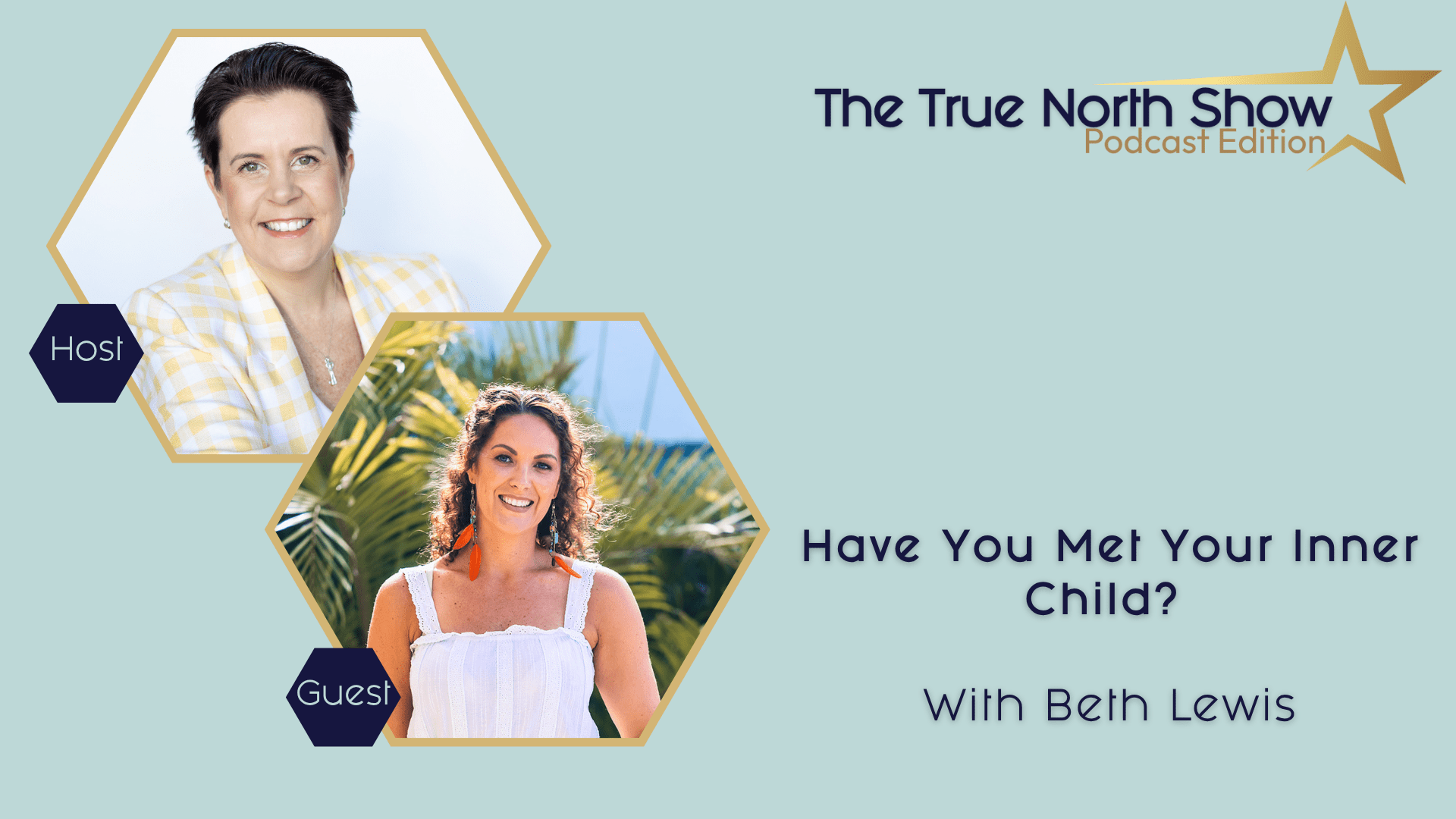
Have you met your inner child with Beth Lewis | Ep. 58
On this week’s episode of The True North Show I am joined by a returning guest who also is my bestie and business partner, Beth Lewis. Beth and I have recently hosted 8 incredible women at a retreat and there was so much wisdom shared throughout the weekend that we wanted to talk about some of the things that she and I are seeing women struggle with at the moment. Of course we don’t get through many of the questions and topics we thought we would cover, but the inner child work was something that we dived deeply into. I really loved speaking to Beth about this and I love the different perspectives and experiences we have had regarding our own inner child work.
Bio:
Beth Lewis is a Holistic Coach, mother, and business owner who integrates science and soul to empower mothers and families to heal at a cellular level creating lives of freedom, vitality, and deep connection.
Her work is not theoretical. It is deeply rooted in her own healing journey. Beth has walked through life’s most challenging terrain and come out the other side with an inspirational story, a powerful toolkit, and an unshakeable passion for helping others do the same.
Through Breathwork, Sound Healing, Wellness Coaching, NLP, and the science of Psychoneuroimmunology, which explores the profound connection between the mind, the nervous system, and the body, Beth guides women to reduce cortisol levels, regulate their nervous system, heal their inner child, and experience transformation that is real, measurable, and lasting.
Because this is not woo woo. This is evidence informed, results driven work that ripples through relationships, health, and everyday life in ways that clients feel deeply and immediately.
Beth works with women through one-to-one coaching, breathwork and sound healing sessions, couples work, corporate wellness, and the retreats and empowering events she creates for women, including the retreat work she and I have built together.
Her mission is simple but profound – to help communities feel calmer, more present, and more connected to who they really are. Not just for themselves, but for the generations that follow.
Beth plays a big role in my life, she is my business partner, my bestie and is a major sponsor of this show.
Beth’s Social Media:
Website: www.bethlewis.com.au
Facebook: www.facebook.com/bethlewiscoaching
Instagram: www.instagram.com/bethlewis_myndcentre
TikTok: https://www.tiktok.com/@bethlewis_myndcentre
LinkedIn: https://www.linkedin.com/in/bethlewiscoaching/
Transcript:
[00:05] Megan North:
Hello and welcome to the True North Show. I am your host Megan North, and I’d like to start by thanking the sponsors of the show: Quantum Awakening, Beth Lewis, and Anne C. Clarke.
Today I am thrilled to welcome back to the show Beth Lewis. Beth is a holistic coach, mother, and business owner who integrates science and soul to empower mothers and families to heal at a cellular level, creating lives of freedom, vitality, and deep connection. Her work is not just theoretical. It is deeply rooted in her own healing journey. Beth has walked through life’s most challenging terrain and come out the other side with an inspirational story, a powerful toolkit, and an unshakable passion for helping others to do the same.
Through breathwork, sound healing, wellness coaching, NLP, and the science of psychoneuroimmunology, which explores the profound connection between the mind, the nervous system, and the body, Beth guides women to reduce cortisol levels, regulate their nervous system, heal their inner child, and experience transformation that is real, measurable, and lasting. Because this is not woo-woo. This is evidence-informed, results-driven work that ripples through relationships, health, and everyday life in ways that clients feel deeply and immediately.
Beth works with women through one-to-one coaching, breathwork and sound healing sessions, couples work, corporate wellness, and the retreats and empowering events she creates for women, including the retreat work she and I have built together. Her mission is simple but profound: to help communities feel calmer, more present, and more connected to who they really are. Not just for themselves, but for the generations that follow.
Beth plays a really big role in my life as my business partner, my bestie, and a major sponsor of this show. Welcome back to the True North Show, Beth.
[03:06] Beth Lewis:
My heart is so full listening to all of that. Thank you. An honour to be here as always.
[03:12] Megan North:
You are welcome. For the audience, this episode is going to be a little different to my usual format. Beth and I have recently run a retreat with eight incredible women, and there was so much wisdom that came out of that weekend that we wanted to bring it here and share it with everyone: what we learned from the women, and what we learned about ourselves. So this is going to be more of a conversation than an interview.
Let’s start with the inner child work.
[03:57] Beth Lewis:
Straight in. Lovely.
[04:00] Megan North:
For someone watching today who has never heard the term inner child before, how would you explain it? And what does psychoneuroimmunology tell us about why an unhealed inner child can show up as physical symptoms in the body?
[04:20] Beth Lewis:
I love that question. It could be an entire conversation in itself.
I think it is one of those terms, like purpose or shadow work, that gets thrown around on Instagram and in reels and stories now. And people who have never heard these terms can get quite overwhelmed and go: what is this? Is this witchcraft? Is this some kind of cult? And fair enough, because it really does not make sense until you are actually in a room with someone who can break it down.
Because at the end of the day, it is quite simple. Complex, but simple. The work is complex, but the concept is actually simple. And that is: we were all children once.
We were all children once, and we are still that person in many ways. You are still little Megan. I am still little Beth, or little Elizabeth, as my mother would say if I was in trouble.
We all have this little person inside us that drives how we show up in the world. Especially for those children who were not fortunate enough to have all their needs met. And let us be honest, many children go through quite severe trauma growing up. Their mental, physical, and emotional needs, one or more of them, may not have been met.
But there are also much simpler things that pretty much everyone can relate to. We are simply raised by different generations, and everyone is doing their best. Grandparents raised parents, parents raised us, and we are all working with the resources, the emotional intelligence, and the belief systems available to us at the time.
I remember, for example, the baby boomer generation, not having a go at anyone in that bracket, just making an observation, would often say things like: do not spoil the baby, do not run to them every time they cry, they learn to manipulate you so fast. And based on science and research and years of therapy and observation, we now know that is actually incorrect information. We are now taught as parents that you cannot spoil a baby. Creating a secure attachment is the whole job. The cry it out method has actually been banned in many countries because of the detrimental effects it has had on children as they grow into adults, including links to severe depression and anxiety.
Even things as simple as that, you know. Because most people hear the term inner child and think: well, I have not been through severe trauma, I had a pretty good childhood. But certain things are unconsciously stored in our bodies. This is why I always recommend the book The Body Keeps the Score. That book should be in schools from a fairly young age. Because we carry a lot of this stuff.
And as adults, all of a sudden, patterns start appearing. You keep attracting the same type of partner who does not listen to you. You keep hitting the same wall with money. You keep getting sick at the same moments. And as I always say, it is all connected.
Whether it is your health, your finances, your mental and emotional wellbeing, it can all be traced back to what happened when you were a child. How we deal with conflict. Whether we feel safe enough to set a boundary. Whether we can say no. Whether we self-sabotage when things start going well. These are all inner child patterns showing up.
For example, for me personally, I had real patterns of people pleasing and finding it hard to say no. And that showed up physically. I would agree to things I did not want to do and then actually get sick, and then of course I could not do the very thing I did not want to do in the first place. You start noticing these patterns. The first step is awareness. And then it is figuring out how to work through that and create a new way of showing up.
[09:25] Megan North:
Yes. And there are a couple of things in there that really resonated for me. I am the youngest of six, with seventeen years between me and the eldest. My parents were completely different parents by the time I came along than they were when they were raising my eldest brother. Every child gets a different version of their parents. And the other thing is that I had an incredibly beautiful childhood. But I have still needed to do inner child work, because as a child I added stories to moments. Some of those stories were not even real. But they were real enough to my nervous system. And when I have gone in and done the inner work, I have realised that the story I constructed around certain moments did not even reflect what actually happened.
[14:10] Beth Lewis:
Absolutely. And it can be something that simple. I have worked with clients who have been through significant trauma in their teens and adult years, but when we use NLP to go deep into the unconscious and uncover these stories, it is fascinating. One client in particular, she had been through quite a lot, and she was so convinced that her self-sabotage and all her patterns in her marriage came from those big adult events. But when we unpacked it, what we found was a girl at school who used to bully her. A couple of things this girl said to her repeatedly. We were convinced it must be elsewhere. And then there it was. This little seven-year-old mean girl in the playground. That is where the belief system started. That she was a freak, that she was ugly, that she did not belong.
And the healing that was possible by going back to that was incredible. It can be the most random thing. I have had therapists laugh about that too, in the best possible way. My own son is six and a half, and sometimes something big happens and I catch myself thinking: oh no, he is going to need so much therapy. But honestly, it can be the tiniest, most unexpected thing. A moment in the hallway at school. Something said in passing. Because unconsciously we process things we do not consciously understand.
One thing I want to mention here, because we covered this a lot at the retreat and it is something Brene Brown says beautifully: when you are triggered in a conversation, before you react, use these words. The story I am telling myself right now is this. Is that correct? Because it does not mean your truth is wrong. It means that there can actually be multiple truths in any situation. We are all showing up through our own filters, our own backgrounds, our own perceptions. If you and I watched the same movie and walked out, we might have completely different meanings from it. So when you are dealing with anyone, you are coming from your filters and they are coming from theirs.
[18:02] Megan North:
Yes. And neither has to be wrong. It is like if I drew a six on a piece of paper and laid it flat between us. From where I am sitting I see a six. From where you are sitting you see a nine. Neither of us is wrong. It is just that our perception of where we are standing changes what we see.
[19:14] Beth Lewis:
I love that. And actually doing little exercises like that with clients is really powerful. I did a walk and talk session with one of my mum clients and she was wearing my polarised sunglasses and I used that as a metaphor. We were walking along the ocean and she was talking about this really difficult argument she was having with her husband. And I just said: put these on for a second. What does everything look like compared to having them on versus off? And I used that as the metaphor for her filters versus her husband’s filters.
I also had a couples therapist once say something that has stayed with me. My partner at the time said: well, you have just got to compromise. And the therapist said: actually, I do not like that word in relationships. Because compromise means giving something up. And when you keep compromising, it can quietly build resentment. What creates a long-term, healthy, respectful relationship is sitting down and respectfully listening to where the other person is coming from. You do not stop talking, calmly, until you can both say: yes, that is exactly what I was trying to say. And what he found is that most of the time, when both people genuinely feel heard, one or both of them is actually quite willing to change their view.
[22:30] Megan North:
Yes. And that goes back to the inner child piece too. If you grew up in a home where you always saw compromise modelled in a certain way and you have not done the inner work around it, that can all bubble up in your own relationships. And the things that bubble up and are not worked on will keep bubbling up. But if they come up and you do do the work, the freedom on the other side is real. It is one less thing you even need to think about anymore.
[23:35] Beth Lewis:
One hundred percent. And a perfect example of this is finding your voice. For me personally, that was a big journey. I am the youngest of three sisters, and my sisters are eight and ten years older than me. I was born into a home full of noise and chaos, and there was a lot going on emotionally. So I learned from a very young age how to be a chameleon. My little soul went: everyone has so much going on, I need to be small, I need to fit in.
I could not get a word in anyway. And even when I did, I would be cut off before I could finish. So I learned to be very good at not speaking, while internally really needing to be heard. And that showed up in my adult relationships in a very specific way. If I was trying to explain something from the heart and someone talked over me, I would have this entire physiological reaction. My body would go into that trauma response. Because that had been my experience: that if I speak, I will be cut off. I will be told I should not feel that way. I am stupid. My voice does not matter.
Overcoming that has allowed me to practice active listening in a much more powerful way too. Because I would never want anyone else to feel that way. And eventually I could understand: the person in front of me does not know that. Someone jumping in because they are excited is not the same as being dismissed. But until I did that work, my nervous system could not tell the difference.
[26:19] Megan North:
Yes. Exactly. And it is a really healthy relationship where you can simply say: would you mind letting me finish? That is part of speaking your truth. And the person who loves you will respond to that with care. On a slightly different note: do you know that the same letters in the word listen are the same letters that spell silent?
[27:14] Beth Lewis:
I love that.
[27:15] Megan North:
Yes. And it is amazing what you learn about someone when you just sit back and listen. And it helps you process too. It is funny because with you, I will sometimes just send back a heart emoji after a big voice message and you know that I have received every word of it.
[27:46] Beth Lewis:
And that is all I need. That is enough. I love it.
And what you were saying about listening and silence is backed by research too. People who feel compelled to fill every silence, who struggle to let pauses sit, many of them have been through some form of trauma. It is a really recognisable anxiety trait. And I absolutely know that was me for a while.
I was very uncomfortable with silence in conversations, in rooms, anywhere. And then through the work, everything shifted. Now I genuinely love a good silence. Especially as a mum. But it was actually quite a journey to get there.
When I was married to my ex-husband, his family was very different from mine. My family gatherings are big and loud and you really do have to hold your ground to get a word in. His parents were quieter. They would eat a meal and only speak if they felt like saying something. And the first few times I was with them, all of my old stuff came rushing up. They are not speaking. Do they find me boring? Do they not want to talk to me?
And then I caught myself. The story I am telling myself. Is this true? Or is this just showing me where I am not yet free?
That became a huge breakthrough. And over time, I actually started to love those quiet dinners. I started to feel comfortable in that space. I would go home to my family gatherings and feel exhausted in a different way, and start to understand that it was okay to just exist in silence without it meaning anything about my worth.
[33:07] Megan North:
Yes. And during that journey of discovery, it is important to be really intentional about where you put your time and energy. You genuinely may not know quite who you are yet. So being considered about which relationships you spend time in, and not accidentally creating distance with a twenty-year friendship just because you are in a strange in-between space, is really worth thinking about.
[33:52] Beth Lewis:
One hundred percent. It is such a real intentional practice. And Jay Shetty talks about this beautifully in The Eight Rules of Love. He speaks about the difference between being alone and being in solitude. Every single person on earth needs to learn to be comfortable in solitude. Not watching TV. Not scrolling. Sitting with yourself. Taking yourself on a date. Going to the ocean, to a museum, to a movie, to lunch, and not being on your phone. Just being with yourself.
And if that sounds genuinely unbearable to you, that discomfort is the work.
One of my mentors encouraged me to try pondering. Twenty minutes, three times a week, sitting at my spot by the ocean, doing nothing in particular. Those first sessions were genuinely uncomfortable. I have got so much to do. I could be using this time so much more productively. My whole identity of being a single mum running a business came rushing in. And I sat with it anyway.
Because if you do not create space within yourself, nothing else shifts. We do not need more time, money, or energy. We need more space. You never find the answer from the place you ask the question. And the question usually comes from a place of overwhelm and overstimulation. The answer comes from stillness.
[36:53] Megan North:
Yes. I remember in between my first and second marriages, I used to do a silent weekend at home. I would message my family on the Friday and say: my phone will be off for the weekend, I am absolutely fine, I am just having a silent retreat at home. And I would come in Friday evening and not leave until Monday morning. No one in, no one out, no speaking. I loved every minute of it. I would have happily done a week.
[37:34] Beth Lewis:
And that would be someone else’s absolute worst nightmare. I cannot be alone with my own thoughts. But I love that. That shows so much growth and self-love and transformation. And it is really important on a healing journey to carve out that time for yourself. Which is actually a perfect segue into something else I wanted to share.
When I was going through a really difficult time after my marriage ended, I had this pattern of retreating into myself completely. Not asking for help. Not reaching out. Because I did not want to be a burden.
A girlfriend and I caught up for dinner after one of those times. And I mentioned that I had had a rough weekend. And she looked at me and said: I want you to know that it would have been an honour to be there for you. And I really need you to not take that away from me again.
I was blown away. Because I had always assumed my pain was an inconvenience. And here was someone telling me that showing up for me would have been a gift to her. I actually got emotional in the moment. And she very firmly said: do not ever wallow alone in that much pain again. I am actually offended that you did not let me help you.
And it changed something in me. Now I have absolutely no issue sending a voice message or picking up the phone and saying: I am having a really hard day, can I just get this out? And the difference in how quickly I move through things when I allow someone to witness it is remarkable.
One thing I do want to be clear about, though: there is a real difference between leaning on the people who love you and constantly expecting friends to function as your therapist. If the same patterns keep coming up, if there is constant crisis and drama and a 24/7 expectation of support, that is when professional help is genuinely necessary. You cannot ask your friends to carry what a therapist is trained to hold. And both Megan and I always have our own coaches, mentors, and therapists. We practice what we preach. You cannot figure the big things out alone.
[48:07] Megan North:
Really good point. And on the topic of boundaries, I have been thinking a lot about what I call the courage versus confidence distinction. If setting a boundary requires courage, if you are already bracing for the response, that tells you something about that relationship. It suggests you are worried about how they will react. But if you can set a boundary from a place of confidence, if you can simply say: this is where I stand, and be genuinely prepared for whatever comes back, that is a relationship built on real respect. Which one applies to the relationships in your life is worth noticing.
[49:20] Beth Lewis:
One hundred percent. And that goes hand in hand with values. When we do boundary work with women, one of the first questions is: what are your actual core values? Because once you know what you value most, the boundaries tend to become clearer on their own.
One of my highest values in every area of my life is respect. And for such a long time, I could not understand why certain things hit me so hard. Why certain moments would send me straight into reaction mode. But once I understood that respect was at the core of who I am, it all made sense. Someone crossing that value, even unknowingly, landed differently than anything else. And I was not overreacting. I was responding to something that went right to the centre of what matters most to me. I just had not had the language for it yet.
[53:55] Megan North:
Yes. And once you have the language, everything changes. So we have really only got a couple of minutes left, which I cannot quite believe because we have covered so much ground on really one topic.
[54:05] Beth Lewis:
It goes so fast. We could talk for hours.
[54:09] Megan North:
We genuinely could. And I think we are going to have to do a Part Two of this because there is so much more to explore.
[54:18] Beth Lewis:
Yes, absolutely. And I love that we got to go this deep on the inner child piece, because I really do think it is such a beautiful and important starting point for anyone who wants to do some work on themselves. It does not have to be overwhelming. It can start with just awareness. Just noticing a pattern and asking: where did that come from?
[55:10] Megan North:
Yes. Absolutely. And if you have any comments or questions from this conversation, please feel free to reach out to Beth or to me. We would genuinely love to hear from you. Thank you so much, Beth. This has been fantastic.
[55:11] Beth Lewis:
Thank you. So much love to everyone listening. You are not alone. And it is never too late to go back and meet that little version of yourself with kindness.

![True North Show [podcast] - Season - Viewing Life With A Strengths-Based Lens With Rosemary Gattuso](https://megannorth.com/wp-content/uploads/2026/03/True-North-Show-podcast-Season-Viewing-Life-With-A-Strengths-Based-Lens-With-Rosemary-Gattuso-768x432.png)