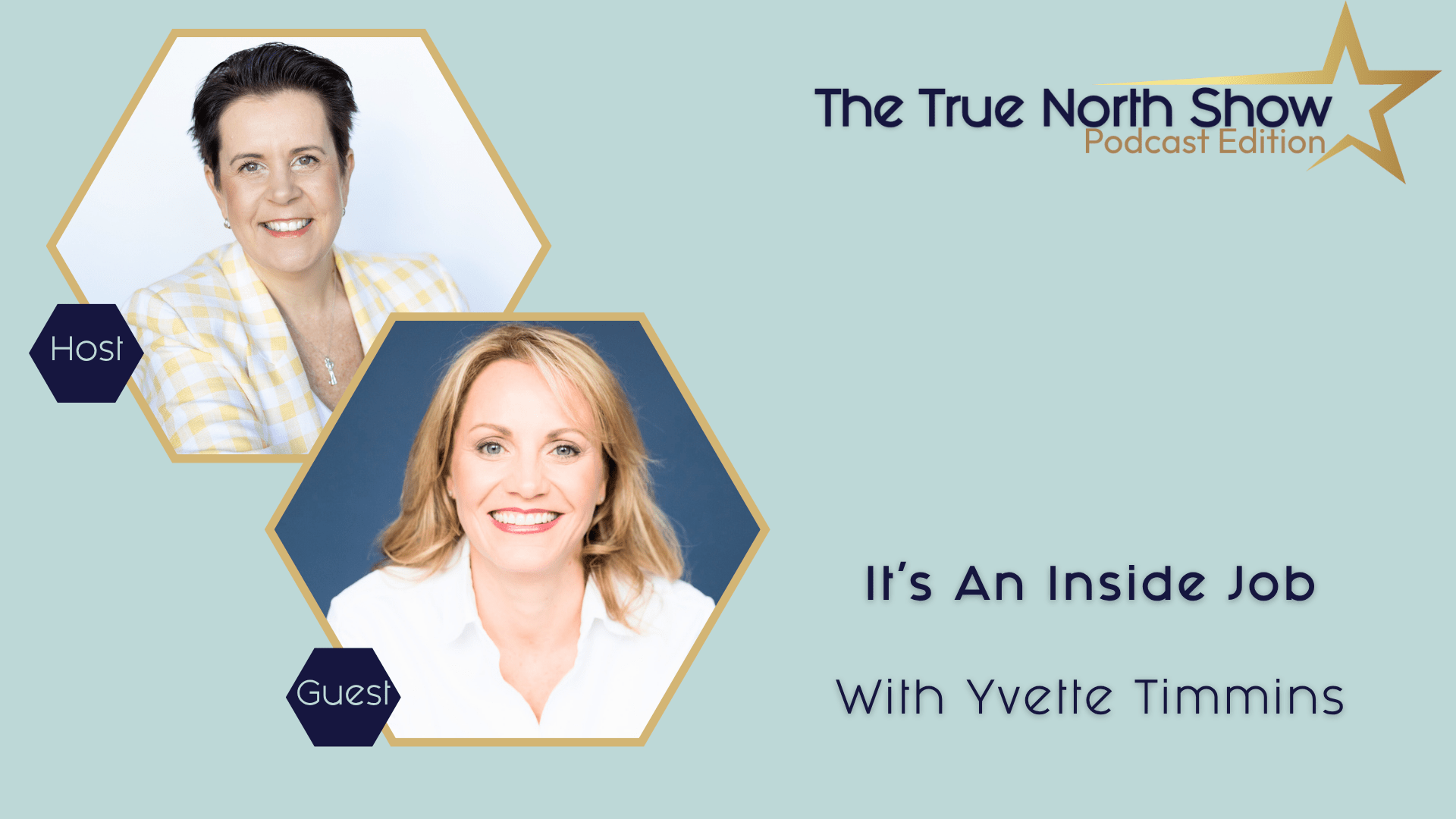
It’s An Inside Job with Yvette Timmins | Ep. 52
On this week’s episode of The True North Show I am joined by a wonderful returning guest Yvette Timmins. Yvette and I were recently chatting about her honeymoon in Japan and she shared with me a conversation she had that stopped her in her tracks and I knew immediately we had to bring it to the show.
Bio:
For Yvette Timmins, flowers are more than just a profession they are a family legacy.
With a Grandmother, Great Aunt, and Great Grandmother who were all florists, it would be easy to say that creativity is in her blood. However, Yvette believes that the art of floristry isn’t a special skill reserved for the chosen few; it is an innate ability available to anyone willing to silence their inner critic and connect with nature.
With over 30 years in the industry, Yvette has truly “done it all”. She has climbed every rung of the ladder, moving from a Casual Assistant to Senior Florist, Shop Manager, and Shop Owner, eventually becoming a Floristry Teacher and the Principal of Bloom College, which she founded in 2013. Her leadership extends to the national stage, where she served as a founding director and board member of Flower Industry Australia.
Beyond the business of blooms, Yvette is a champion for the mental health benefits of creativity, she has witnessed firsthand how working with nature decreases anxiety and nurtures the soul. This passion led her to co-found the charity Floral Acts of Kindness and to write her recently published book, Feed Your Soul with Flowers.
Today, through her online membership and app, Yvette is dedicated to ensuring that geography and physical ability are no longer barriers to learning. She is here to help you grow your business and feed your soul, one stem at a time.
Use this link to purchase the book – Feed Your Soul With Flowers
Social Media:
- Website: https://bloomcollege.com.au/
- Facebook: https://www.facebook.com/bloomcollege
- Instagram: https://www.instagram.com/bloomcollege
Transcript:
[00:00] Megan North:
Hello and welcome to the True North Show. I’m your host Megan North, and I’d like to start by thanking the sponsors of the show: Quantum Awakening, Beth Lewis, and Anne C. Clarke.
Joining me today is the wonderful and amazing Yvette Timmins, florist, educator, author, and founder of Bloom College. Yvette and I were recently chatting about her honeymoon in Japan, and she shared with me a conversation she had that stopped her in her tracks. I knew immediately we had to bring it to the show.
Yvette, welcome back to the show.
[01:08] Yvette Timmins:
Thank you, Megan. It’s so nice to be back here with you again.
[01:11] Megan North:
It’s really lovely. So for the audience and the listeners, today the show is going to feel a little different to usual. I’m doing this in a rapid-fire, conversational interview style. This is going to be more of a free-flowing conversation. And although Yvette and I have an idea of what we’d like to focus on, we both know that when intuition kicks in, who knows where this will go.
So grab your favourite drink or your snack, sit back, and enjoy. Let’s see where the conversation takes us.
[01:46] Yvette Timmins:
Wonderful.
[01:47] Megan North:
Alright, I’ll start with an easy one. How was the honeymoon in Japan? And was this the first time you’d travelled to that country?
[02:00] Yvette Timmins:
For me it was my second time in Japan. My husband has been multiple times. But it was our first time in a place called Okinawa, which is south of Japan and quite separate culturally. Japan took over Okinawa in the late 1700s. It was occupied by the US from 1945 after the war, and around 1970 it was handed back to Japan. So it’s quite different to mainland Japan. It’s tropical, close to the equator, and it’s one of the Blue Zones. It was my first time there, and it was a genuinely magical experience.
[02:47] Megan North:
Beautiful. We’ll come back to the Blue Zone in a moment, but first, can you take us back to the moment you met this man? Where were you, how did it come about? Share as much detail as you like.
[03:09] Yvette Timmins:
Absolutely. There were actually multiple people we met who really touched us and where there was a real connection. But the gentleman in Okinawa who was probably the most significant for both of us was an elderly man named Oidasan. He ran this gorgeous campground right on the water, and we were the only people there. We had hired a small RV and were driving around to these beautiful free campsites.
At his particular campground, he really wanted to share his space with us, and he did so incredibly generously. He didn’t just want to show us around, he wanted to deeply connect with us. I had done some reading about Okinawan culture and what makes it different, and a lot of it centres on personal connection, that deep soul-level connection and genuine interest in people, as an integral part of life.
He was able to share that with us, not like reading from a textbook, but because he genuinely lives it. Not just him, but his family and neighbours, who we also got to meet and connect with. Part of the lesson is in that human interaction itself: making real connection an important part of daily life, rather than coming home from work and shutting the door on the world. It’s about connecting with your existing community, but also with new people and what you can learn from them.
That was really important for me, because we can read things and intellectualise them, but there are moments when we connect with something emotionally instead. Meeting him was one of those moments, because he is genuinely living it. It is part of his culture and lifestyle. We could easily have come home and forgotten about it, slipping back into old habits of not connecting enough with our community or even our own families. So now it is something I am actively trying to make a habit in my life, because it is something I have shied away from many times before. We know things intellectually, but it’s about actually making it part of how we live.
There is so much more that makes up their lifestyle and longevity, of course.
[06:42] Megan North:
And what was the specific moment, the words he said, that really struck you, and then struck me when you shared it?
[06:56] Yvette Timmins:
Part of it was about connecting with nature. But the biggest one, the one that really hit home, was about living in the moment and living for today. That doesn’t mean they don’t plan for the future. They certainly plan. They plant, they farm, that is planning for the future. But there’s a difference between planning for the future and worrying about it. He does not worry about or stress over the future, because of course we have no control over it.
More than that, if we enjoy the moment and appreciate it, looking for everything within it that we’re grateful and happy for, we project that energy and align with it, and we bring more of that into our daily lives. It’s like farming in itself. It’s setting ourselves up for the future we want. So it is planning for the future, but it’s not worrying about it.
[07:58] Megan North:
And did he specifically say “just focus on today”? Were those close to his actual words?
[08:07] Yvette Timmins:
He did, but he was also very physical about it, you know, putting his whole body into the message. It was kinesthetic, almost. Part of the message was: don’t take today for granted, marvel in it. Look at the beauty around you, look at nature, bring nature inside, go out and be in nature, marvel in it, enjoy it, appreciate it for what it is, and look for the beauty in everything. That was a really important lesson for me too. We can read about this, hear people tell us, but feeling it from someone who lives it daily, who has it as a habitual part of life, hit home a lot more.
[09:06] Megan North:
I imagine his energy was vibrating exactly that, which is why you felt it so strongly.
[09:16] Yvette Timmins:
Yes, exactly. And living it for over eighty years. He was vibrating at a very high level, that’s for sure.
[09:31] Megan North:
I read somewhere, I’m not sure exactly where, something to the effect that if we’re focused on the past, that’s usually regret or depression. And if we’re focused on the future, that’s anxiety. But if we’re just focusing on today, we’re truly present. There’s none of that, because we’re here, today.
[10:06] Yvette Timmins:
Absolutely. I’ve heard Eckhart Tolle speak about something similar.
[10:11] Megan North:
Right. It’s a really good reminder, isn’t it. Since our conversation, I’ve been connecting into it myself. I get that we do need to plan for the future, it’s not about just sitting here hoping tomorrow will be fine.
[10:44] Yvette Timmins:
Not reckless about today either, no.
[10:47] Megan North:
Exactly. It’s about what can I get out of today that’s genuinely beneficial. And then there’s almost a layering effect, isn’t there? Today I’ve learned something, I’m grateful for it, and we know that learning will help us tomorrow and the next day too.
[11:13] Yvette Timmins:
Yes, having that knowledge, but not with that specific purpose or intention. The intention is just to enjoy today, appreciate the moment. We can know it’s setting us up for the future, but that’s not the driving intention. The intention is: let’s enjoy right now.
[11:40] Megan North:
Yes. And it ties into something else too. When I left the corporate world, I had a really successful HR career, earned a lot of money, and it’s actually five years ago on the first of July that I started my business.
[11:54] Yvette Timmins:
Wow. We’re talking about this today.
[12:08] Megan North:
It’s funny, isn’t it. For me, I’ve always had this innate trust that things would work out. I knew it when I was leaving. So many people at work said: are you really sure? It was funny, because at the time I was on contract and about to be made permanent. That was actually my tipping point. I thought, if I’m made permanent, I’ll feel like I have to stay for at least another couple of years. That was the moment for me. I just had this innate trust that everything would be okay, every single day. And I think that’s why this conversation with you resonated so deeply, because it felt connected to exactly that: if I’m just focusing on today, I’m in that trust.
[13:13] Yvette Timmins:
Do you feel you’ve always had that, even as a child, or do you feel you created it as a habit over time?
[13:15] Megan North:
I think when I was younger I did have it, and then I lost my way with it for a while. It came back, and not just in the last five years. It’s interesting you ask, because reflecting now, my dad passed away ten years ago tomorrow, and my mum twelve years ago. Losing both parents completely changes your life. No one prepares you for it. My mum died, and then my dad died, and it was just devastating.
But I think the trust came back in because, I’m clairaudient, so I hear my mum. When she passed, it was a shock, we weren’t expecting it. Connecting with her afterward was really beautiful. Then two years later when my dad passed, I’d actually had a conversation with him before he died about how he would show up to me in the physical world afterward, since I’d never known him to be particularly spiritual.
He turns up to me as a Willie Wagtail, the little bird with the tail that flicks up. I asked him why, and the answer was: because they’re cute and cheeky, like you. So I see them all the time and know it’s my dad. I think knowing my parents are still around, especially being able to hear my mum, brought that trust back into my life. They’re in the angelic realm now, so I can ask them for help with things, and I know from the messages I receive that they’re always around me, always looking after me. That’s where the trust returned. And I’ve built on it slowly since, even during the hard moments in my business, by going back to that same focus on today.
[16:01] Yvette Timmins:
Isn’t that wonderful. Do you have anchors that help you build that as a habit? What advice would you give people who don’t have that but want to build it into their daily life? Because I know so many people who are fearful of the future, who worry about it constantly, partly because we’re culturally conditioned to. Marketing constantly tells us to worry, life insurance, all of those things.
[16:55] Megan North:
For me, reflection is the big one. When I feel stuck or like nothing’s working, I reflect on where I’ve been, even just the last week, the last month, or a year ago. That really helps, because it resets my brain. It reminds me: I’m just chipping away every day, doing what I need to do. When I feel unfocused or lost, that reflection brings gratitude back in, and the lessons and wisdom I’ve gathered along the way come back into view too. It’s almost like a gratitude practice, but I don’t have a scheduled one, because I find myself grateful instantly, every time something happens. The reflection piece is what I use specifically when I need to recentre.
[18:18] Yvette Timmins:
For me, gratitude was something I had to build in deliberately at first. I had to remind myself to do it at set times of day to make it habitual, which it is now. If I notice negative thoughts creeping in, or I start slipping into a victim mindset, I catch myself and ask: what do I actually need to be grateful for right now? It shifts things very quickly, and then everything starts to flow back into alignment. It’s a reminder that it’s an inside job. I’m only reflecting outward what’s happening inside, so I have to fix the internal system first, and then things flow again.
Many of us haven’t been conditioned to trust the universe, to trust that things work out the way they’re meant to. So we try to control instead, and the moment we try to control, that becomes a world of pain.
I was curious, when you left your job and it was about to become permanent, and people were telling you not to leave, did you question yourself? Did you wonder if maybe they were right and you were wrong?
[20:14] Megan North:
I’d made up my mind. It had been a long time coming, a couple of years of feeling like, this isn’t really what I want to do anymore, even though I’d been very good at it. I was in HR for over twenty years, loved my job and what I did. But it stopped filling my cup the way it used to.
I’d also spent my career coaching and mentoring people, which HR naturally involves. But the more I learned about myself, doing my cards, becoming a healer, the more I wanted to coach people on my own terms. I knew I couldn’t walk into a CEO’s office and pull out a tarot deck. So it really came down to that feeling: it’s the right time. If I stayed, I knew it would be another couple of years of feeling soulless and full of “I should have.”
One very senior person I supported directly, the chief information officer, told me he was in awe of me for taking that leap of faith. He said it was something he could never have done himself.
[22:13] Yvette Timmins:
That’s interesting. Do you ever reflect and wonder what would have happened if you hadn’t taken that leap?
[22:27] Megan North:
The first couple of years were genuinely hard. I’d left a very high-paying job, and most people would say that was crazy, but I don’t tend to listen to most people. My husband has a very good job, we don’t have debt, his children are older, so we were in a reasonably secure position. But I panicked about not earning money, even though he wasn’t worried at all.
In those first couple of years I did some short-term HR consulting contracts. And going back into that space confirmed exactly why I’d left. It brought in good money, but it became clear that it was never really about the money. I think those two years were me testing it, keeping a foot in both worlds. After two years I drew a line in the sand and said: no more.
[24:00] Yvette Timmins:
You can’t really have one foot in and one foot out, can you.
[24:04] Megan North:
Exactly.
[24:09] Yvette Timmins:
If someone were in the position you were in five years ago, sitting on the fence, wanting to pursue something else but afraid, fear of uncertainty, fear of what friends and family might think, fear about finances, what advice would you give them?
[24:48] Megan North:
This is exactly the kind of work I do with women, particularly those wanting to leave the corporate world. It doesn’t need to be as dramatic as what I did. You can start something, explore something. The first and most important question is: what is it you actually want to pursue? That’s actually the focus of a new program I’m about to release, helping people uncover whether something is genuinely their purpose or just a hobby. Because there’s a real difference. Someone might love yoga but not actually want to run a yoga studio.
I also think limiting beliefs deserve real scrutiny. People can be fearful, but the belief driving that fear might not even be theirs. It could be inherited from parents, grandparents, generational conditioning. We’re told you need a permanent full-time job, you need to own a house, you need children, on and on. To me those can be deeply limiting messages.
So it doesn’t need to be dramatic. You could start a side business. Some people start something and realise it’s not what they thought, and decide to keep it as a hobby instead, and try something else. Or you take the full leap of faith. It really depends on where the person is and what their situation allows.
[27:02] Yvette Timmins:
And their circumstances. If someone has a mortgage, quitting a full-time position outright might not be the right move for them.
[27:30] Megan North:
Exactly. And I think it’s also important to trust how you feel rather than listening to everyone else. If you want specific advice, go ask someone you trust directly. Otherwise, sometimes it’s better to keep things quieter, share with your inner circle, get some private guidance from people you genuinely trust, and just do it anyway.
[27:36] Yvette Timmins:
Do you have a group of cheerleaders?
[27:36] Megan North:
I do. But I also have people I love and trust who aren’t part of that cheerleading team. Not everyone is a cheerleader, and that’s fine.
[28:28] Yvette Timmins:
Sometimes people feel like they’re going to lose you if you do something different from where their own life is heading. We can move in different directions and still love each other deeply and spend time together. Moving in different circles doesn’t have to mean loss. But for some people, that’s exactly how they perceive it, and that’s often where the discouragement comes from.
[28:55] Megan North:
Definitely. That inner circle is so important. I have only about three people in mine, people I trust who will also challenge me. Each one is different, I go to them for different things, for different kinds of advice, because I value and respect them for that particular strength. I don’t want an inner circle that just says “yes, Megan, that’s amazing.” I actually need some genuine challenge too.
[29:02] Yvette Timmins:
You don’t want to be placated. That critical feedback is genuinely valuable.
[29:10] Megan North:
Absolutely. And don’t assume family and friends will automatically be the right people for that circle. I read recently that sometimes family aren’t supportive, not because they don’t love you, but because they only know one version of you.
Were we talking about this exact thing before?
[29:40] Yvette Timmins:
We were. If they see your identity potentially shifting, that’s where the sense of loss can creep in. They feel like they’re losing you to something or someone else, even though your essence hasn’t actually changed.
[30:00] Megan North:
Interesting. So can we go back to the Blue Zone? I’m genuinely curious, because I hadn’t heard the term before we spoke.
[30:14] Yvette Timmins:
There are five, from memory. One is in the US and is essentially man-made, designed intentionally. The others formed naturally and developed their own cultures. They’re defined as the places with the highest concentration of people living to or past 100. The question becomes: what is it about their makeup, their culture, that creates that?
Diet is a big one. They grow their own food, catch their own food, and eat as cleanly as possible. The only Blue Zone that doesn’t drink at all is the one in California, which is essentially a dry community. In the others, it’s not excessive drinking, but they will have a drink that complements the meal, as part of the overall ritual of eating. It’s not just what they eat, it’s how they eat: sitting down, enjoying the moment, not watching television while eating. Food, the growing of it, the catching of it, the cooking of it, the eating of it, is treated as a meaningful, separate part of the day.
Community, which I touched on earlier, is integral. Staying in communication and connection with people. Even those who live alone will have others come visit and spend time with them regularly. Physical movement, ideally outdoors in nature, and bringing nature into your living space as well. Even the people we met living in smaller apartments had pot plants and bonsai everywhere, but would also actively get out and walk in nature.
And of course, living for today. Mindset is a really significant piece, not stressing about the future, and importantly, not being focused on retirement either. People continue working, not necessarily a traditional nine-to-five job, but remaining a meaningful part of society, doing whatever their particular gift or contribution is, whether that’s stacking supermarket shelves, gardening, cleaning, or running a business. What matters is that they enjoy doing it, do it to the best of their ability, and do it with a smile.
[33:49] Megan North:
It really is just living simply, isn’t it. Even a simple mindset, and I don’t mean that in a derogatory way.
[34:04] Yvette Timmins:
Exactly. The complexity of modern life is genuinely stressful. Living as simply as possible doesn’t mean living completely stress-free, there are things we can’t control, but it means not focusing on those uncontrollable things. The more we add, sometimes thinking that filling a gap with more stuff or more activity will create fulfilment, the more we actually move away from the simple enjoyment that removing those things tends to create.
[34:48] Megan North:
I find that the more content I am, the simpler my life naturally becomes, because I realise I just don’t need the stuff. It’s the people, the situation. It’s getting cold here in Australia, and just sitting on the lounge holding hands with my husband, with the heater on, that’s genuinely content for me. I don’t need a fancy car or a twenty million dollar penthouse. I’d feel the same regardless.
[35:39] Yvette Timmins:
That’s exactly right.
[35:39] Megan North:
Do you think that philosophy, that energy he had, is just innate in him because of how he grew up, generation after generation living that way?
[36:00] Yvette Timmins:
I can’t say for certain, but based on meeting so many other people on our travels through Okinawa, his son, his neighbours, his friends, we found most people to be similarly oriented. In the city it’s a little different now, there’s McDonald’s there, and there’s some concern among older generations about whether the younger generation will preserve the culture as it changes. But certainly my sense was that it’s almost built into them, part of the cultural DNA, though being immersed in that environment makes it much easier to live that way too.
[37:05] Megan North:
It would be really obvious if you were living somewhere like that and went shopping and spent thousands on something flashy. You’d really stand out wearing a Rolex.
[37:22] Yvette Timmins:
That’s true. There are a couple of department stores in Naha, the capital. But elsewhere, particularly in the rural areas we visited, there aren’t even real shopping centres, just community stores selling things grown or made locally. A few convenience stores like Seven Eleven and Lawson, but no major supermarkets in those areas.
[37:56] Megan North:
So interesting. It reminds me of clearing out my parents’ place when they downsized into a retirement village. We all picked things we wanted, but it became really obvious that all the stuff we were boxing up and donating, it’s just stuff. Mum and dad were gone. They didn’t care about the brand of the clothing or the sheets or the crockery. It was just enough.
[38:37] Yvette Timmins:
Absolutely.
[38:41] Megan North:
That whole feeling of wanting to fill a space, thinking “if I get this, I’ll be happier.” So many people say winning the lottery would change their whole life. Maybe. Or maybe it would be disastrous. There have certainly been plenty of cases of that.
[38:50] Yvette Timmins:
I’ve read that it often comes down to identity. If someone still holds the identity of “I’m poor” internally, unless that shifts, they’ll often lose the money or give it away somehow. Whereas if someone feels genuinely wealthy and rich as a person internally, they’re more likely to attract that abundance and more likely to keep it. And that doesn’t just apply to lottery winners, it applies to everyone, in everything.
[39:48] Megan North:
With all these beautiful moments from your trip, do you think the work you do with your clients at Bloom College will shift? Are there subtle changes coming in how you work or what you offer?
[40:11] Yvette Timmins:
Yes, I think it’s reminded me to really look at what type of business is going to genuinely fulfil each student, what’s going to meet their actual needs. We’ve explored that before, but it feels even more important now to dig into it properly. How big a business do they actually want? How small? What’s going to give them the lifestyle and fulfilment they genuinely need, which is sometimes quite different from what’s simply possible. What’s possible is endless, but what do they actually want and need?
As we were saying, more complexity and bigger structures aren’t always more stressful, but sometimes they are. So is that what this particular student actually wants? Another student might want a large business with a full support team and the capacity to build that. It’s about individualising: what’s right for this specific person, and having them decide that for themselves, not me, not the people around them. Really uncovering their values and building a business aligned to those values.
[41:53] Megan North:
I love that you brought values into it, because that’s so important in the work both of us do. When you’re aligned with the values you want to live by, decision-making completely changes. Your intuition kicks in much faster, because you have a kind of internal checklist. Does this tick the boxes? If not, you know straight away that’s not for you.
[42:29] Yvette Timmins:
That’s right. And you also attract clients who are aligned to those same values.
[42:36] Megan North:
Really beautiful. We’re in June already, which is wild. Has your own approach for the rest of the year shifted as well?
[42:56] Yvette Timmins:
Yes, I think it has. It’s pushed me to actually do more from a Bloom College offering perspective, even while saying “live simply.” Because it’s highlighted that I don’t need to wait until tomorrow for what I can do today. Having that presence in today means asking: why am I saying let’s do this next month or next year, when I know I could do it today? It’s not about cramming an entire to-do list into one day, but really focusing on what’s most important, what’s going to move the needle, what’s going to leave me feeling genuinely fulfilled if I give it real time, focus, and energy today.
[43:52] Megan North:
I love that. I think something similar has happened for me, particularly through James Clear’s book Atomic Habits, which has really resonated. He talks about chipping away, doing one percent a day. That’s probably why this conversation landed so strongly with me, because it’s the same idea. What can I do today? What’s the most important thing? Not the easiest thing, the most important thing. The easier tasks naturally sink to the bottom of the list, and what rises to the top is what actually shifts things for tomorrow and the day after.
[44:54] Yvette Timmins:
Exactly right.
[45:01] Megan North:
If you could bottle this man’s wisdom into one piece of advice for everyone, what would it be? Is it simply “focus on today,” or is there something else?
[45:25] Yvette Timmins:
I think it’s about minding your energy. Focusing on your energy for today, and remembering that’s genuinely your job and within your control. We’re not going to be high vibing all the time, and we don’t need to be. But especially in shared spaces with others, it’s a responsibility to bring our best selves and carry our best energy as much as possible.
If you’re feeling down, that’s fine, be open about it, acknowledge it. But with the intention of doing something to help yourself move through it. It doesn’t mean snapping your fingers and suddenly being thrilled and happy. It means holding the intention that you’re not going to slip into victimhood, that you’re going to bring the best energy you can into the space you’re in. And that’s an inside job. No one else can do it for you. We sometimes look externally, to other people or experiences, expecting them to do it for us. But ultimately it’s our responsibility, and it’s the best gift we can give to everyone and anyone we encounter.
[46:52] Megan North:
I love that you’ve reinforced it’s an inside job. It really is up to us, everything from managing ourselves and our energy to our perspective and our actions. What do you do, practically, to protect your energy? Any rituals?
[47:13] Yvette Timmins:
A few things. I do various flower meditations. As an example, my husband and I have been looking to move into our forever home, and in the meantime we’re living in a rental. I’d been telling myself: I’ll start my garden again once we get to the place. My husband helped me realise: let’s just start our bonsai garden now, we don’t have to wait. So we did that this past weekend. Being with plants, flowers, and nature definitely helps me. It’s a big one.
[47:56] Megan North:
I think protecting your energy is so important. I do a lot of different things. I use oils on my crown chakra, frankincense is usually best for that kind of psychic protection. I put oil on my feet as well to stay grounded, particularly if I’ve been sitting in the office for a while.
The other thing I teach people, if they’ve never done it, is to imagine a halo of white light above your head, then pull that light down over your whole body. Do that in the morning. It’s remarkable, because when your energy is properly protected, other people’s energy genuinely bounces off rather than affecting you. Sometimes you might need to do it more than once a day, depending on where you are and who you’re around. If we’re not looking after our energy, we absorb other people’s, and it drains us. If you’re around someone happy and joyful, you naturally feel happy and joyful. If you’re around someone sad or angry, we tend to absorb that too.
[49:08] Yvette Timmins:
Absolutely. I was taught a shower ritual once, I’d laminated it and kept it in the shower for a while, though now I just remember it. It’s about washing away the energy of others from the day, and washing away whatever no longer serves you, including your own residual energy. The white light visualisation is wonderful too. The same person who taught me that also taught a version for children, though I use it for myself: imagine putting on a white onesie and zipping it all the way up as a layer of protection, especially useful at night if you don’t feel safe or protected, physically or energetically.
[50:34] Megan North:
The shower is such a great example too. I love crying in the shower, particularly if I’m feeling emotional and need a good release, because I can literally watch the tears go down the drain. It feels like I’ve genuinely shifted the emotion.
[51:05] Yvette Timmins:
That’s wonderful. Especially around a full moon, I find it particularly helpful.
[51:09] Megan North:
There you go. So: focus on today, be present, live simply, and plant the seeds for your energy.
[51:27] Yvette Timmins:
Planting the seeds for tomorrow, exactly.
[51:33] Megan North:
Beautiful. Do you think you’ll go back to Japan?
[51:43] Yvette Timmins:
Most definitely, yes. We saw some more rural areas this time, which was wonderful, and we’d love to explore more of that again.
[51:57] Megan North:
Beautiful. Thank you, this has been really lovely.
[52:03] Yvette Timmins:
I’m looking forward to hearing more about your new offerings as well.
[52:12] Megan North:
Yes, I’m in the process of finalising all of that, so there will be plenty more to share soon. Thank you.
[52:28] Yvette Timmins:
Thank you for having me. It’s been wonderful.
[52:33] Megan North:
It really was lovely. I knew this would be a beautiful conversation, every time we get together it is. I think the audience is going to get so much out of this one.
![True North Show [podcast] - Season 2, Ep 2 - Naomi Can](https://megannorth.com/wp-content/uploads/2025/09/True-North-Show-podcast-Season-2-Ep-2-Naomi-Can-768x432.png)