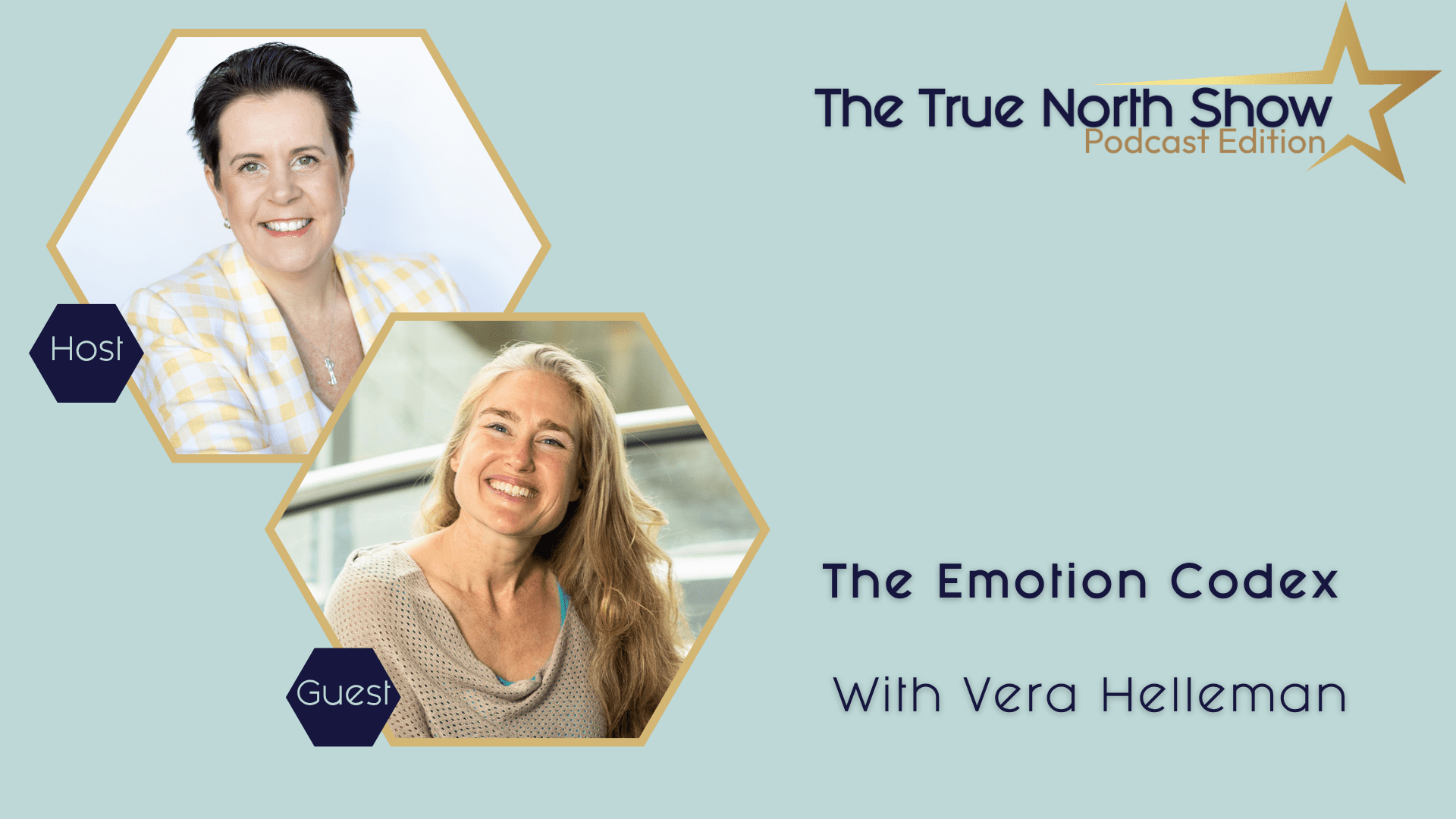
The Emotion Codex with Vera Helleman | Ep. 46
On this week’s episode of The True North Show I am joined by a wonderful returning guest, Vera Helleman. Vera and I explore everything about emotions, how they show up in your body, how they appear before we even feel them in our body and how we can look at them as gifts of wisdom and what we can learn from them. I love Vera’s perspective that our emotions aren’t here to be ignored or swept under the carpet, they are here to guide us and once we can understand them, our lives completely shift.
Bio:
Vera Helleman is a teacher, speaker, and founder of The Emotion Codex, a transformative body of work dedicated to restoring the role of emotions as a guiding intelligence in human life. With a background that bridges practical experience, deep inner inquiry, and energetic awareness, she has developed a unique approach that invites people to relate to their feelings not as obstacles, but as precise signals within a living system of consciousness.
Her work centers on a simple yet radical premise: emotions are not random, personal disturbances to be managed or suppressed, they are expressions of an underlying energetic order. When understood correctly, they reveal how reality is being perceived, interpreted, and created. Through this lens, Vera offers a framework that moves beyond traditional psychological models, pointing instead toward a direct, experiential understanding of how feelings, awareness, and energy interact.
As the creator of The Emotion Codex, Vera has mapped emotions into eight distinct groups, each representing a specific movement within the human experience. These groups are not categorized in terms of “positive” or “negative,” but as functional expressions within a dynamic system. Her work helps individuals recognize the intelligence within their emotional responses, enabling them to move from resistance and confusion toward clarity, alignment, and creative flow.
Vera’s work also extends into the domain of energy mastery, where emotions are understood as entry points into the broader dynamics of creation. Here, she explores how awareness and energy move together, and how this movement shapes both personal experience and external reality. This perspective forms the foundation for her ongoing development of advanced teachings and programs.
At the heart of Vera’s approach is a respect for the intelligence of the individual. She does not seek to position herself as an authority over others, but as a facilitator of insight – a voice that helps articulate something people can recognize within themselves. Her work invites a shift from seeking answers externally to discovering a deeper inner coherence.
Through her teaching, she aims to contribute to a broader shift in how emotions are perceived and valued, not only as personal experiences, but as essential components of human intelligence and collective transformation.
Social Media:
- Website: https://emotioncodex.com/
- Facebook: https://www.facebook.com/verahelleman/
- Instagram: https://www.instagram.com/verahelleman/
- LinkedIn: https://www.linkedin.com/in/vera-helleman/
Transcript:
[00:00] Megan North: Today I am joined by a wonderful and returning guest, Vera Helleman. Vera is a teacher, speaker, and founder of the Emotion Codex, a transformative body of work that restores emotions to their rightful place as a guiding intelligence in human life.
Rather than seeing emotions as problems to be fixed or pushed aside, Vera invites us to understand them as precise signals that reveal how we are perceiving, interpreting, and creating our reality. Her work is built around the idea that emotions are not random disturbances, but part of a deeper energetic order.
Through the Emotion Codex, she has mapped emotions into eight distinct groups, giving people a practical framework for understanding the intelligence within their emotional responses and moving toward greater clarity, alignment, and flow. Blending non-dual philosophy with grounded experiential teaching, Vera encourages people to explore their own inner experience rather than simply adopting beliefs.
Through her Emotion Mastery Program, live events, and writings, she helps others build emotional awareness, authenticity, and inner stability. Vera’s work speaks to those who want a deeper, more conscious relationship with themselves and a more meaningful way to understand the role emotions play in life, leadership, and transformation.
Vera, welcome back to the True North Show. I’m thrilled that you’re here with me again today.
[01:47] Vera Helleman: Me too, actually. Thank you for having me.
[01:50] Megan North: You are very welcome. Vera says that your emotions aren’t random at all. They’re intelligent signals showing you exactly how you’re creating your reality. Stay with us because after this quick commercial break, she’ll share how understanding your emotions can unlock clarity, alignment, and real inner power.
Welcome back to the True North Show. I am here with Vera Helleman, founder of the Emotion Codex, whose work helps us see emotions not as obstacles but as intelligent guidance.
Vera, you describe the Emotion Codex as a living language of energy. What does that mean, and how is it different from how we usually understand emotions?
[03:25] Vera Helleman: Well, first of all, most people experience emotions physically. And eventually they do penetrate the body, but emotions start energetically. When we become aware of those energetic movements at an earlier stage, before they have already reached the body, we can also see earlier where we are off or out of balance. We can sense when something is happening beneath the surface that we may not have noticed on a mental or conscious level.
It also means this: we all know a lot about the body, we know a lot about the mind, and we are busy raising our consciousness. But emotions are still these nagging, unwelcome things that throw us off, things we want to get rid of. Through our emotions, however, we can learn to understand the energetic templates that actually carry this whole reality. That is what I find most fascinating about our emotions. They are an entrance to a whole new and different world.
[04:49] Megan North: Yes. And the way we respond to our emotions, the way we deal with them and experience them, is that something we’re taught as we grow up? Do we absorb it from our parents, or is it a DNA thing, or is it a little bit of everything?
[05:11] Vera Helleman: Energetically, we are all connected to each other, so we are also affected by each other. That is one thing that influences our emotions, and it is a fundamental principle of the energetic world.
But emotions are also responding to what we believe. When we believe we are not good enough, or that we are being rejected, criticism immediately evokes an emotion, a kind of internal contraction in our system. We can inherit that from our parents because they criticise us, because they criticise themselves. We learn to criticise ourselves. Then we develop inner voices, which started as outer voices, and our emotions respond to those beliefs.
So our emotions are not something we inherit from our parents. It is the beliefs we inherit that our emotions respond to, and of course the way our parents coped with their own emotions. When we look at the generation of our parents and their parents, they all tended to suppress emotions. Don’t talk about it. Don’t show it. Sweep it under the carpet. Most people have not learned to deal with emotions in a healthy way. But fundamentally, the energetic movements are the same everywhere, in every culture, all around the world, even in animals.
[06:57] Megan North: I remember when we spoke last time, you gave me an example involving a goat?
[07:08] Vera Helleman: Yes, it was. And I also remember that I mixed up the kilos and the pounds. It was actually a 160-pound goat. We sold her eventually.
[07:24] Megan North: Can you give an example, something from a client experience or from your own work, that would give the audience a little more understanding of what you’re explaining? I understand it because I work as an energetic healer, but I think for someone hearing this for the first time, an example always helps.
[08:00] Vera Helleman: Yes. Let me give you a quite breakthrough example, and that’s about anger.
When you look at anger, it feels as though your fists are clenched and you want to lash out at someone else. But when you look at the energetic evolution of anger, at how it first starts, the energy is actually not outward at all. It is inward.
That is because before we got angry, our energy was scattered, divided, or pulled toward something in the outer world. So anger is something that most people hate, don’t understand, or won’t accept. But when you understand that anger arises to help us regain and re-centre our energy because we have spilled it somewhere else, the process of getting angry is actually a good thing. It is retrieving your energy from where it was dispersed.
[09:28] Megan North: Wow, that’s a fantastic example.
[09:33] Vera Helleman: Yes, because it is all about energy. Emotions serve partly to restore your balance continuously, because they are also responsible for your vitality and your energetic field. Emotions are the language of the energetic part of you.
[10:03] Megan North: When you talk about energy going out and needing to come back, I do a lot of work with clients around boundaries, energetic boundaries around who you are, your belief systems, your values. Does that tie into this? If you have strong boundaries, can that help you emotionally?
[10:37] Vera Helleman: Yes and no. When you have strong boundaries on a mental level, things actually become more difficult. People with rigid mental frameworks of right and wrong, of what they should and should not do, live in a very contracted way. Everything outside of that view is threatening, and that actually evokes a lot of emotions.
But when we speak about energetic boundaries, that is a different thing entirely. That belongs to what I call the emotion group of disgust and aversion. Energetically, you immediately feel whether something is feeding you or draining you. That is a real boundary. You can sense it. And when that boundary is crossed, you feel that something is off.
[12:31] Megan North: That’s a perfect example of what we experience when we spend time with someone who drains us, versus someone who lifts us up. We say here in Australia that someone really fills my cup. I think that’s a good example of the energetic difference you’re describing.
[12:31] Vera Helleman: Exactly. And in this world we have all these social rules that keep us in the company of draining people, because we feel we need to be polite. But when you find people on your wavelength, they amplify your essential energy. That is what those people do. They resonate with you, and that resonance is amplifying.
[12:58] Megan North: I love that. So many people approach emotions as something to manage or heal. You approach that differently. What is the shift?
[13:20] Vera Helleman: When we talk about healing, there are two parts. One is looking at things differently so you can make peace with what happened. The other is the energetic release, which is pure energy work, rebalancing the system.
But working with the Emotion Codex gives you something more. It gives you insight not only into the pain and the beliefs that aren’t aligned with your true essence, but also into the true purpose of the emotional forces themselves. They are here to give you something.
When you feel negative emotions and you tune in to that emotion as if it were an external messenger, you begin to understand why the emotion is hurting you. Not only because the feeling is painful, but also because you are ignoring or rejecting the gift it carries. That is what the Emotion Codex can truly offer. Understanding those forces can uplift your life in ways that only deeply conscious people have tended to experience.
[14:57] Megan North: For people like me who need to understand the why, the Emotion Codex gives you that insight. Once you understand what the emotion is offering, I imagine that also helps you understand and integrate it.
[15:48] Vera Helleman: Yes. You know, I have many students who dive deep into their stories. What happened, why it happened, what message there is to receive from it. And they can get completely caught up in those stories, and it can become a never-ending process.
The Codex gives you the energetic logic underneath all of it, and that goes beyond the story. Take the anger example. You can get angry at a person, you can explore why you stayed in that situation, and on one level that matters. But understanding that your emotions are helping you restore your balance, and that someone on your path helped activate that anger because you needed to re-centre your energy, makes the other person’s behaviour far less central. You can almost thank them for it.
[17:19] Megan North: Yes, and the story is so interesting in relation to healing and emotions. Often the story is the thing we benefit from holding on to. But if you remove the story, you have to take more ownership. You can’t blame the story anymore. You have to ask: what is this emotion and why is it here?
[17:54] Vera Helleman: Yes, they all work together. I have a model I work with. This is part of the Codex. These are the four fundamental forces on which the entire universe is built, and you see them reflected back in everything in our lives. In simple terms, this is our mind, our thoughts. This is our body. These are our feelings. And this is our consciousness.
What we are always looking for is how they come together. For example, something happens in our life, we make a conclusion about it, and if that conclusion is not aligned with our true essence, our emotions respond. Let’s say someone is depressed. We feel our energy is being drained and we blame that person. Or we blame ourselves for staying too long. And so we get increasingly reactive. Most of this happens automatically. These are unconscious patterns. So we have to break the loop somewhere. That is where consciousness comes in.
Our emotions always reveal what we truly believe, not what we think we believe. We can think differently from what we actually believe at a deeper level. And that is why it is very hard to sweep emotions under the rug. They will eventually surface. They are mediators between our conscious mind and what is happening unconsciously within us.
[20:47] Megan North: A good example of that would be when someone says something and the other person doesn’t respond in words, but you can read their body language immediately. The true self has reacted even when no words are spoken.
[21:26] Vera Helleman: Yes, exactly. And they have probably made an assumption that may not even be true. We all live inside our own story. We are often trapped in it. And that is why we sometimes feel negative. We are caught in our own narrative, trying to solve things in the outer world when the work is actually on the inside. Our emotions are the guide that show us what’s really going on, because each emotion teaches us something different and asks something different of us.
I have divided all the emotions into groups, and they correlate to life themes. They are actually an inner roadmap for understanding life and for bringing the best out of yourself.
[22:15] Megan North: And that was exactly what I was going to ask next. You’ve mapped emotions into eight groups. What became visible to you when you started to see emotions in that structured way?
[22:35] Vera Helleman: It was mind-blowing when I started to see the different structures and how they interacted. I had always thought in terms of three, the holy triangle, mind, body, soul. But then I began to see that everything contains four principles. And with emotions, there are eight different groups, but they speak in pairs. Each pair relates to one of the four fundamental forces of life: the force of oneness, the force of information, the force of interconnection, and the force of motion. You see these in everything.
When I started to dive into the emotions through this lens, they gave me insight into the energetic principles that underlie the physical world. When they revealed themselves to me, I saw all the magic in the world again. I could see that everything was built on the same principles. The magic amplified in my perception, but it also became deeply logical, understandable, and reassuring.
[24:03] Megan North: And I remember from our last conversation that this came through as direct downloads, and not even in English.
[24:17] Vera Helleman: Yes. That was the strangest thing. It started with one enormous bubble of information. I understood what it meant, but I could not produce it with my mind. That was deeply uncomfortable. The ground was shaking beneath me because I could see the universal structures and understand their meaning, but I could not bring them into language. That process took several months.
I saw all these symbolic structures of moving energy. My head was exploding with puzzles. So I started drawing all these symbols. I started recognising them. I knew these symbols, but I did not know what they said. I looked them up and they did not quite match what I was seeing. So I stayed true to my own experience, because it was so clearly rooted in something beyond what I could have invented. And then I began to understand that all these symbols were connected to each other and had been left to us in ancient times as a record of energetic understanding. That knowledge had simply been forgotten over the centuries.
All the symbols that we use differently in different traditions are interconnected. They all speak about the same thing: the energetic structure of the universe. Through our emotions, we can receive and translate that structure into something tangible and recognisable for everyone, because we all experience it through our emotional lives. You don’t have to be psychic or especially sensitive to access this. We all experience it through our emotions.
[26:47] Megan North: And I love that the symbols were part of what came through for you, because for someone unfamiliar with this kind of work, having something tangible and visual is a real gift. It helps you explain the work and the emotions themselves.
[27:21] Vera Helleman: Exactly. And we are all equipped for what we need to do in life. I was born to teach people about energy through emotions. So I received the psychic ability, the artistic, structured mind, and perhaps the right personality to carry it. We all receive what we need to fulfil our purpose.
[27:51] Megan North: Beautiful. So why do you think so many personal and societal problems are connected to a disconnection from feelings?
[28:01] Vera Helleman: When you look at society, there is a huge lack of understanding of feelings. We are in a deeply intellectual era. And now with AI and the relentless mental stimulation around us, I see how we are contributing to the destruction of this planet, all because we haven’t integrated the force of interconnection.
Looking at the model again: information, motion, oneness, and interconnection. The force of information is science, intelligence, the pursuit of knowledge. The force that points upward toward higher consciousness may correspond to what some call religion or spirituality. But this fourth force, feeling, the force of interconnection, this is the one that is left out.
And interestingly, many people who are very conscious can still be quite undeveloped in feeling. I used to assume that high consciousness automatically brought emotional intelligence. That is simply not true.
When you look at this planet, it is feeling that connects us all. And in a practical sense, the moment you actually share what you are feeling, without wanting to fix it or be advised on it, that is where real connection happens. And everyone is so scared of that. But we all long for it.
[30:21] Megan North: Yes. I always think it’s telling when you ask someone “how are you?” and the answer is always “I’m fine.” With a couple of close friends and my business partner, we have an agreement. That answer is not enough. We ask: how are you really?
[30:55] Vera Helleman: But most people are afraid of such a question. Don’t reach into my soul. Stay out. It can feel like a real threat when someone genuinely wants to know.
[31:04] Megan North: About 18 months ago I wrote a research paper on mental health and wellbeing in the IT industry in Australia and New Zealand. When I spoke with leaders, CEOs, and executives managing large teams, what I found was interesting. It wasn’t that they feared asking their employees if they were okay. What they feared was: what do I do if someone says they are not okay? How do I respond?
And I think that’s true for many of us, especially around mental health. If you haven’t experienced it personally or been close to someone who has, the fear of not knowing what to do can stop you from asking at all.
[32:41] Vera Helleman: Yes. And perhaps also because we don’t know how to respond to our own unhappiness inside. They are all left-handed, so to speak, when it comes to coping with negative emotions. If I can’t even handle my own, how do I handle someone else’s? And so the loop continues. No sharing. Masks worn. Everyone saying “I’m fine.”
[33:12] Megan North: Yes. So what do most people misunderstand about emotions? And what changes when someone truly starts to understand them rather than simply reacting to them?
[33:44] Vera Helleman: Well, the first misunderstanding is that people identify completely with the emotion. They say: I am angry. I am sad. I am disappointed. There is no distance. They are inside it with no perspective.
Because of that, there is no consciousness in the response. We need to understand that we are not our emotions. Emotions are experiences that give us advice. We can consult our emotions, rather than being driven by them.
There is also a deeply mathematical logic underneath emotions because they are energetic. Their speed is faster than our physical responses. This means that many things we feel we need to act out in the outer world can actually be resolved in the inner world first, and that changes the outcome completely.
When I first started teaching about emotions, the most common reaction I received was: how do I get rid of them? Everyone wanted to remove them. But emotions are fascinating. They are important. They are enriching. We all want to feel happy, and happiness itself is an emotion. You don’t want to get rid of emotions. You want to understand and integrate them. They are your energetic vitality.
When you balance all the emotion groups, they begin to work together as a kind of energetic system. That system keeps you healthy, keeps you vital, and provides all the ingredients needed to attract a life aligned with your true essence.
[37:02] Megan North: So if we talk about emotional mastery, what does that actually feel and look like in daily life?
[37:27] Vera Helleman: Each of the eight emotional groups contains positive as well as negative emotions. They correlate to life themes. When a life theme is out of balance, that corresponding emotion responds. The more we are misaligned, the more negative those emotions will be. As we learn to understand and work with them, we can raise ourselves up that ladder within each group and find more peace and calm inside.
But what we can also do, when we truly understand these forces, is amplify them. When all eight groups are raised and working together, they amplify our energy. That becomes an attracting quality. It gives us not only unconditional love, but clarity, an adventurous mind, determination, focus. At the top of that ladder, when they are all working together, you can create the life you were born to live.
You need intention. You need ideas. You need focus. You need the energetic carrying field. You need determination to produce something in the outer world. All those forces are needed in the act of creation.
[39:30] Megan North: So is the mastery partly about the pause? Recognising the emotion, observing it, and then working with it rather than being swept away?
[39:59] Vera Helleman: Yes, and that process becomes quicker and quicker over time. In the beginning, when you are learning the language, when an emotion appears, it is an alarm bell waking your consciousness. You stop, you consult the emotion, you understand what it is pointing to, you know the message, and you know how to resolve it.
It can feel like a process taking a few minutes at first. But as you work with it, you begin to understand that life isn’t so bad, and that very little is random. You begin to realise that you actually drew certain experiences toward you because you were already aware of something in your energetic inner world at an earlier stage.
The more you work with your emotions, the more you resolve old pain, and eventually you live a life that is more aligned. An aligned life does not evoke as many negative emotions. And when something does arise, you catch it much earlier. You sense the discomfort and realign before it spirals. You are far more centred, far more of the time.
[41:27] Megan North: Amazing. And how can people connect with you and learn more about the Emotion Codex?
[41:44] Vera Helleman: I don’t work one-on-one in the traditional sense, but within the Emotion Mastery Programme there is a great deal of personal interaction. The programme runs for nine months, with access for a full year. It includes courses that explain each emotion group, and those courses are also a healing process in themselves. We confront, teach, heal, and uplift.
During that time, I am present four times a week in live sessions. Anyone can raise their hand and have a direct interaction with me, while others in the group are also present and learning. You meet people on your own wavelength. It is a very practical platform shaped to benefit all kinds of learners.
[42:42] Megan North: And for someone just starting out, can they step straight into the programme?
[42:56] Vera Helleman: Yes. You can start today, actually. You would book a call with me first, and there is an onboarding process. Everyone who is an active student has access to everything within the year. You also learn from the stories of others who are further along, or you gain new angles on things you have already moved through yourself.
We all have our own pace. I moved away from strict group structures for that reason, because it created too much pressure. But we are still a group because we are in this together.
[44:14] Megan North: Wonderful. Now I want to ask about something I mentioned in your introduction. How does your work relate to spiritual awakening and non-duality?
[44:31] Vera Helleman: That’s a real question.
I was originally a psychotherapist, so that was all about the human mind. Then I had one of those experiences, the experience of oneness, and what fascinated me was that in that state there were simply no scars. No emotional triggers. I was completely beyond them.
That led me down that path. But then a voice came through telling me to write about emotions. And what I discovered in creating the programme and working with students was this: the law of attraction, the physical world view in which we set goals and build our lives, and non-duality, which says we have no free will, always seem to contradict each other. But I found they are two sides of the same coin.
Only because I understood both sides could I see the whole picture. Because emotions are energy, and they reveal how this life actually unfolds, whether we have free will and on what level. Emotions are not only psychological instruments. They speak to something much larger.
We are all connected. So we are something like a great root system. And when we truly live from ourselves, from the inside out, the energetic field moves outward and inward at the same time. In that way, we take care of ourselves and the whole system simultaneously. We are living our individual life while also being part of something much greater. All of that is woven into the principles of the Codex.
[47:52] Megan North: And what is the difference between emotions, feelings, and intuition? Are they different?
[47:52] Vera Helleman: Yes, totally different, although in approach they are not so far apart.
At the physical level, we experience emotions as instinct. The primal fear at the top of a building. At the mental level, emotions give feedback to our beliefs, they respond to what we have concluded about life. At the energetic level, we feel what I would call feelings, the pure energetic vibrations we sense when we come close to people or situations. And when insights from higher consciousness speak through those feelings, that is what I would call intuition.
They come from different levels of existence. But none of them is more important than the others. Many people think intuition and feelings are elevated, while emotions belong to the lower self and should be removed. That is not true. Emotions bring to light all the misassumptions we carry as human beings. They are just as important. They simply teach us different things about life.
[49:27] Megan North: That’s a beautiful way to frame it. I’ve been asked that question before and I was never quite sure how to answer it. I might borrow that one, thank you!
I can’t believe we only have a couple of minutes left. I feel like we’ve only been talking for five minutes. So, the final question I ask all my guests, slightly tweaked because you’ve answered the original version before: what is one lesson or truth you have learned in the last twelve months that you are truly grateful for?
[50:20] Vera Helleman: What I’m grateful for is something very practical, because once you understand life, your most important lessons are about simply being human.
I knew I needed to share my purpose in English, and that was daunting. I am a rural girl from the Netherlands. I am not a natural traveller. But what I have learned through meeting people from all around the world, from every religion, every background, is that inside, we are all the same.
All the same.
And when I say that out loud, it genuinely moves me. Because there is so much misunderstanding in the world, so much belief that we are fundamentally different from each other. At the level of emotions, we are not. We are all the same.
[51:22] Megan North: I felt that when you said it. What a beautiful way to close our conversation. Thank you, Vera. I’ve loved our time together again today. I feel truly grateful to spend this time with you and learn more about your incredible work. Hopefully we will have you back again in another twelve months to hear more.
[51:55] Vera Helleman: I really wouldn’t mind at all.
[51:57] Megan North: No pressure! But thank you so much for being here today.
[52:05] Vera Helleman: I was happy to be here. Thank you too.
[52:08] Megan North: And thank you to all of my wonderful and dedicated audience, supporters, and sponsors. I hope everyone has a beautiful rest of the week, and I look forward to seeing you all again next week. Thank you so much, Vera.
[52:24] Vera Helleman: You’re welcome. You too.