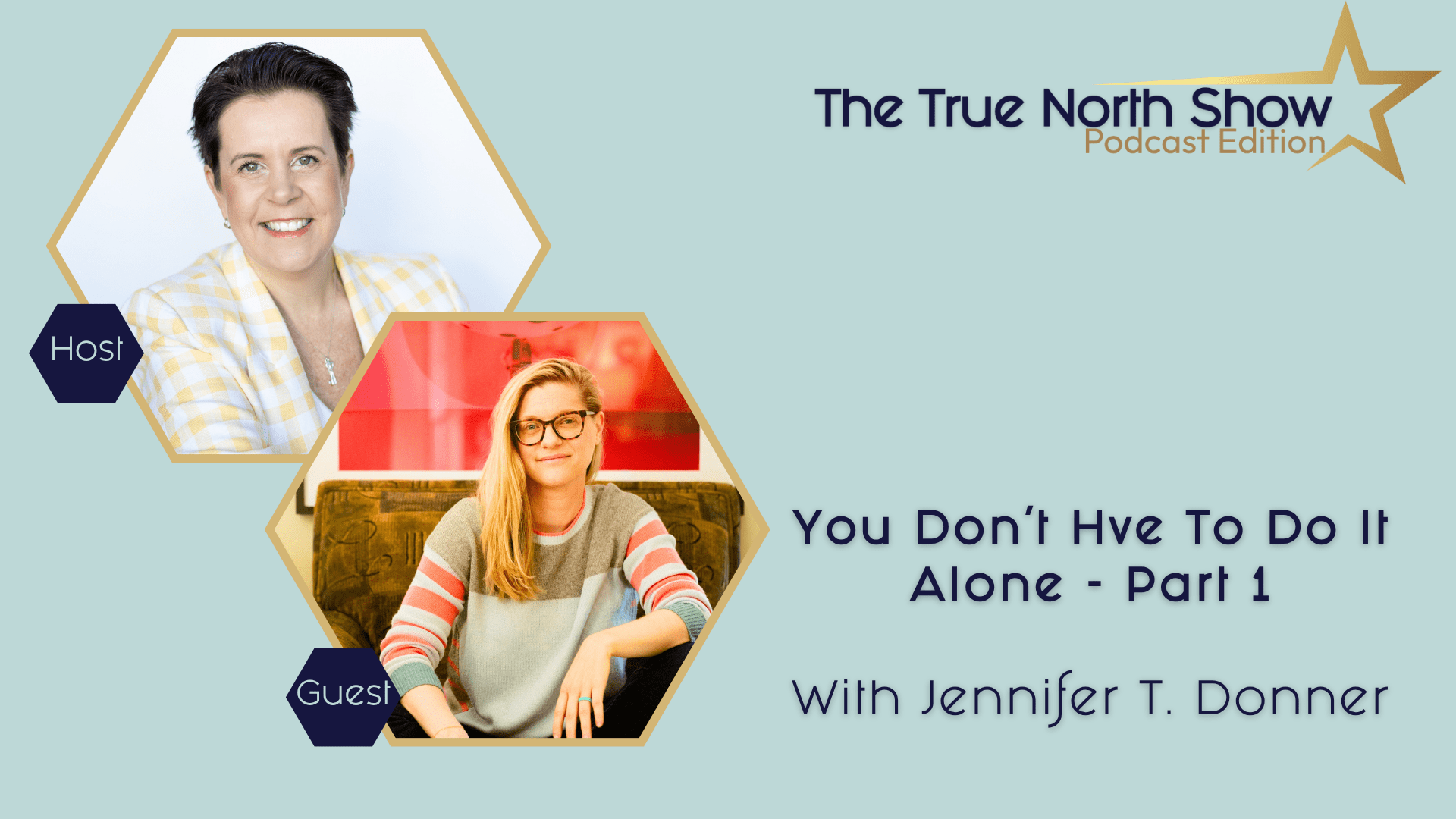
You Don’t Have To Do It Alone – Part 1 with Jennifer T. Donner | Ep. 54
On this week’s episode of The True North Show I am joined by Jennifer T. Donner, a woman who I’ve only met recently but someone I connected with in the first few minutes of chatting. Jenn shares her journey over the last couple of decades and how particular moments in her life really challenged her and gave her the opportunity to look at things with a different perspective, to do the inner work and to grow on a personal and professional level. Those moments have led her to be in true alignment, to be working in a more purposeful way and to be living her True North. This is the first part of Jenn’s journey and she will be sharing more in another episode later in the season.
Bio:
Jennifer T. Donner is a mindset and empowerment coach for women who’ve hit that “enough is enough” moment – tired of feeling stuck, behind, or secretly like they’re failing at adulting, even when life looks pretty okay from the outside.
Jennifer T. Donner, a mindset and empowerment coach for women who have hit that ‘enough is enough’ moment, the women who are tired of feeling stuck, behind or secretly feel like they are failing at adulting, even when life looks pretty okay from the outside.
She doesn’t just understand that feeling she lived it in her twenties. Jenn had the steady job, the long-term relationship, and the support system, all the things that were supposed to add up to a good life. But beneath the surface, she felt anxious, stressed, and quietly depressed, constantly wondering ‘is this really it?’
A pivotal wake-up call became the beginning of a very different path. For the first time, Jenn stopped trying to figure everything out alone and opened herself to therapy, coaching, and deep inner work. What followed was a gradual and powerful return to herself built on honesty, self-compassion, and a willingness to question the stories that had been running her life.
That journey led Jenn to her true north helping other women find their way back to themselves. She works with women who are done suffering and ready to trust themselves, reconnect with who they are, and feel genuinely excited about what is next.
Her work is rooted in the belief that nobody teaches us how to navigate the mixed bag of emotions that comes with the ups and downs of life – and no one should have to figure it out alone. Her style is warm, playful, and disarmingly honest, she normalises the hard stuff and creates space for women to feel less alone.
When she’s not coaching, you’ll find Jennifer puzzling, rock climbing, kayaking or exploring new creative adventures with her photographer and filmmaker husband, Miguel, while co-parenting their very opinionated cat, Sami.
Social Media:
Website: https://www.livelovelifenow.com/
Transcript:
[00:34] Megan North:
Hello and welcome to the True North Show. I’m your host Megan North, and I’d like to start by thanking the sponsors of the show: Quantum Awakening, Beth Lewis, Anne C. Clarke, and my lovely guest who paid to be featured today.
Today I am thrilled to welcome Jennifer T. Donner, or as I’ll be referring to her, Jen. Jen is a mindset and empowerment coach for women who have hit that enough is enough moment. The women who are tired of feeling stuck, behind, or secretly feel like they’re failing at adulting, even when life looks pretty okay on the outside. She doesn’t just understand that feeling. She lived it in her twenties.
Jennifer had the steady job, the long-term relationship, and the support system, all the things that were supposed to add up to a good life. But beneath the surface she felt anxious, stressed, and quietly depressed, constantly wondering: is this really it? A pivotal wake-up call became the beginning of a very different path. For the first time, Jen stopped trying to figure everything out alone and opened herself to therapy, coaching, and deep inner work. What followed was a gradual and powerful return to herself, built on honesty, self-compassion, and a willingness to question the stories that had been running her life.
That journey led Jen to her true north: helping other women find their way back to themselves. She works with women who are done suffering and ready to trust themselves, reconnect with who they are, and feel genuinely excited about what is next. Her style is warm, playful, and disarmingly honest. She normalises the hard stuff and creates space for women to feel less alone.
When she’s not coaching, you’ll find her rock climbing, kayaking, or puzzling alongside her husband and their very opinionated cat Sammy.
Jen, welcome to the True North Show. I’m so excited about our conversation today.
[02:50] Jennifer T. Donner:
I’m so excited just to be in your space. I love it. You put me at ease. I am ready.
[02:57] Megan North:
And is Sammy on the side listening to this conversation too?
[03:02] Jennifer T. Donner:
She is. I’ve given her lots of different plates of food, so hopefully she will not share her opinions. I did my best to anticipate her needs as always. She is seventeen years old. She is our baby. She gets whatever she wants because she deserves it. She’s a little high maintenance as she gets older, so we do our best.
[03:30] Megan North:
Jen had the job, the relationship, the support system. Everything was supposed to equal a good life, and yet something was still deeply missing. Stay with us because after the break, Jen is going to share exactly what happened when she finally stopped trying to figure it all out on her own.
Welcome back to the True North Show. I’m here with mindset and empowerment coach Jen Donner, and we’re about to get into the kind of honest, real conversation that I know so many of you love to hear.
So let’s start with: what does it actually feel like to have everything and still feel like something’s missing?
[05:05] Jennifer T. Donner:
What you alluded to in the introduction was just a tiny bit of what it really felt like. I had a good job, stable, and I was great at it. I had colleagues I enjoyed being around. They relied on me. I had good benefits. I had my relationship. My longtime partner, now my husband Miguel, we met when we were seventeen. In my twenties we’d been together a long time. He was this unshakeable foundation for me. And between him and my identical twin sister who I came into the world with, I really had two people who had my back through anything.
I had a beautiful home. And I was completely unhappy. I knew I had those pillars, but how I felt about everything was really hard. I was suffering every day. I was noticing people around me leaving their jobs, moving on to bigger and better things, getting married, having kids, having these big life milestones, or just seemingly living their life. I genuinely did not feel like I was living mine.
My evenings and weekends were taken up by recovering from the day. As my work became more stressful and I started to realise I’m great at what I do but I’m not fulfilled by it, that freaked me out. Because I didn’t know what I wanted to do. I never had a sense of direction. A lot of my friends growing up had something they wanted to do or study in college. I never had that. It took me until days before the deadline to even decide on a major. I just never knew.
The job I had at the time was the one that sounded most interesting at an entry level. This was the early 2000s, I was flipping through a newspaper looking at job ads, trying to find something that piqued my interest. I just sort of fell into corporate work because it seemed like the standard path. Okay, I don’t have any other desire. I guess I’ll do that. And over time it just started to wear me down.
I felt scared that I didn’t know what I wanted, because it seemed like other people did. My fear was: what if I never figure this out? Is this how life is going to be forever? I kind of resigned myself to: at least I have a job and I can pay my bills. And the other side of that was just depression.
Every moment at work, I’d be having a conversation with someone, engaging with them, but there would be a whole other conversation happening in the back of my mind. Because I’d concluded: I’m smart, I’m creative, I should be able to figure this out on my own. It seems natural for other people to adult, to make choices, to shift paths. So maybe if I just kept thinking about it, yes, I could figure it out. So all day, every day, in the back of my mind, I was investigating, wondering, assessing.
That was the start of my anxiety. For almost twenty years now I’ve struggled with anxiety. That was the starting point, because I was alone in feeling stuck. I felt lonely all the time. It felt like everyone else had somehow figured it out and I’d been left behind. I didn’t know how to catch up. I would spend my free time recovering, or having my sister or my husband talk me through things. I wasn’t even enjoying my life. I had no excitement for the future.
[10:36] Megan North:
Yes. I can completely relate to that, because your story and my story are mirror images in so many ways. That emptiness of knowing you’re really good at your job but it’s almost soul-destroying. And those questions: what am I doing? Is this it? Just hold out another year, because you’re being paid well and you’ve got the benefits. I have no doubt that so many people listening right now are nodding along. We think everyone else has it sorted. But if we took an honest poll of how people actually feel when they go to work each day, I think we’d all be surprised.
[12:00] Jennifer T. Donner:
That is such a gold nugget, because we operate in our own little vacuums. We’re the only one inside our head with our thoughts. People don’t go around having genuinely honest conversations where they feel safe to say how they actually feel. So the comparison is really just to the facades of everything we see, which we know is not the truth at all.
That’s something I’ve grown to understand over time. I have yet to meet somebody who actually feels like they have it together and figured it out. Even people who are experts in their field are still dealing with imposter syndrome. I’ve started to really deepen my understanding of what it is to be human.
[12:55] Megan North:
What a complex job it is.
[13:01] Jennifer T. Donner:
I don’t have it figured out, but I definitely have a better understanding. And it’s allowed me to let go of a lot of the judgments and harsh self-talk, the belief that there’s just something wrong with me, versus recognising that my experience is part of what it is to be human.
[13:22] Megan North:
Yes. And the guilt as well, letting go of that narrative: I’m paid really well, I have so much more than a lot of other people, I should be grateful.
[13:41] Jennifer T. Donner:
I shouldn’t be unhappy. Maybe if I just reframed it, just felt more grateful. But I think over time, and I think you can relate to this, the years just start grinding you down until you realise: I can’t talk myself out of this anymore. Or maybe it’s more accurate to say I can’t talk myself into staying anymore. No, it’s fine. Maybe tomorrow it’ll be better.
[14:15] Megan North:
So what was the pivotal moment that led you to decide you wanted to step out and do what you do now?
[14:26] Jennifer T. Donner:
I’m pausing because there wasn’t a pivotal moment that led me to coaching. The pivotal moment started my inner transformation, which eventually led to coaching. Because what my purpose was, personally, in my twenties and into my thirties, was simply: I just don’t want to be this unhappy. I wanted to stop suffering. I wanted to feel better about myself and my life. I wanted to enjoy my life.
The pivotal wake-up call that you alluded to earlier was inside my marriage. My husband and I met when we were seventeen. We’d been together over ten years, married for a few years. I just never had to worry about him. We loved each other, I trusted him, I just never thought otherwise. And then one day, in a kind and loving way, he shared that he needed some space. That what he could no longer do was keep supporting me the way he had been.
What he could no longer do was pull me out of the dregs of this unhappiness, day after day. I relied on him and my twin sister enormously just to get through. And he had sacrificed a great deal in doing so, his own needs, his career, everything had gone on the back burner.
I was really caught off guard. And I think in the shock, I didn’t immediately become upset. But there was this deep part of me that was grateful and that knew this was a turning point. Like: get the help you need. Because I’d been talking about being unhappy for a while. He had been gently encouraging me to work with someone because he didn’t have the answers. My sister had been seeing a therapist locally. I kept thinking, yeah, I should get back into therapy. But I never took the action.
In that moment I thought: I cannot navigate this alone. There’s no way. And within a couple of days, I was in my first therapy session as an adult who had chosen it myself. I’d been in therapy as a younger person, but that was my mum’s doing after my parents divorced. This was the first time I raised my own hand and said, I want this.
And it changed everything. That moment to this moment, we’re talking maybe eighteen years, and it wasn’t overnight. I didn’t become a different person the next day. But I finally started seeking outside guidance for what was happening internally, to make sense of it, to understand it, to challenge it. And I’m really grateful.
I knew in that moment, somewhere in my intuition, that this was a blessing. I had felt stuck for so long and everything had looked the same. Now something had changed. And within about a month, we had come back together. He’d moved back home. We still had a lot of work ahead. But the reason we came back together was that even in those few weeks of being on my own and starting the work with a therapist, I had already started to shift. And he started to notice the energy, the sense of myself, how I was moving in the world. And I think it was what he had always wanted for me, first and foremost.
[20:10] Megan North:
Yes. And sometimes we can do a quick piece of work and shift through something ourselves. But there are times when we’re so inside our own experience that we need someone else, someone who isn’t attached to us emotionally and who we’re making an investment with through an exchange of money, to offer a completely different perspective. Sometimes someone will say the one thing in five minutes that shifts everything, precisely because they can see what we cannot.
[21:25] Jennifer T. Donner:
I totally relate. I often say I need someone like me, for me, to sift through the muddy water to clarity. Because it’s what I can now do for others, because we’re not attached. We can see what they cannot, because they’re so emotionally wrapped up in their experience.
If I get really activated, I do have all these tools I rely on now. But every once in a while I still do seek outside support. I continue regular therapy. I maintain a network of people around me. I never went back to believing I could do this alone. I have really cherished the community I’ve found and cultivated, people I can go to whether or not it’s a paid service.
Because we actually were never intended to do life alone. When we leave ourselves to our own thoughts and don’t share or lean on others, which I understand can feel very scary and vulnerable, it can become very lonesome. And nothing I’ve learned over all these years was intuitive. It was never just delivered to me. I sought it out. I put myself out there. I had conversations. I asked for support.
Here’s where I’m feeling stuck and I’m not okay with that. What am I not seeing?
[23:30] Megan North:
And it’s also really important for those of us who coach others to still be getting coached ourselves. I want to constantly level up, to keep growing and learning about myself, so that it trickles down to my clients, to the people who love me. I’m on a constant journey. And so it’s really important that we’re walking the talk. If someone said to me, I don’t need a coach anymore, I’d think: well, you’re not the coach for me.
[24:14] Jennifer T. Donner:
Exactly. It never ends. And I do sometimes hit a wall where I wish I could be done. Just check the box. But I can’t. In this life I am a sponge and I enjoy learning. Once I’ve worked with a blind spot and developed some capacity around it, it just reveals the next one. I’ve heard that transformation is a mountain with no top, and I completely agree. There’s no finish line here.
[24:57] Megan North:
But I find that the more inner work you do on yourself, the quicker things actually shift, because all that deep, heavy early stuff is already done.
[25:19] Jennifer T. Donner:
That has been one of the greatest blessings. The amount of time I’ve gained back over the years is remarkable. When I was in my corporate job, if something happened that really set off some past baggage with someone, I could genuinely lose an entire weekend mulling it over. I don’t do that anymore. It is night and day. And I know I can get even more facile with it, because life keeps handing me opportunities to sharpen that muscle. I’m grateful for the opportunities. And sometimes I’m like: I’m good. Can I just have a month off?
[26:23] Megan North:
So how does mental health and wellbeing play a part in your life now, and has it evolved over time?
[26:43] Jennifer T. Donner:
It is night and day. In my twenties, when things really started getting hard, I had no concept of what mental health and wellbeing meant for me. I knew therapy existed, but there was never any importance placed on it. In seeking out help, programs, coaches, mentors, therapists over the years, I’ve created this whole toolbox of mindset and wellbeing tools that support me consistently. But I had no relationship with any of that before.
And I think that is a huge missing in the world globally. Ever since I started doing this inner work and seeing how understanding what it is to be human, unpacking my experience and getting freed up around it, I would think: why is this not taught in school? This is the most important thing you could teach someone. How to actually get through life. How to navigate the ups and downs. We are not taught.
Years ago I had this thought: there should be a Life 101 course. And where I am now, thinking about how I can give back on a larger scale, it comes from this place of: we are doing a disservice to people. Nobody should feel the way I felt for so long. Nobody should feel alone, stuck, unsure if there is ever going to be a way out.
My mental health and wellbeing are in a drastically different place today. I feel really confident that I can navigate what comes up. It doesn’t spiral me out anymore. I have a fortitude within my mindset that I feel genuinely grounded in. I feel safe internally. I did not feel that before.
[30:22] Megan North:
I often wonder, when I review what’s happened in my life and the times I’ve been in really dark places, what would my life look like if I’d never been through that? At the time you’re thinking: really? But now when I reflect back, I think: if I hadn’t been through that, I might feel very differently about this. It’s an interesting thing to sit with.
[31:14] Jennifer T. Donner:
You could get so deep in that. I look back now and realise everything happened exactly the way it was supposed to. And it was hard for a really long time. But even when it was hard, I would have these moments of clarity, maybe intuition. Like I somehow always sort of knew what was ahead without clearly knowing what that was.
I used to tell myself: if this is happening so that it can help somebody in the future, or if there’s some purpose behind it, I’m okay with that. And I think that idea helped me every once in a while. But when you’re really deep inside of it, it’s hard to see any way out. It’s only in looking back that things line up. I used to think my life was so hodgepodged and untraditional and weird, and I didn’t know how it was ever going to sort itself out. And now there’s a definite sense of: okay, I get it, universe. You knew what was in store. There were things I needed to move through in order to be here and to really help people.
[32:46] Megan North:
Yes. I have a deck of Oracle cards behind me, Work Your Light by Rebecca Campbell, and one of the cards says: this is happening for you, not to you. It’s a really interesting card to receive because it completely shifts the mindset toward wisdom rather than victimhood.
[33:15] Jennifer T. Donner:
Over just the past year or so, I have anchored myself into that belief. I’ve fully released myself into the hands of the universe. Having that trust that no matter what comes up, it’s happening for me, that it’s a gift and an opportunity, shifts everything. And it really helps when my default patterns want to take me back into victim thinking. I go: no, there’s no victim here. If this is a gift in some fashion, let me reframe and trust. That’s the space I want to live in now.
[34:42] Megan North:
And I’m assuming that the kayaking, the rock climbing, and being outside are really important for grounding and centring you too?
[34:42] Jennifer T. Donner:
Yes, being outside is major for me. I live in Virginia, just outside Washington DC, and the older I get, the more I’m yearning for open space, quiet, and nature. It’s becoming much more important to me than I ever realised.
I’m an earth sign, a Virgo, so apparently I love all the elements. I love the sun on my face, the breeze on my skin, being by water, being in nature. Seeing squirrels or any wildlife makes me genuinely happy. I’ll be honest, I don’t get enough of it. It’s something I’m still working to bring more of into my world.
But where I live now, I have a small outdoor balcony and I go out there every single day. Just being in the elements and not inside gives me something. I sometimes describe myself as a sunflower: I just want to turn my face up to the sun and receive the energy. It’s rejuvenating. And moving my body is also very important, especially as I get older.
[37:04] Megan North:
So let’s talk about your work. Why do you think so many women who look fine on paper still feel stuck or lost on the inside?
[37:04] Jennifer T. Donner:
The limiting factor for me was mindset. The thoughts. And it’s why, even before I knew I was going to coach, I came up with the name Live Love Life Now. It became a mantra for me at my most stuck, because as I mentioned, I was not living my life. On Mondays at work, people would debrief about their weekends. I used to dread Mondays because I never had anything to say. The comparison would leave me feeling less than, like there was yet again something wrong with me.
That mantra became something I aspired to: go out and start living now. And what it’s morphed into is this idea that at any moment, we can love our life and live it fully, without any external changes having to happen first. Because so often, the stuckness is tied to believing we can’t get unstuck until something external changes. If only my partner did this differently. If only I got that raise. When we move out of the apartment and buy a house, that will be the thing that changes everything.
I believe mindset is one of the most important things in life. It becomes the source of how life occurs for us, who we are, what we think is possible for ourselves and our future. When I’m working with stuckness in clients, whether it shows up as feeling lost, uncertain, depressed, or just quietly dissatisfied, even though from the outside someone might say they have the house and the career and the family, what’s there to complain about, it’s because external life has no relationship with how you feel on your happiness meter. But there’s a false belief that it does, and it’s reinforced constantly by advertising and social media.
So it’s really necessary to start untangling the internal experience first. Because when you’re feeling stuck and disempowered and frustrated, it’s very hard to create or take action from there. You can’t put lipstick on a pig. If you don’t clean up what’s underneath, it’s really hard to build anything on top of that. I think of myself as a bit of a cleaner, helping people make sense of the internal mess, start organising it, and understand how it’s been impacting everything.
Looking fine and feeling fulfilled are completely different. One is external, the other is internal. And my world is the internal.
[41:29] Megan North:
Yes. And when we do the internal work, the energy shifts and other people feel it. You talked about that, how Miguel noticed within a month. That’s exactly what happens. People feel the shift before we even fully understand it ourselves.
[41:30] Jennifer T. Donner:
Absolutely. If I had to put a label on that energy, it’s that possibility started to show up. More understanding and compassion for myself. I didn’t feel alone anymore. I started to break through the belief that there was something wrong with me. I truly carried that weight for years.
My experience in the details is unique, but it is not rare. And as I started to free myself up and experience more joy, hope, ease, power, and confidence, over time, and I want to be honest: this took a long time, it wasn’t months, it was years. But as I realised it was possible, I wanted to share it. I don’t want anyone else to feel the way I felt for so long. That became my true north. The passion and purpose I always wanted to find came out years after I just started trying to heal myself. It showed up. And it was something I never actually expected to find.
[43:39] Megan North:
I love that. When we find our true north and start following it, everyone around us notices too. Not because of the work we’re doing but because of the alignment. Everything becomes easier because we’re so aligned with why we’re here.
[44:15] Jennifer T. Donner:
Yes. I can feel the alignment with the universe. Things show up. It doesn’t have to feel so hard. I don’t have to talk myself into it all the time, the way I did in those corporate days. And for me, I share my story because I care very much that nobody ever feels alone in their experience.
If you are feeling frustrated, confused, disappointed, scared, you should. And I don’t love that word anymore. But you should, because nobody teaches us how to navigate all the things that give us those feelings and those assessments. Once you start making sense of those internal burdens that are really wearing you down and limiting you, it allows your true north sometimes to surface. Because for me, there was a lot on top of that purpose that needed clearing first. I had to take care of myself before I could help anyone else.
I got closer to thirty and realised: maybe I actually have to actively participate in my own life to have it sort itself out. I honestly assumed as a kid that you just grow up and things happen, you get a job and a house and you get married and have kids. I thought it just happened. When I was approaching thirty with almost none of those things, and honestly not sure I wanted a lot of them, I thought: maybe it’s not just going to click. Maybe I have to be more involved.
Fortunately, my husband gave me the kick I needed. Not in an unkind way, but I got that incentive and that wake-up call to start actively participating. And things had to get hard enough that I couldn’t stay inside myself anymore. Until that moment, I guess it just wasn’t painful enough.
[47:24] Megan North:
Yes. And you mentioned the word should, which is really interesting. My niece, who I’m very close to, would sometimes say to me: Auntie Megan, are you shuddering all over yourself again? And it would make me stop. For me, the mindset shift of changing should to can completely changes the scenario.
[48:05] Jennifer T. Donner:
Yes. Should absolutely needs to be outlawed, the same way certain other words are considered no-go words. The phrase shuddering on yourself can catch people off guard, which is exactly the point.
My therapist many years ago introduced me to the shift from should to could. Just a couple of letters, and it really does alter everything. Because should carries responsibility, burden, expectation, pressure, and a right or wrong built right into it. You either did it or you didn’t, and you should have. But could opens something. It invites rather than accuses.
I look out for that in language because language is powerful. It doesn’t just reflect the world we live in. It creates it. Before I even got into transformation work, people would point out to me all the time: you really talk negatively about yourself. You’re really hard on yourself. They could hear it in my language because it was always the running conversation in the back of my head, and it just came out when I spoke to others.
That doesn’t happen anymore. And I’m really grateful, because I was genuinely mean to myself. I love working with people on catching and reframing that language, because it’s sneaky. I wasn’t even aware. People would point it out and I still couldn’t catch myself. It was completely unconscious, tied to what I believed about myself, which at the time was not very kind.
[50:58] Megan North:
Yes. We judge ourselves in ways we would never judge a friend or even a stranger. It somehow feels easier to be cruel to ourselves than to anyone else.
[51:21] Jennifer T. Donner:
We are not naturally kind to ourselves. And the inner voice, the thoughts, the emotions, those take time and practice to work with. We’re not in control of the thoughts that come to us, but we very much can be in control of how we respond. And the first step to all of that was simply becoming aware that it was happening. Because it was so unconscious, I didn’t know how to look at it differently until I learned.
[52:19] Megan North:
We literally only have a couple of minutes left. So the question I love to ask all of my guests before we close: what is one lesson or truth that you’ve learned on your journey that you wish you had known earlier?
[52:50] Jennifer T. Donner:
I’ve learned that it couldn’t have happened earlier. Even though I sometimes still use the language of: I wish I had found this sooner, I know it couldn’t have happened any other way.
The lesson or truth that I wish I had known earlier, and that I’m really grateful I did eventually learn, and it’s the one I most want to help others learn, is this:
There is nothing wrong.
You are not broken. There is nothing wrong with you. Because deep down, for years, my truth was that there was something fundamentally wrong with me for how I felt, for how I felt about myself. To whoever is listening: if you are struggling, if you’ve ever struggled, if you run into stuckness or challenges, there is nothing wrong with that. You are a perfectly imperfect human being. This is what it looks like to be human.
And here is the thing: every single person on this planet is experiencing this confusion, this journey of how can I be happier, how do I get through this the best that I can. We are literally all doing that every day. So I was not failing. There was nothing wrong. I was not broken.
That is the foundation of everything I do in the world, not only through one-on-one coaching but through everything I’m creating. Because what I love most in my work is normalising wherever someone is. There is nothing wrong in your experience. There is nothing wrong with how life has gone or how you’re feeling. There is literally nothing wrong here. And that can be life-altering.
[55:02] Megan North:
What a beautiful way to wrap that up. Thank you so much for spending this time with me. It’s been really lovely to hear more of your story and your journey. Thank you so much.
[55:07] Jennifer T. Donner:
Thank you for the opportunity. It has been an absolute honour and a gift. To anybody listening: you are not alone. I’m in this with you. And we can do this.
[55:37] Megan North:
And I’d also like to thank all of my amazing and dedicated audience, supporters, and sponsors. I hope everyone has a wonderful rest of the week and I look forward to seeing you all again next week. Thank you again, Jen.
[55:50] Jennifer T. Donner:
Thank you, Megan.