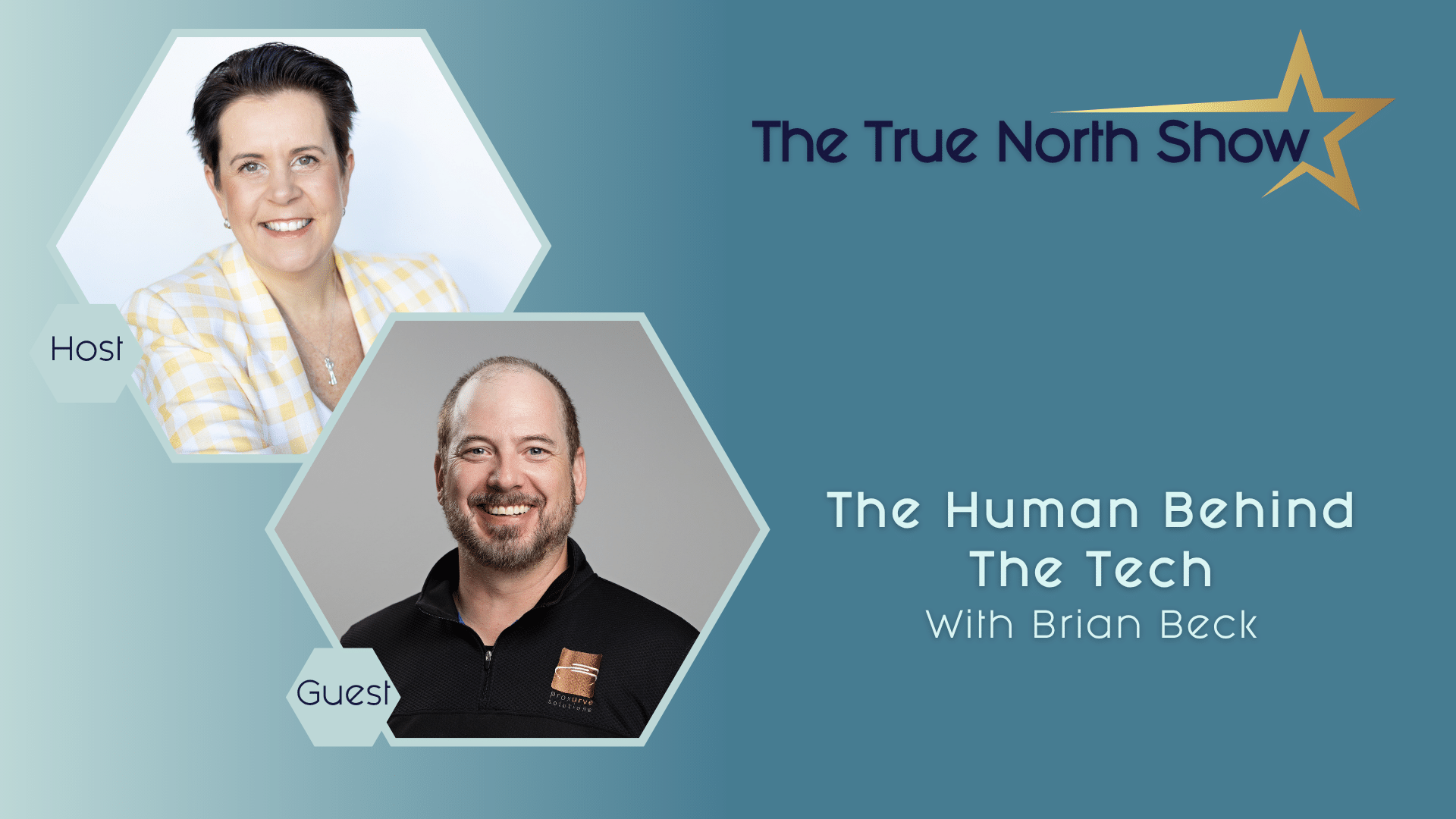
The Human Behind The Tech with Brian Beck | Ep. 64
On this week’s episode of The True North Show I am joined by Brian Beck, an incredible human who brings so much joy to a conversation that could have been too technical and way too boring for some! Brian shares the reasons behind the work he does, what drives him, why his family is so important and most importantly why human connection in a world filled with technology is the key. Brian and I have so much fun in this episode and his joy for life and the work he does is so obvious that you will have no choice but to smile through our episode.
Bio:
Brian Beck helps business leaders turn AI, cybersecurity, and digital transformation into measurable business outcomes.
As a leader at Proxurve Solutions, recognized among the Best of the Wabash in IT Services and named to the MSP501 list, Brian works with mid-sized organizations to improve efficiency, reduce risk, and grow with confidence.
Known for a practical, no-jargon approach, he connects complex technology to executive priorities and helps leaders move forward with clarity, strategy, and momentum.
Brian’s Key Expertise include AI strategy and adoption; Cybersecurity leadership and risk reduction; Digital transformation and operational efficiency; Business growth through data-driven decision-making and Executive technology strategy and innovation leadership.
Social Media:
Website: https://www.proxurve.com
LinkedIn: https://www.linkedin.com/in/brianbeck73/
Transcript:
[00:00] Megan North:
Hello and welcome to the True North Show. I’m your host Megan North, and I’d like to start by thanking the sponsors of the show: Quantum Awakening, Beth Lewis, Anne C. Clarke, and my guest who paid to be featured.
Today’s guest is Brian Beck, a technology strategist and leader at Procserve Solutions, a company recognised among the best in IT services and named to the prestigious MSP 501 list, which recognises the world’s most progressive and forward-thinking managed service providers.
In a world drowning in buzzwords, jargon, and technology hype, Brian has built his entire reputation on doing the opposite: cutting through the noise and connecting complex technology to the things that actually matter to leaders, including efficiency, growth, risk, and results.
What truly sets Brian apart is not the accolades. It is the way he thinks and communicates. Brian works with mid-size organisations to help them navigate three of the most critical challenges facing business today: artificial intelligence, cybersecurity, and digital transformation. And he does it in a way that is refreshingly practical, deeply strategic, and completely free of the kind of tech speak that makes most leaders’ eyes glaze over.
He believes that AI, cybersecurity, and digital transformation are not IT problems. They are leadership problems. And the organisations that understand that distinction are the ones that will thrive in the decade ahead.
I’m so happy to welcome you to the show, Brian.
[01:57] Brian Beck:
Thank you, Megan. I am really hoping I get to live up to that bar you just set for me. I think I’ve got my work cut out for me. Thank you.
[02:06] Megan North:
Just sit there and talk, you’ll be fine.
[02:09] Brian Beck:
I’ll give it a shot.
[02:13] Megan North:
Brian works with business leaders every single day who are trying to navigate AI, cybersecurity, and digital transformation. And what he has discovered is that the biggest barrier is almost never the technology itself. Stay with us because when we come back, Brian is going to share what that barrier actually is and what the leaders who are getting this right are doing differently.
Welcome back to the True North Show. I’m here with technology strategist and leader at Procserve Solutions, Brian Beck, and we are about to have the kind of honest, practical conversation about technology that I think every business leader needs to hear.
So Brian, before we dive in, I’d love to learn more about you and where everything started. Was there a defining moment that led you to pursue this passion, this purpose, this true north?
[04:00] Brian Beck:
Yeah. It was probably a good twenty-plus years ago. I am not going to date myself. But more than likely I’m going to do it anyway, and it’s not going to be intentional. So about twenty-plus years ago I wound up attending an event where Microsoft was coming to town, in Joliet, Illinois at the time. They were talking about this new technology called the cloud.
You can tell when engineers are leading the conversation. They are absolutely brilliant people and they get really excited about the technology and the design work. But how you translate that excitement for a different audience can become complicated. And those are the areas where they thrive.
So I’m sitting in the audience with a couple of hundred people in this hall. They’re doing this presentation, thirty or so slides, with every kind of arrow and pictogram and acronym absolutely everywhere to describe how the technology all comes together. This is going to be revolutionary. And I’m looking around, and a lot of business leaders, some I knew and some I didn’t, were completely blank. Like that look of: what am I sitting through?
And ultimately you start connecting the dots and you realise: it is a secure server over there. It is just not inside my building. That could be that simple. Instead of a two-hour presentation and thirty slides, it could have been thirty seconds: this is why it is important to your business.
And that is when I realised: if I can do that, I think not only can I help other people, it could be a career-launching opportunity. What I didn’t realise was the challenge within the industry is that it is not so easy to be that translator. As technology continues to evolve at the pace that it evolves, trying to keep up with that is pretty challenging. And continuing to speak to leadership about how this stuff relates directly to their business results is a different language.
So that was the moment of: I should pursue this. I continued to invest in education and practice presentation skills. And I was also a musician in the evenings, so getting up in front of people is not something that makes me nervous. I really enjoy it. Being able to combine both sides of that was something that over time continued to evolve and morph and turned me into the man I am today.
[06:58] Megan North:
And were you already in IT when you attended that conference? You were already in that space, right? It was just that defining moment of looking around and seeing the reactions of people.
[07:17] Brian Beck:
Yeah, I’d been in technology for a while. Before that, my dad had started a business, and it continued to evolve organically, from one segment to being invited into a different segment, and just continuing to grow. I started doing education around it and certifications, because in our industry certifications are important. But it is the application to business where you wind up getting lost. The certifications are all focused to the tech, not the tech application to an organisation. So.
[07:58] Megan North:
And is that one of your specialties, one of the things in your personality? Looking at something quite complex and being able to speak to it like you would explain it to a five-year-old. Is that the way you communicate generally?
[08:19] Brian Beck:
Yeah, it is a gift and a curse. I see the complexity and I can just take it and be like: well, ultimately this is all we’re doing. Where people see the complex, to me it is just intuitive.
[08:33] Megan North:
My husband has got a very similar background. He did IT support for a long time. And because he was used to dealing with people on the phone who had no idea about technology, he learned to bring it back to the real basics. So I say to him sometimes: explain it to me like I’m five. And it’s fantastic because I get it straight away.
[09:13] Brian Beck:
Yeah, when you can do that naturally it makes communication so much easier. But in our minds we’re like: how is this not obvious? It should be like that, right?
[09:30] Megan North:
And sometimes I’ll say to him: I’m going to ask you a question and can you just give me the answer today, because I haven’t got time for the twenty-minute explanation. Most of the time I’m glad to go on the journey, but sometimes I just need the answer.
[09:54] Brian Beck:
Yeah. I got introduced to a fine young lady a number of years ago, probably about fifteen to seventeen years ago. I went to work at a different organisation and wound up getting transferred out to Indianapolis from the Illinois area. And there was a young lady inside that organisation who made me realise: oh wow, I see things from a higher level, more opportunity, from up here. I do not see the details down underneath it because in my head it is just intuitive. We go A, B, C, and we are there. But she was like: well Brian, I understand that, but here is the twenty steps under A that we have got to make sure we are checking before we can move to B. And in my head I am just like: how do we not just assume that?
But the more I started working with her to fill in those gaps, the more she understood what I was trying to get done, and the more I understood the steps that sit underneath my thinking. It was a phenomenal complement. I credit her to this day. If I had not had that interaction and had her as a team member for those five-ish years, and now we have a chance to work together again in a different organisation, I would not be in the space I am at the moment. Because she helped me realise the complementary component I need to be successful. We teamed up and did some pretty cool things.
[11:42] Megan North:
What a gift. Absolutely amazing. I love that. And so before all of the technology strategy and cybersecurity, there was music. You mentioned that. So tell us about that. And I’d love to understand how music shaped the way you communicate with people and lead.
[12:19] Brian Beck:
I love that question. I’ve never been asked that before. Exciting stuff right there.
So when I was growing up, I had an Italian side of the family and an Irish side of the family. The Italian side had incredible food and I was so spoiled and didn’t even realise it back in the day. Then we would go over to the Irish side of the family, the big family, and at the end of dinner everybody would gather around a piano and start pulling out instruments and singing.
My mum had an incredible voice. And one of my uncles, his name was Bob, he was so gifted he could literally pick up any instrument whether he had played it before or not. You could hum a bar or two to him and somehow in his head that was just boom, and he was off and running. Banjo, guitar, piano, organ, it did not matter. You would say: hey Bob, can you play this song? And he had never heard it, and you’d hum a couple of bars and suddenly he was hitting it. You are like: how? So I am constantly introduced to this pretty much every weekend, one house or the other.
The music really resonated with me. I loved listening to my little Sesame Street radio, listening to rock, Billy Joel and Elton John and Journey and all those guys when I was a kid growing up. And yeah, I probably accidentally dated myself.
[14:10] Megan North:
My favourites as well.
[14:11] Brian Beck:
And I loved listening to these guys and watching my family perform just for themselves after dinner around the piano. So when there was an opportunity to do orchestra at school, okay. I wound up picking up violin and I was first seat violin for the first two years, but something about it just did not fit for me.
Then I got introduced to the trombone. My teacher at the time, Miss Bressler, she was awesome. She said: you’ve got a personality. She somehow recognised that back in the day. She said: why don’t you give this thing a shot? And as soon as I picked it up I was a big goof, which I still am most of the time. I was like: this is way too much fun. My goodness.
And then I turned out to be really good at it. I won all kinds of competitions. The bands I was in from middle school were winning regional stuff, we were travelling around, getting first place medals for bands and solos and all these things. Winning to anybody feels good, right? And it makes you want to continue to do it.
One night I was doing my chores, taking out the garbage, and I had my Sony Walkman on. And I heard this particular riff from an instrument. I couldn’t place the instrument, but I could not stop listening to it. So as soon as I finished taking out the garbage, I ran inside and said: mum, you’ve got to listen to this. What is that instrument? It happened to be a metal band. And she listened for about two seconds and said: honey, that’s bass guitar. I said: I want that. I want to learn how to play that. I had the tingles. I was so excited.
The next morning she took me to a local place in Niles, Illinois called Minstrel Music. The owner was Mike. He handed me a four-string Cortez bass that was probably as big as I was at the time, and a ten-watt Crate amp. He showed me how to hold it. Within five minutes I said: mum, this is what I want to do. She bought it for me.
Went home to my basement bedroom. I was getting really into Iron Maiden at the time. And I learned the entire album from Somewhere in Time in about the span of an hour. I was like: I need more of this. And I started listening to more bands, and the more I listened the more I could play it. I was thinking about my Uncle Bob. I was like: I’ve got some Uncle Bob in me. This is great.
Within about three months, somebody was like: you play bass. And at that time, nobody wanted to play bass guitar. Everybody wanted to be a drummer, a singer, a guitar player. But nobody wanted to be a bass player. So all of a sudden I start getting passed around everywhere. Hey Brian plays bass. So I caught the bug and I absolutely loved it.
And that also helped me understand, to your other question: when you are engaging with people, are you reading the room? You see when people are completely disinterested, and you’re like: ooh, I don’t want to do that again. But you also see when people get excited, when they start coming up to you after the show. You start to anticipate: I connected with those people, I connected with that person. One band that I was in, I learned a lot of lessons from. Those guys were absolutely incredible and I’m still in contact with most of them to this day.
You said, Brian: it does not matter if we have one person in the room and the only person we are playing for is a bartender, or it is a packed place and we are playing to tens of thousands of people. You play with the same intensity and you bring it every single time. You do not know who is in the room or why they are there, but you give it everything you have got at every single moment and every opportunity you have.
And we did. And I’ll be darned if they’re not right. That applies to every single aspect of everything you do.
So when I am doing a presentation or working on team development or interacting with an individual person, I am always looking for cues: visual cues, changes in tone, how they’re listening, how they want to react, the types of questions they are asking. How engaged are they? Am I connecting? Do I need to change this up? Do I need to lighten it up? And I will make a fool of myself to get somebody to laugh for a second, and I am not above it. Because you wind up connecting with people, the guard comes down, the conversation starts to flow, it is more natural. And then other times you walk in a room and they want the expert. They do not want anyone they feel is goofing around or not focused. So you read those people and you go: here is where I am at. Let us focus to the facts, the business impact, get serious. Let us drive it this way.
Trying to adapt to the different types of rooms you are in. It has translated well.
[21:22] Megan North:
Yeah. I love it. That is reading the room. We call it EQ now, emotional intelligence. But it is also bringing your whole self to whatever you are doing, with a slight adjustment depending on what the room needs. I have a background in HR, so I know what it is like walking into a boardroom sometimes and thinking: okay, I really need to have my A game, my professional hat firmly on. And then walking into another place where they are a little more relaxed and you can be a bit more of yourself.
[22:20] Brian Beck:
Absolutely. I have walked into boardrooms where the group of people are joking around before the meeting starts. Talking about the football game the day before, their favourite team, what the kids did last night. They are loose. And then when it is time for go time, they focus. But at the same time, you have some cues, some points of reference. What is important to them? How can you connect with people you have never met before to break the ice?
And if you are willing to listen and pay attention, you have a way to connect. When you have that opportunity, I do not know why you would not take it. Start to adapt your message, not to manipulate the situation, but to be able to connect with people so that it is a more meaningful conversation with more value added to it.
I cannot tell you how many friendships and relationships have come out of rooms full of people I had never met before. By the time we walked out, it was: we should grab lunch and talk about this sometime. And when you get off site with them, the relationships really develop. But you have also got to realise they are testing you. There is interest in pursuing a further relationship, professional or personal or both. They saw some kind of connection and they want to make sure: are you who I think you are?
So you have got to be genuine at the same time. It is a balancing act. Being able to read the room so you can show them your genuine self without going too far, being respectful within that. And as the relationship develops, all of a sudden you are watching football together and the families are barbecuing.
[24:48] Megan North:
And I love that you use the word connection so many times, because that is what we as humans are craving right now, with so much technology. Because technology cannot do that. Meeting someone in person, giving someone a hug, going out for lunch, that connection is so important to us as humans. And it lands with me as to why the work you do is so successful. Because organisations are filled with people. Organisations are led by people. And we all want connection.
[25:41] Brian Beck:
Right.
[25:42] Megan North:
Beautiful. I love it. And so, technology is your thing. What about you from a mental health point of view? How do you prioritise your mental health? Do you have tools and strategies to switch off?
[26:03] Brian Beck:
It’s called my wife. Keeping me in check.
Family is the most important thing. Even working with the gentleman I have the privilege of working with and the rest of the team, they know: family is first. If my wife needs anything, if there is something going on with my son, and I need to pull myself away, the second I say my wife, my son, they know I have one priority at that point in time.
From there, I like physical fitness. I like going to the gym. I like challenging myself, perhaps a little too much, as my wife keeps reminding me now that we are getting older. And I go: nah, that is not a thing. We are not there. Come on, Brian can still go play football. And then I come limping home and go: you know what, yeah. But I still caught a touchdown and it was glorious. I still got it. I just cannot move for three days.
I also like to be challenged mentally. I have silly games I like to play on my mobile. That is my wind-down at the end of the day. Challenged by things that do not have true consequences but have a different strategy associated to them. I need to build this to be able to survive this, to be able to go up the next level. And I do not like to lose. But I am also a humble loser. When someone takes it to me, I look back and think: how did they do that? What can I learn from this? I always look for the opportunity to learn from something and apply it to other aspects of my life. So I enjoy those things.
[29:00] Megan North:
And I love that you have shared that because it is a question I ask all my guests. I love exploring it with everybody because when we look on social media, we are often being told: you should do this, you should do that, if you are not doing this you are not looking after your mental health. For me it is about what works for you. I had a lady on the show a few seasons ago who said she does not meditate or anything like that, she just loves playing chess. Chess is her thing. And I said: great, because she found what works for her. And I think that is really important. What do you do? What works for you to switch off and reset?
And one of the things I’ve really noticed about you is that you take every opportunity as a learning opportunity. What is the wisdom I am being gifted and how can I use that? I think that is a really lovely trait.
[30:16] Brian Beck:
Well, thank you. Sometimes it can get exhausting, I am not going to lie. Every once in a while it is like: man, I just want to. And I will tell my son: I need to do something stupid. I need to switch off my head. What are we going to do? And he is like: hey, we should watch the new Spider Man movie. Yes. That would be great. I love Spider Man, one of my favourite characters. We went and saw the new He-Man movie, I had no hope for it, we walked out laughing so hard. We had such a blast. Or we will play zombie games. And he absolutely smokes me. I remember back in the day when I could beat him. He turned about ten and that was it. But he takes mercy on his old man and we play for an hour or two and I just have a blast spending time with him. It is something that does not have consequences. We just have fun.
[32:00] Megan North:
When you and I first met there was an instant connection, and this is such an easy conversation. You did talk about the thing that makes your personal focus: being an amazing dad and husband. So what is behind that? Why is that so important to you?
[32:20] Brian Beck:
Well, being the amazing dad, my son gave me that title. So I feel like every single day I need to continue to earn it. And he was texting me songs I should listen to the other day. I must have got eight or ten text messages from him, which to me is incredible. That reinforcement.
You are going to get the emotion going out of me. But he has always been like my sidekick and we have always done the crazy things together. We used to play, I called it superhero soccer. He would dress up like Robin, I would dress up like Batman, and we would go out in the backyard and play soccer. We did not care if other people saw us over the fence. We were outside, I was having meaningful time with my son. I knew we were making memories.
He may not directly remember that particular moment, but he is going to remember something about it. My dad did stuff with me. He spent time with me. My dad was silly with me. We even did a couple of YouTube channel things together, and we still go back every once in a while and watch them. And you hear that little ten or twelve-year-old voice laughing. To me that is incredible. It has got so much meaning. And to see him smile when we go back, he will say: hey, why don’t we watch that video for a few minutes. I think there was one time where you said this thing. Let’s go back and do this.
And then when I had the opportunity to meet my wife. It was one of those lightning rod moments when I first saw her. She always likes to remind me that love at first sight is not real. But when she first opened that door, I literally had the thought: do not screw this up. Do not screw this up.
And over the next couple of weeks as we got to know each other, she was what I thought was there. And then over the next couple of years as the relationship developed, I mean, I cannot be who I am or do what I do without her. I have no doubt. She is absolutely my rock.
And my son is my heart. I am an extremely fortunate guy, and I realise it and I am extremely thankful for it.
[35:19] Megan North:
And I also think that your cultural background, Italian and Irish, family is really important in both of those cultures. And Brian, I think the memories are the most important thing. I have lost both my parents and the memories I have of them are everything. My dad was the best teller of terrible dad jokes. They often go through my head. That, to me, is the most important thing. It is the connection. The connection we have with people is so important.
[36:06] Brian Beck:
Incredibly important. Yeah. And especially in today’s day and age where so many people are living on their screens. Get off the screen. Live in today. When I go to some family gatherings, there are a few family members who have to take a picture to post on Facebook for everything. And I am like: you realise we are standing right here, right? Is the picture of the pot roast really that important? We all enjoyed it, but would you not rather create the memories with the people who are present?
And even in business, the two-dimensional screen has its place and it helps enable certain conversations that you would not otherwise have, like you and me. You are in Australia, I am in Indianapolis. How else would we be sitting here having this conversation or have made an initial connection? My son is in Cincinnati. How do we maintain that relationship if we do not have video calls and, yeah, he loves Brawl Stars and stuff like this, and I am absolutely god-awful at it. But the fact that we are just doing something together, that connectivity has a place.
But then when we get together, we put the screens down. We are high fiving and sitting on the same couch watching a movie together, having a meaningful conversation. My wife and I the same. If she is travelling, we video call to maintain that connection. And then when she is back home, we are together. Put the screens down. We are right here. Let us be with each other.
[38:12] Megan North:
Yeah, absolutely. So I would love to shift the conversation a little to business and business owners. Business owners who are navigating the AI hype and the technology buzzwords: what is the single most important question every business leader should be asking right now?
[38:38] Brian Beck:
How do I use this to scale?
So many conversations right now are still focused on the hype and the promise of what AI can do. And I hear them: Brian, I want to use AI. Great. And as soon as you say: to do what? The answer is: something. Literally tell me something.
In every other aspect of your business, you are going to know why you want to do that thing. What the goal is. You want that thing to help you achieve something. You have done some investigation, worked with some teams internally, put together some kind of strategic plan, and then started to take action. Why is this different? This should not be different.
And it is transformational to the organisation. This is not about: hey, I can automate my email. This is: I want to scale my business.
Students are being taught this stuff now. My son showed me before he left for school: dad, check this out. It was an AI readiness course that every single incoming freshman had to take. A twelve-chapter thing they had to be able to do. And I work with some universities out here and they are all starting to do the exact same thing. So these students are being trained and educated alongside this as they build their careers.
And when they get out into the real world to find their first meaningful jobs, they are going to be evaluating: is this organisation ready for me? If there is a mismatch, this job is not going to be fun. So it is not just about today. It is about scalability and strategy for your organisation to build toward long-term success. And it is knowing that in the next three to four years, your staff and your culture need to be established so that as you want to continue to grow and scale, you can continue to recruit talent. You need to align your organisation to receive and prepare for that talent and allow it to take off. Yeah. So it is a bigger deal than what agent do you use.
[41:22] Megan North:
Mm. And I mean, I use AI. I use it as a prompt for me. I am not very good at looking at a blank piece of paper and creating something. So I will use it to give me some ideas. Once it gives me some, I’m like: my gosh, that is amazing, fantastic. But I use it as a tool. It is just another tool, like email or Excel or Word. To me any AI tool is just another tool I am using to help me in my work. And I think it is really interesting how there is so much hype about it, everyone is so scared of it. But if you just bring it back to the bare basics, I think it is just another tool we can use in our business or for personal use.
[42:22] Brian Beck:
Well, it is definitely a tool to be used. But I think it is unique in the fact that it does cross where it lives within the technology ecosystem, but it also has cultural impact. Most technology did not have that kind of impact, not only on an organisation but also on society.
Some of the bigger ones: the cloud. When the cloud came out, it was built on top of the internet. Did it really transform how people do all their work? No. It allowed them to do the work they did before, but how you govern that information is now enhanced. Those tools continue to scale, and now you do not have to have the infrastructure on premises that you once had. It is a shared infrastructure, and that is why you pay the ongoing cost. Scalability, continued updates, features, all kinds of things. But it did not transform how you run or govern an organisation.
The internet, on the other hand, did. The dot-com era. All of a sudden people were reacting and freaking out: this retail space is going to go away, nobody is ever going to talk to one another again, all these things are going to go out of business because the internet is going to take everybody. There was an overreaction, then a correction, and now there is a balance. To us now it just seems normal and natural. Our kids are like: what, you guys did what back in the day? And we are like: yeah, we had phones on the walls. It was a thing.
But AI hits you similarly to that. This transforms organisations. Leaders do not understand the implications of introducing it.
Not-for-profits, for example. Board members come in and say: you need to use this like I use it at home. And I keep going: stop. You are talking about the impact across twenty different people or thirty-five different people, and you serve how many thousands of people, and you have donors with how much money coming in, and sponsors helping to provide information for you, and some of these board members are tied to high-value organisations. So now you are exposing all of them to: timeout, timeout, timeout. Let’s talk about this, let’s put together a plan, because we need to train our people and set the right expectations: you are going to use this to do what?
[45:30] Megan North:
Right.
[45:32] Brian Beck:
Yeah. It is not about the tool, or I really like Claude, or I really like ChatGPT, or I really like Perplexity, or Grok, or open source. I mean there are like eleven thousand of these things out there now and everybody seems to have an opinion. But when you look at: I need to get twenty people on board with using the same thing so that I can train them and make sure my data is safe and my organisation is going to remain successful and I can scale this out, how do I do that? That is not with twenty different people doing twenty different things.
We need to focus to this tool that complements our people to achieve our business goals. So we are making an investment. We have an ROI target. Let’s begin with the end in mind. What do we want to achieve? How do we want to achieve it? What is the right tool to complement that? And then I need scalability out of this tool to support my organisation across different personalities and different teams.
That means my leadership needs to be prepared for this too. So how do we train them, message them, govern with them? Do the right people have the right access to the right data? Because now this tool is the world’s most powerful intern. And you would not have a human walk through that door and just give them the keys to every single kingdom with absolutely no oversight in any way, shape, or form.
[47:24] Megan North:
Yeah.
[47:24] Brian Beck:
So let’s not. Just because you can do a thing does not mean you should. And if you are going to, let’s do it right.
[47:35] Megan North:
Let’s do it right. Yeah. Great. And that is really good for me too, because it has given me a broader feel in terms of how it weaves in and works with organisations and leadership. We have come back to that: the leaders really need to think about how it is going to integrate, but also culturally as well. And also ensuring that organisations and people are still connected, not just from a technology point of view but from a human one too.
[48:23] Brian Beck:
Yeah. And remember, I am a bass player. So hand me a blank piece of paper and say: write a song. A vast majority of bass players, not all, there are some out there like Nikki Six, that guy can take it and he can run, Steve Harris from Iron Maiden, that guy can run with it. But most of us are not those guys. So we need some kind of: give me an idea, where are we at, get me off the blank page. And AI can take that and start to give you a concept. It can do that with absolutely everybody.
The challenge is that different people think differently. Like we were talking about before: I think like this, your husband thinks down to the detail, you are more the visionary. I am visionary-ish, but I need that complementary piece to be able to come off and achieve what we are both capable of. AI is the same thing for all of those people. And some of them, when they think about the detail, AI can be almost a hindrance because they are looking for that and trying to provide ninety-nine different details to get to one end result. Whereas someone like me or you, we are putting in general concepts, higher-level concepts, and we may not have the detail needed to really draw down.
So AI works with different people differently. And if we do not give it a goal to work toward: chaos. It is absolutely everywhere. It becomes more of a distraction than an enabler.
[50:07] Megan North:
Can you believe we only have a couple of minutes left?
[50:13] Brian Beck:
What? I’m looking at my watch. Oh my god, you’re right. I’ve had fun.
[50:30] Megan North:
Me too. Good. So I am going to ask you the same question I love to ask all of my guests before we finish. What is one lesson or truth that you have learned on your journey that you wish you had known earlier?
[50:45] Brian Beck:
I have learned many lessons along the way. I learn something new every day for the most part. I think the biggest thing, honestly, is the importance of connections.
[50:58] Megan North:
Yeah.
[50:59] Brian Beck:
I talk about it in my organisation all the time. Relationships matter. And I usually even put it in big bold on some kind of animated PowerPoint slide: period. Because it is that important.
Being able to stay connected, being in the same room with people, shaking hands, a pat on the back, a high five. When you are sitting in the room or across the table from people, it is different from being on a screen. It is a different level of connectivity. The tone of the voice, the inflection, what they may be doing under the table that you do not see on a screen, where their hands are, whether they are getting fidgety, are they getting nervous, all of those different aspects of things that you can read when you are in the room, to continue to drive meaningful connection, change the tone of the conversation, whatever that happens to be.
[52:01] Megan North:
I love it.
[52:02] Brian Beck:
Yeah. Relationships and connectivity.
[52:04] Megan North:
Beautiful way to tie up our conversation. For those watching, I’ve been putting up Brian’s LinkedIn and website. For anyone listening on the podcast, all of that information will be in the podcast description. If anyone wants to connect with Brian, please feel free. I am sure he would love to have a conversation. So thank you so much for spending this time with me today. I knew we would have a great conversation and it has not disappointed.
[52:33] Brian Beck:
Thank you, Megan.
[52:35] Megan North:
And even though you are still the tech guy, I love that you love to laugh. And that makes me really happy. So it’s been fantastic. Thank you so much.
[52:46] Brian Beck:
Absolutely appreciate the time. I had a blast. Thank you. Thank you.
[52:52] Megan North:
And I’d also like to thank all of my amazing and dedicated audience, my supporters, and again to my sponsors. I hope that everybody has an amazing rest of the week. I look forward to seeing you all again next week. And again, thank you so much, Brian.
[53:07] Brian Beck:
Thanks, Megan.