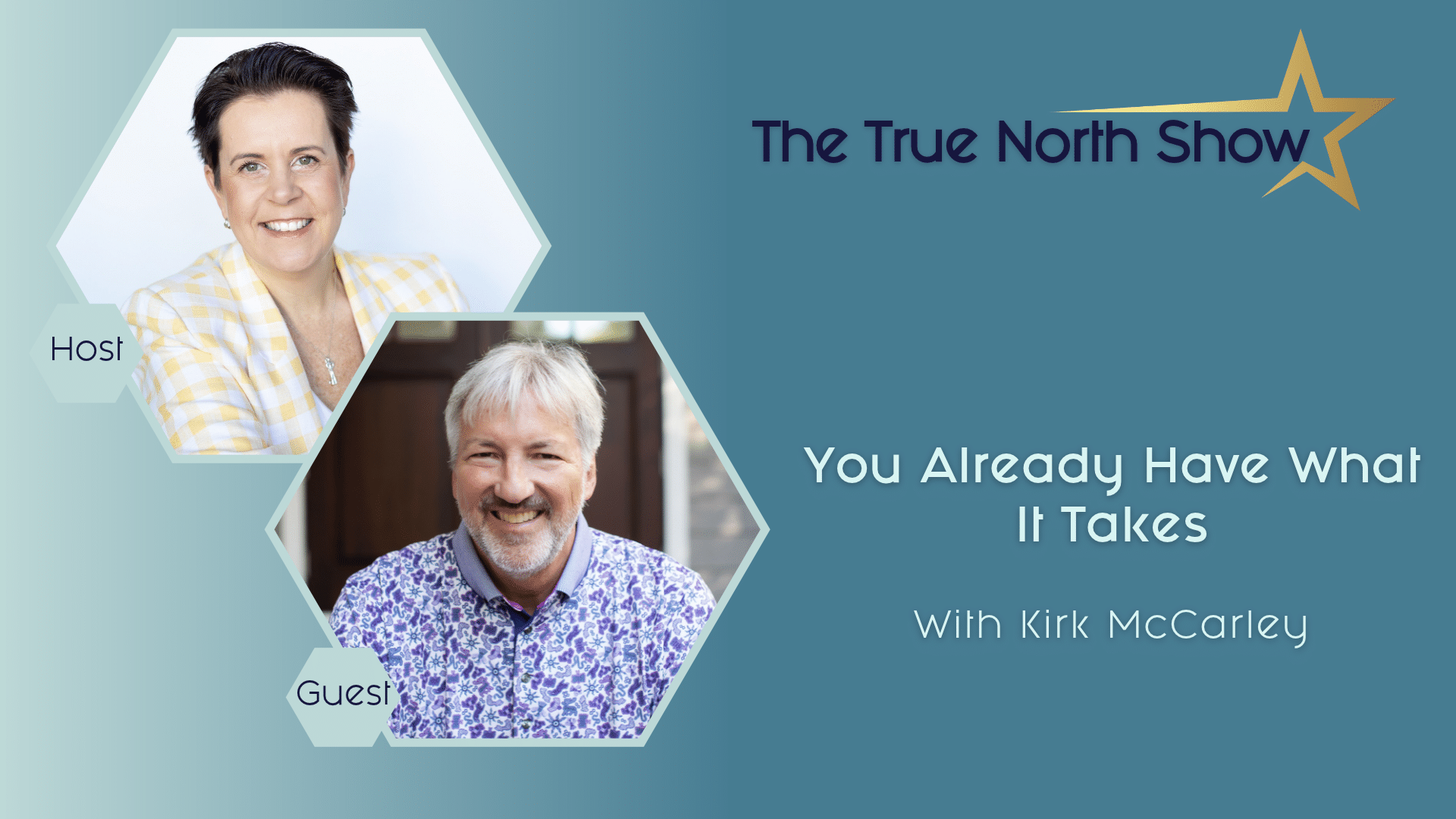
You Already Have What It Takes with Kirk McCarley | Ep. 70
On this week’s episode of The True North Show I am joined by Kirk McCarley, a wonderful man who believes that by looking within you realise you already have what it takes. Kirk uses this belief in the work he does with his coaching clients, always tuning in to find that one question that will get his client to go to a place they may never have been before and realise that what they have been looking for has been there all along. Our conversation is filled with so much wisdom that you will definitely needs a pen and paper for this one!
Bio:
With more than 30 years of executive leadership experience in both public and private sector environments, Kirk McCarley has a solid reputation for fostering individual growth and development beyond the client’s expectation. He is also the author of “Thoughts for My Kids…and Other People’s Kids,” a collection of vignettes and assorted stories on life and keys to success.
As an executive and career coach, his focus is on desired client outcomes, predicated upon the premise that the individual possesses their ingredients for success. His belief is the coach’s role is to ask the right questions to draw out those ingredients, help the client develop the recipe, and then serve as an accountability partner as the plan manifests.
Enthusiastic while also contemplative; determined, yet relaxed; his passion as a coach is to help clients celebrate self-confidence and achieve full God-given potential.
A graduate of the University of North Texas, Kirk is an accredited coach through the International Coaching Federation (PCC) level as well as a Professional in Human Resources (PHR) and SHRM-CP Certified. He also is a Production Assistant for major sports for ESPN, leads group cycling classes as a Certified Spinning Instructor, and authors a monthly column on leadership, careers, and communications in his local paper.
Purchase the book using this link: https://www.kirkmccarleyauthor.com/
Social Media:
Website: https://theseedsowercoach.com/
Facebook: https://www.facebook.com/KirkMcCarleyTheSeedSowerCoach/
Instagram: https://www.instagram.com/kirkmccarley/
LinkedIn: https://www.linkedin.com/in/kirk-mccarley-1bbba950/YouTube: https://www.youtube.com/@DrCynthiaBentzenMercer/
Transcript:
Megan North [00:00:33]
Hello and welcome to The True North Show. I am your host, Megan North, and I would like to start by thanking the sponsors of the show: Quantum Awakening, Beth Lewis, Ann C. Clarke, and my guest who paid to be featured.
With more than 30 years of executive leadership experience in both public and private sector environments, Kirk McCarley has a solid reputation for fostering individual growth and development beyond the client’s expectation. He is also the author of Thoughts for My Kids and Other People’s Kids, a collection of vignettes and assorted stories on life and keys to success.
As an executive and career coach, his focus is on desired client outcomes, predicated upon the premise that the individual possesses their own ingredients for success. His belief is the coach’s role is to ask the right questions, draw out those ingredients, help the client develop the recipe, and then serve as an accountability partner as the plan manifests. Enthusiastic while also contemplative, determined yet relaxed, his passion as a coach is to help clients celebrate self-confidence and achieve their full God-given potential.
A graduate of the University of North Texas, Kirk is an accredited coach through the International Coaching Federation, as well as a professional in human resources. Alongside this, he is also a production assistant for major sports for ESPN, leads groups of cycling classes as a certified spinning instructor, and authors a monthly column on leadership, careers, and communications in his local paper.
Gosh, Kirk, really, are you doing enough? Welcome to the show.
Kirk McCarley [00:02:28]
Thank you, Megan. I’m trying to figure out what I’m going to do when I grow up.
Megan North [00:02:33]
And when you’ve got some spare time.
Kirk McCarley [00:02:36]
You catch me at a time where, in the location we live in in Northwest Florida in the States, near the Gulf of Mexico, we just battled a hurricane. So I have improved my skills with the chainsaw these past couple of days.
Megan North [00:02:52]
Okay, we’ll need to put that on the bio, I think.
Kirk McCarley [00:02:55]
That’s right.
Megan North [00:02:58]
Kirk has spent more than 30 years helping people unlock what is already inside them, and his belief that every single person already holds the ingredients for their success. Stay with us, because when we come back, Kirk is going to share what happens when people finally stop looking outside of themselves for the answers and start trusting what is already within.
Megan North [00:04:43]
Welcome back to The True North Show. I’m here with executive coach, author, and all-round extraordinary human being, Kirk McCarley. And we’re about to explore a very interesting and timely topic. The ingredients for your success are already inside you, and sometimes all it takes is the right question to bring them to the surface.
So Kirk, I’d like to understand your journey and what was the pivotal moment that led you to step out of your role in corporate HR and onto this new true north path with your coaching.
Kirk McCarley [00:04:59]
I’d had a long career in HR. I’d been an HR person for 35-odd years. Late in that career, I had designs on wanting to do something else. I didn’t know exactly what that was. I’d been doing this for a long time. I wanted to try something different.
But also within that HR career, it had evolved into people coming to my office saying, “Kirk, I’m frustrated with where my career is, what’s happening, what can I do? I feel stuck.” At about that same time, concurrently, I hired a coach. The first couple of meetings we tried on some shoes, so to speak, contemplating what I might do next in my professional career. And it was about the third meeting I had with that coach. I said, “I want to do what you do.”
So I went back, got some education on what coaching is, and about 10 years ago I hung out the shingle myself. And Megan, at the age of 60, I really figured out what my true north was. This has been a fantastic journey of connecting with people not only from the area in which I live, but throughout the United States and really around the world. I have learned so much from the people I’ve coached.
Megan North [00:07:17]
It’s interesting, isn’t it, when we’re in that corporate HR space? I felt like I was in a box. I could coach people, but I wanted to coach them in my own way. I wanted to be able to talk to them about different things. And as an HR professional, when someone comes to you saying “I feel stuck,” in your mind you’re thinking, well, I can’t talk to this person about how they’re going to leave the organisation because we’re always trying to retain employees.
Kirk McCarley [00:07:55]
That’s right. And as the HR director, you were expected to have all the answers. In coaching, you don’t have all the answers, but you have the confidence to acknowledge that because the client has the answer. They just don’t know it yet.
Megan North [00:08:12]
Yeah. And was there also a health situation that happened to you around the time you stepped out of HR?
Kirk McCarley [00:08:22]
There was. I’m a group exercise instructor for cycling, and I was working out at the gym when all of a sudden the world went black. The next thing I knew, I had emergency medical personnel on top of me, an oxygen mask on, being asked, “What’s your name? What’s your date of birth?” I was wheeled out of the gym where I taught to a local hospital.
It was on a Friday afternoon, so there weren’t tests performed until the following Monday, when I learned that I had some locked arteries. Triple bypass surgery followed on the Tuesday after the Friday that occurred.
People would ask me, “Were you worried? Were you scared?” No, not particularly. I was aggravated because I had a lot of things to do. A few days into recovery I was starting to get a little down, a little bored, because I don’t like sitting around. So I was resolute on two things. One: I’m going to get into better condition than I was before. And second: God has given me a wake-up call. Son, it’s time to get serious about this coaching business. So I got after it, and here we are now.
Megan North [00:10:06]
I always talk about when we get nudges from the universe. Often they’re a little tap on the shoulder, it’s a little light, and then when we’re not listening it gets a bit harder. And then when we’re really not listening, it starts to really move. For you, that’s a very dramatic instance. A message from the universe saying, come on Kirk, we’ve been trying to do this gently.
Kirk McCarley [00:10:38]
Determining if something is a divine nudge or just static, this one felt divine because there was peace associated with it. There was a resolution: I’m going to move forward and do this. I kind of had the internal go-ahead, and I’m lucky that I listened to it.
Megan North [00:11:07]
That’s really beautiful. When I stepped out of corporate, I just had this innate trust that things would work out and I would be okay. When we’re in line with ourselves and we feel peaceful about what’s happened, there’s no fear associated with it. So it can only be a divinely guided message.
Kirk McCarley [00:11:39]
There is peace associated with it, but there is also the element of work ahead. It’s oftentimes not the easy path, but the more difficult one. The easy path would have been to go back and finish out that career in HR. The difficult one is to do something new, with some financial insecurity, not knowing if you’re going to be any good at it. Okay, let’s give it a try.
Megan North [00:12:17]
Yeah. Deep breath.
Kirk McCarley [00:12:19]
That’s right. Let’s move forward.
Megan North [00:12:22]
From a mental health and wellbeing point of view, you’ve been active a lot of your life. Do you think that activity and being fit and healthy has helped you with your mental health through the years?
Kirk McCarley [00:12:39]
Without a doubt. And I’ve learned more about the mind-body connection as I’ve grown older. If I am physically active, that is going to support me mentally as well. When I get to those rough points now, I’ll tell my wife I’m going to go on a bike ride. It’s usually a long one, maybe a hundred kilometres. I’m going to get it out, think, process, be in prayerful contemplation. And more often than not I come back, okay, it’s not all solved, but it’s better.
Megan North [00:13:24]
What is it about the cycling that you love? Has it always been something, or did you pick it up later?
Kirk McCarley [00:13:36]
I work with ESPN as a talent statistician. Numbers have always fascinated me. So I play little number games as I’m cycling. When I get to 31 miles, 50 kilometres, I’m half done with the ride. I’ve already achieved something. But I also transport myself to another place. What is a distance similar to what I’m riding? I put myself somewhere else, maybe going from Los Angeles to San Diego, and ask: what am I going to pass by, what am I going to see, what am I visualising? Playing these games and keeping score is cathartic for me.
Megan North [00:14:52]
And is cycling the only thing you do from a fitness and mental health point of view?
Kirk McCarley [00:14:59]
I lift weights as well. I alluded to being an active gardener. The name for my business, The Seed Sower, partially comes from that. Right now there’s been recovery work here after the storm, felled trees and roots in the ground, so there’s a chainsaw to get after. That’s another form of therapy that becomes physical. And while I’m outside doing something physical, I often think of clients in particular, because I get a different perspective that leads me to a question I think is going to be a key ingredient to ask.
Megan North [00:15:51]
I read years ago that there are enzymes in soil that are actually natural antidepressants. A lot of therapists say to people, go and do some gardening, because you’re unconsciously getting a natural antidepressant as well.
Kirk McCarley [00:16:18]
I love the dirt. There is something to that for me. My wife said after I had this activity today, “You’re showering outside. You’re not bringing that into our house.” Which was even better, because there is nothing I enjoy more than a good outdoor shower. So it worked well for her, it worked well for me.
Megan North [00:16:49]
You’ve got the best sense of humour. So you talk about helping people achieve their full God-given potential. What does it look like when someone finally steps into that? And what usually has to happen before they’re willing to go there?
Kirk McCarley [00:17:09]
I liken it to being outside on a hike with that client. We’ve got a destination, but there are going to be some potential diversions along the way. Metaphorically: do you want to check this out? I see a road sign. I don’t know where it’s going to take us, but would you like to explore it, or do you want to stay on this path?
Well, let’s give it an exploration. And it may be a dud, or it may be a beautiful waterfall, or a mountain vista we hadn’t considered.
What that is doing for the individual is triggering something. Maybe somebody who is in the capstone of their career and contemplating retirement, or what I call “refirement,” it may be a catalyst to become an adventure cycling leader or to take people on trails. Just cleansing, releasing endorphins, excitement.
And what I crave as a coach is that breakthrough moment with the client, and then being able to step into: what do you need to do next to effectuate this? Who do you need to contact? When are you going to do it? What do you hope the result will be? That aha moment for me as a coach is where the rubber meets the road.
Megan North [00:19:23]
I think as a coach it’s a very privileged position. Someone is coming to you, and I think we are more of a guide than a helper. For me, the word “help” implies the person is broken or in a bad place. Guidance gives a different energy to the work we do. But it’s such a privilege, isn’t it, to work with people and see that shift happen?
Kirk McCarley [00:20:09]
A good friend in St. Louis, he was also a cyclist. When he wanted to chat, he would say “Let’s walk.” And we would walk. That mind-body connection stimulates things that enrich the conversation. And on the beach with my wife, we see things that stimulate thought, other conversation, maybe related to dreams, goals, things we want to achieve. Because we see the vastness of the world and it makes us look internally, think, contemplate.
Megan North [00:21:03]
When you talk about that internal piece, during your own transition from HR to coaching, was there a particular question your coach asked you that gave you that aha moment?
Kirk McCarley [00:21:23]
I had a coach early on who was older than me. He came from a military background and had also been a therapist. What I liked is he challenged me. It was always a little uncomfortable.
When I wrote my book, Alan said, “Kirk, you would have more legitimacy in your book if you aspired to get advanced coaching certification.” Alan, I wish you hadn’t brought that up. But he knew my trigger and it got into my head and it wouldn’t go away. So I pursued it. It was very hard to go through that process, but I was successful. Now I’m a Professional Certified Coach. I hated him for it at the time, but I love him now for causing me to go through that.
And as a coach, that’s what we do. We make our clients a little bit uncomfortable sometimes, but we don’t ask them to do anything that isn’t going to be legal or ethical. We challenge them to things they haven’t considered.
Megan North [00:22:56]
What would you say is the most powerful question you’ve ever asked a client?
Kirk McCarley [00:23:10]
I like this question, and I’ll ask it every now and then. It actually came from a fire captain back in my HR career when I sat on a panel hiring firefighters and police officers. The captain would ask: “What is the one question you think needs to be asked of an interviewee?” I transferred it to coaching: “What is the one question you think I should ask you as a client?”
It will stump them. But they’ll think about it. And then you come back with: “How would you answer it?” Just to see how they think, to see if they’ve got something in them that will give a response beyond “I don’t know.” Because if they say “I don’t know,” the question that follows is: “Well, if you did know, what would the answer be?”
Megan North [00:24:19]
I started working with a client recently who said when I asked her my first question, “Really? That’s my first question?” And she uses the analogy of a baseball bat to the head whenever I ask her something. But that’s what we want. We want a challenge. That’s where the biggest transformation happens.
Kirk McCarley [00:25:21]
Those aha breakthrough moments often happen at 30 to 45 minutes into the discussion. There is ground that needs to be covered first. When I was doing employment interviews in HR, I’d be so-so on a candidate, but about 30 minutes in they’d say something that really got my attention. You’re intriguing me. You’re different. You’re unique. I want to follow this. The same thing happens in coaching.
Megan North [00:26:08]
And that’s actually a great point just in relation to us as human beings. I don’t want to be the same as someone else. I want to offer something different to what someone else can offer.
Kirk McCarley [00:26:42]
There was a leadership programme I attended years ago. Tom Peters was facilitating it. He was going on and on: “I want weird people. Show me strange people, bring them into the organisation.” What he was really saying was: bring me unique people. Individuals with their own ideas who aren’t a carbon copy, who aren’t just trying to please the status quo.
Those words have stuck with me. I ask coaching clients: “What’s your differentiator? What’s unique? What’s different about you?” And see what they do with that.
Megan North [00:27:45]
I’m going to change tack. When I was introducing you, I mentioned your book, Thoughts for My Kids and Other People’s Kids, which is such a beautifully personal and generous title. What inspired you to write it? And what is one piece of wisdom in that book that you hope most people can carry with them?
Kirk McCarley [00:28:23]
When I started my business I had to develop a website, and the website needed activity, so I started blogging. We have a local paper, a tabloid available in hotels and holiday apartments. I got a section in it and had been writing monthly for several years, accumulating quite a few articles. The publisher said, “Kirk, these are pretty good. You ought to write a book.” Okay.
I did some research. Eighty percent of people, at least here in the States, have a desire to write a book at some time in their life. Less than three percent actually do it. And there’s an even smaller number that actually gets it published. I’ve never been in the top three percent of anything. Here’s my chance.
One story that comes to mind: when I worked in government as an HR director, we had a mayor and a county executive who was his counterpart. The county executive was argumentative, difficult in conversation, and had developed a reputation for that. At lunch one day, the county executive asked the mayor, “What do people think of me?”
The mayor said, “Would you ask me that question again?” He wanted to confirm the county executive really wanted an answer. So he asked again, and the response was, “Well, since you’ve asked me, I think people find you abrupt, argumentative, a little uneasy to be around.” A way of getting honest feedback is to ask the question twice. The second asking signals: I really want to know. And then the question becomes: what do I need to do to alter this behaviour?
Megan North [00:32:01]
And I love the way the mayor positioned that, because it actually gave the other person time to really tune in and say, yes, I actually do want to know.
Kirk McCarley [00:32:33]
And it made it a safe conversation, because he had affirmed, yes, I do really want to know, by that exchange.
Megan North [00:32:48]
What was it like writing a book? Is it something you would do again?
Kirk McCarley [00:33:05]
I want to do it again. It was actually a lot of fun. I had help, and the biggest help came from an editor. You go back and forth with several renditions, and it gets a little less corrected each time. What I liked about her is she gave me input in a positive way. She knew how I would respond best. It was an effective process, more than worth its weight in gold.
It’s a commitment of time and a little bit of money even with self-publishing. But I have more blogs now. I want to do more things with them. So I’m looking at a volume two, which is maybe a year or two away.
Megan North [00:34:33]
I’m shocked by that statistic of how many people want to write a book but only three percent actually do it.
Kirk McCarley [00:34:43]
We authors, we’re a small universe.
Megan North [00:34:46]
Congratulations on being in the top three percent.
Kirk McCarley [00:34:51]
Thank you. More than you know.
Megan North [00:34:56]
Earlier this year, you were struck by a truck while cycling. An experience that really could have broken a lot of people. Instead, it deepened your understanding of forgiveness and lit an even greater fire under your coaching purpose. Can you take us inside that experience?
Kirk McCarley [00:36:16]
This was six months ago. I was about done with my ride. I checked behind me, didn’t see anything, and stuck out my left hand to signal a left-hand turn. There was a large truck behind me. Something took place in the driver’s brain where he thought I was giving him a go-ahead to come around me. He struck me from behind.
I don’t recall anything after that until there was a helicopter in an open field. Similar to the cardiac incident 12 years ago: “What’s your name? What’s your date of birth?” I could tell I was in significant pain.
Here’s the good thing, Megan. I had never been in a helicopter before. It was my first helicopter ride. And given it was a somewhat windy day, I thought it was going to be rough. It wasn’t. I was impressed.
I was taken to the intensive care unit with a concussion. I was wearing a helmet, fortunately. 16 stitches to the head after some gravel was cleaned out. Five broken ribs. A separated shoulder. A partially torn rotator cuff. And a punctured lung.
After a couple of days in ICU that I don’t really remember, my wife showed me the police report of the truck driver. And once again, a kind of divine intervention. I’m usually not the type of person that wants to stir things up. But in this case, I saw the driver’s name and his phone number. I called him.
I said, “I’m Kirk McCarley. I’m the person you struck a couple of days ago.” I could hear a gasp. I asked, “How are you doing?”
I learned that he had served our country in the military for many years. He was suffering a little PTSD because, as a military person, he seeks to help people. In this instance, he had not helped someone. We talked further. He was very sorry about what had happened. I said, “It’s an accident. They happen.” And then the key words came: “I forgive you.”
That meant a tremendous amount to him and his wife. And for me, Megan, it was a release. There was a lightness that came with it. I can’t quite put my finger on it even to this day, but it was an important thing to have done.
Since then we communicate periodically. We’ve gone to lunch. We’ve broken bread together with his wife. It’s become a divine connection. Sometimes God brings us together in odd ways, and this was certainly that. I don’t wish it wouldn’t have occurred. There are tremendous benefits that came from it and different perspectives that have opened up that have helped me not only as a coach, but hopefully as a human being.
Megan North [00:40:43]
Forgiveness, to me, is freedom. When you can forgive someone else and yourself, it just gives you an enormous amount of freedom. There’s no story attached to it. There’s no suffering. It’s complete freedom to continue on with life.
Kirk McCarley [00:41:13]
I love that word, freedom. It’s given me a story to take to others, which has had impact on them through circumstances we wouldn’t have wished would happen. But what is the silver lining? What’s the benefit from what’s occurred? People who have overcome things can be very helpful to others in similar situations.
Megan North [00:41:45]
And there’s an important distinction with forgiveness. I had some stuff happen to me as a child with a family member that was horrible and traumatic. As I got older, I started to do the forgiveness work because I didn’t want it to weigh me down. I did a lot of healing, I forgave them and myself, and I wrote them a letter saying, I forgive you. But I also said, this doesn’t mean I ever want to see you again or that you’re going to be my friend. I’m just closing this chapter for myself so I can move on.
So forgiveness doesn’t mean the person has to become your friend. In your situation, I love that you’ve continued the relationship. But that’s not always the case.
Kirk McCarley [00:42:58]
I heard a pastor say once that we are to forgive, but not necessarily to forget, because we don’t want to put ourselves in a vulnerable position that repeats itself. Forgive, release, but remember what was learned. For me, I’m looking even more carefully at what’s behind me when cycling, pulling off to the side of the road before making that left-hand turn. No animosity to this individual. But awareness is part of it.
Megan North [00:43:54]
I think sometimes people believe that if they forgive someone who has wronged them, they need to welcome them back into their life. No, it doesn’t. It’s possible in some situations. In others, it’s not. The forgiveness is for you.
So, you’re a coach, an author, a sports broadcaster, a cycling instructor, and a columnist. You clearly practice what you preach when it comes to living fully. What drives that for you personally?
Kirk McCarley [00:44:36]
If I’m not moving, I get bored. And when I get bored, that’s a dangerous place for me. I’ve dealt with clinical depression at times in my life, and one of the best remedies is physical activity. Get my mind away from that moment. Move.
My word for 2025 is “move,” to constantly remind myself. There’s a book, Make Your Bed, by US Admiral McRaven. First make your bed. Take that first step. Go splash some water on your face, brush your teeth. Make yourself a pot of coffee. You start to gain some momentum. Pretty soon you’re focused on the activity of the day, and the things that are weighing you down ease up a little.
For many people, just getting out of bed every day can be difficult. Prop yourself up, read, do a devotional. What can you do? And then step a little further beyond that the next day.
I’m at an age where I could be retired. But what would I do? I’ve got to be doing something.
Megan North [00:46:26]
And you’d probably drive your wife crazy.
Kirk McCarley [00:46:29]
She is so happy I’m doing what I’m doing. And I’m so happy she is still working. It’s been wonderful for our marriage. We come together at the end of the day, debrief on what has happened in our work, talk about the kids and the grandkids. It’s a very much a stimulant for our relationship. And there’s always something new, something different, a surprise, which keeps it interesting.
Megan North [00:47:02]
So for people watching today, when you say they’ve already got the ingredients for their success sitting inside of them, what would you say would be one question for people to ponder to start seeing that for themselves?
Kirk McCarley [00:47:34]
I’m going to listen carefully to that individual to determine if they’re audio, visual, or kinaesthetic, and listen to the language they use.
If they say things like “my vision of the future” or “what I see,” they’re visual, and I’ll ask: what does this look like to you when you get to this place?
If they’re auditory, they’ll say things like “it’s music to my ears” or “it sounds like this.” I might ask: do you have a favourite musician? When they sang this song, how did that resonate? What did you hear?
And “feel” is the key word for those who are kinaesthetic. I’ll use terminology along those lines to parse the question in a way that works for them.
I’m also disciplining myself to make sure my client owns 75 to 80 percent of the conversation. High curiosity, high degree of listening. The discipline as a coach is that something they say triggers a question I want to ask immediately, but I sit on it and listen. If the question is important, it will come back to me. What do they say?
Megan North [00:49:53]
I love that. Did you know that the same letters you use to spell “listen” are the same letters you use to spell “silent”?
Kirk McCarley [00:50:12]
Interesting. I have learned something.
Megan North [00:50:16]
Yes.
Kirk McCarley [00:50:17]
We’ve got two ears and one mouth. So it should be about a 70/30 proportion, just like I was saying.
Megan North [00:50:26]
Exactly. I’m a little shocked to say this, Kirk, but we’ve actually only got a couple of minutes left.
Kirk McCarley [00:50:32]
I’m having too much fun.
Megan North [00:50:35]
I know. So I’m going to ask you the same question I love to ask all of my guests before we finish. What is one lesson or truth that you’ve learned on your journey that you wish you had known earlier?
Kirk McCarley [00:50:51]
I’ve got this on a sticky note right in front of me. It was from my coach, Alan. Let me pull it out.
When I was a teenager, a 20-something, a 30-something, I didn’t have a lot of self-confidence. What are people going to think if I do this? Is this too out of the box? I’d like to say that changed immediately, but it was over the course of years that I started doing things that were a little avant-garde, and people didn’t know how to react.
Learning about this uniqueness, this differentiation, at that earlier time, rather than being self-consumed with what people would think. As a young person, I wish I would have known: you really do have a lot of reason to be confident in what you’re doing. Don’t be so doubting. Trust yourself. Trust your higher power, whatever that may be.
Megan North [00:52:08]
I love that. I feel like that has wrapped our conversation up in a beautiful bow. It’s just perfect. Thank you. I’ve really loved sharing this time with you today. I knew this conversation was going to be amazing, but it has surpassed everything I expected. Thank you for being so amazing.
Kirk McCarley [00:52:31]
You’re so kind, Megan. Thank you for your joyful demeanour, your encouragement, and your good questions. I really had a good time.
Megan North [00:52:40]
I’m so pleased. I’d also like to thank all of my amazing and dedicated audience, supporters, and my sponsors again. I hope that everybody has an amazing rest of the week, and I look forward to seeing everybody again next week. Thank you so much, Kirk.
Kirk McCarley [00:52:57]
Thank you, Megan.