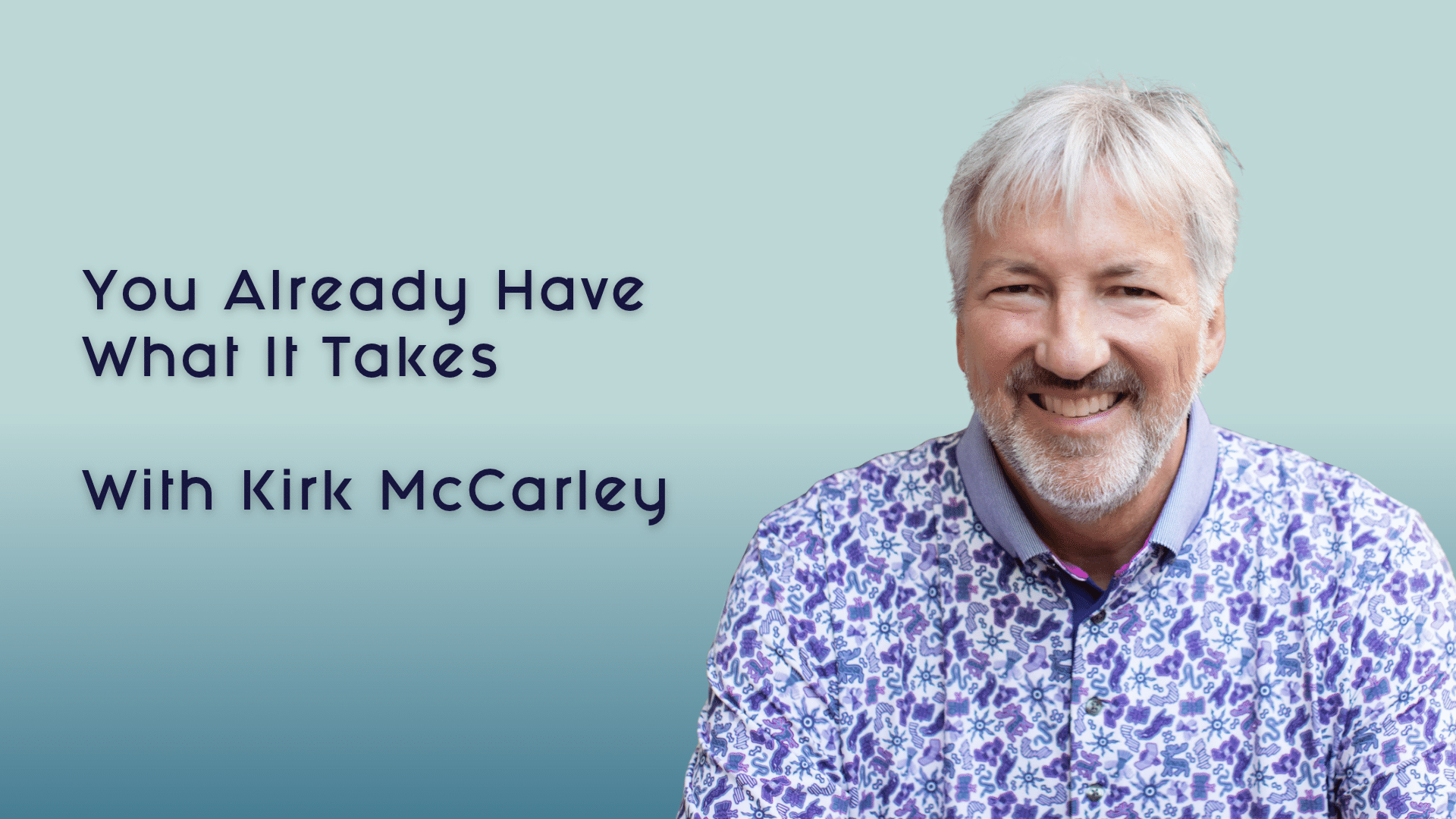
You Already Have What It Takes
Kirk McCarley spent 35 years in human resources. He was the person in the organisation who was supposed to have all the answers. And for a long time, he played that role well.
But something was shifting beneath the surface. Fewer and fewer of his days were spent on benefits management or compensation structures. More and more, people were coming to his office with a different kind of problem. The feeling of being stuck. A career that no longer fit. A version of themselves they could not quite access from inside the organisation they were in.
Kirk recognised the feeling. He was having a version of the same conversation with himself.
“I had designs on wanting to do something else,” he says. “I didn’t know exactly what that was. I’d been doing this for a long time. I wanted to try something different.”
He hired a coach. By the third session, he told the coach he wanted to do what the coach did. And so, after 35 years, Kirk McCarley hung out his own shingle.
He was 60 years old. And he says it was the first time he had truly figured out his true north.
The cardiac event that confirmed everything
Not long after making that decision, Kirk was teaching a cycling class at his gym. He was an active, committed exerciser. Fitness had always been part of his life. And then the world went black.
He woke up with emergency medical personnel around him, an oxygen mask on his face, and questions about his name and date of birth being asked. He was wheeled out of the gym and taken to hospital. The following Monday, tests confirmed he had locked arteries. Triple bypass surgery followed on the Tuesday.
When people asked him afterwards if he had been scared, he said no.
“I was aggravated. I had a lot of things to do and I had to get on with that.”
A few days into recovery, he felt something resolve inside him. Two commitments formed clearly. One: he was going to get into better condition than he had been before. Two: this was a divine nudge. It was time to get serious about his coaching business.
He has not looked back.
A philosophy built on what is already there
At the heart of everything Kirk does as a coach is a single belief: the client already possesses the ingredients for their own success. The coach’s role is to ask the right questions, help the client develop the recipe, and then serve as an accountability partner as the plan takes shape.
This is not a passive model. It requires deep listening, precise curiosity, and the willingness to let the client lead the conversation. Kirk disciplines himself to ensure the client owns 70 to 80 percent of every session. He listens for the language they use, visual language or auditory or kinaesthetic, and tailors his questions to match how they process the world.
If a client says “what I see” or “my vision of the future,” Kirk knows they are visual, and he asks questions that invite them to picture the destination. If they talk about how something “sounds” or “resonates,” he follows the auditory cues. If they speak in terms of how something “feels,” he works with sensation and the body’s knowing.
The most powerful question he ever uses he borrowed from a fire captain he encountered during his HR career. The captain used to ask job candidates: “What is the one question you think needs to be asked of you?” Kirk adapted it for coaching: “What is the one question you think I should ask you?” The pause it creates, and the answer that eventually follows, tells him almost everything.
And if the client says “I don’t know,” he simply follows with: “If you did know, what would the answer be?”
The truck, the helicopter, and the phone call
Six months before this conversation, Kirk was cycling near the end of a long ride when a truck struck him from behind. The driver had misread his left-hand turn signal as a go-ahead to pass. Kirk remembers nothing after the impact until he was in an open field with a helicopter nearby and, once again, the familiar questions: what is your name, what is your date of birth.
It was his first helicopter ride. He says he was impressed by how smooth it was, given the wind.
He was taken to intensive care with a concussion, 16 stitches to the head, five broken ribs, a separated shoulder, a partially torn rotator cuff, and a punctured lung.
A few days later, still in ICU, his wife showed him the police report. Kirk saw the driver’s name and phone number. He called him.
“I’m Kirk McCarley. I’m the person you struck a couple of days ago.”
He says he heard a gasp on the other end of the line. Kirk asked how the driver was doing. He learned that the man was a military veteran who had been suffering PTSD since the accident. He had dedicated his life to helping people, and the weight of having hurt someone was significant.
Kirk listened. They talked. And then Kirk said: “I forgive you.”
Since that phone call, they have been to lunch. They have shared a meal with their wives. Kirk describes it as a divine connection, brought about in an odd way. He says he does not wish the accident had not happened.
“I would be a much wholler person to myself now. But there are tremendous benefits that came from it and different perspectives that have opened up.”
What forgiveness actually does
Kirk is thoughtful about what forgiveness means and what it does not mean. He shares a distinction he heard from a pastor: forgive, but do not necessarily forget, because memory protects us from repeating what hurt us. Forgiveness is a release, he says. A lightness. A story that, once carried through, can be given to others who need it.
He is clear that forgiving someone does not mean re-engaging with them. It means freeing yourself from the weight of the story so you can move forward without it.
“It was a release. There was a lightness that came with it. I can’t quite put my finger on it, even to this day, but it was an important thing to have done.”
Moving as medicine
Mental health has been part of Kirk’s personal story. He is open about having dealt with clinical depression at various points in his life. The remedy that has consistently worked for him is movement. A long bike ride, often 100 kilometres. Weight training. Gardening. Chainsaw work after a hurricane came through Northwest Florida.
He describes playing games with himself on long rides: converting distances, imagining he is riding from one city to another, picturing the landmarks along the way. The numbers keep his statistician brain occupied. The physicality does something else entirely.
“That mind-body connection is stimulating things that just enrich the conversation.”
He keeps a word for each year. His word for the year of this conversation is “move.” He references a book called “Make Your Bed,” and the idea that small actions taken first thing in the morning build momentum that carries you through the day. A bike ride. A splash of water on the face. Coffee. Each small act builds on the last.
Trust yourself
When asked the question he has been asked throughout this conversation, the one lesson he would carry back to his younger self, Kirk reached for a sticky note on his desk. A note from his coach, Alan.
When he was young, he says, he was held back by concern for what others would think. Was this too different? Too out of the box? He spent years inside that hesitation before he gradually moved through it.
The note said, in essence: trust yourself. Know that your uniqueness is worth backing. Stop asking what people will think and start living from what you already know.
“You really do have a lot of reason to be confident in what you’re doing. Don’t be so doubting. Trust yourself. Trust your higher power, whatever that may be.”
It is, in the end, the same invitation Kirk extends to every client who sits across from him. The ingredients are already there. They always were. You just need someone willing to ask the right question, and the patience to hear what the answer already knows.