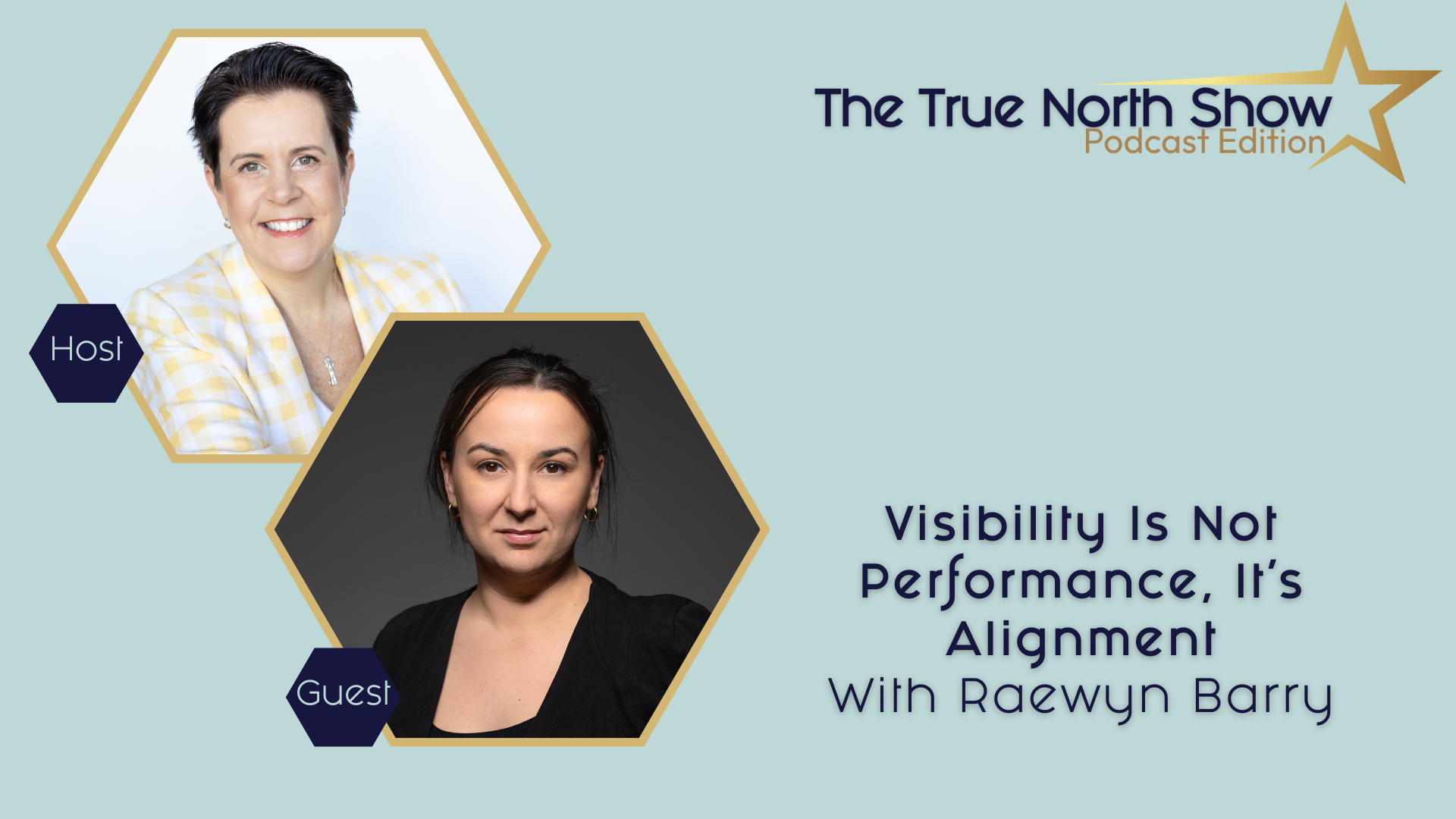
Visibility Is Not Performance, It’s Alignment with Raewyn Barry | Ep. 24
My guest on this week’s episode of The True North Show is Raewyn Barry, a woman who has always known what she has wanted to do and has gone out and made it happen. Raewyn grew up with incredibly supportive parents who encouraged her to do what felt right and that has stuck with her through her whole life, both personally and professionally. Our conversation is both deep and light and a has a beautiful blend of love and laughter, a conversation you definitely don’t want to miss.
Bio:
Raewyn Barry is a Video Presentation Consultant and Creative Director who empowers professionals and leaders to showcase their expertise with magnetic on-camera presence. With 16 years of film and television experience and a background in NLP, Raewyn helps clients communicate online with clarity and earned authority, ensuring every message is as powerful on screen as it is in person.
Her philosophy is simple: visibility is not performance, it’s alignment.
Raewyn’s background includes every role behind the camera, from producer and director to editor and live broadcast manager, with credits in international fashion events and campaigns for major brands. Her deep technical skill is matched by her understanding of the inner psychology of presence.
As a Circle of Excellence NLP practitioner, Raewyn guides clients to dissolve barriers to being fully seen. Her coaching blends nervous-system regulation, energetic alignment, and storytelling, facilitating the shift from visibility anxiety to confident, embodied self-expression.
Raewyn’s Align → Frame → Express → Create framework supports clients from mindset to message to media, helping them align their true identity and intention, frame their narrative, refine delivery, and create resonant video content with strategic impact. She offers 1:1 coaching and dynamic workshops such as CEO Zoom Room, mentoring clients to elevate their virtual presence and create authentic brands.
Distinct from typical camera coaching, Raewyn’s integrated expertise in psychology and production allows her to help people transform not just their skills but their entire experience of being seen. Her approach fosters calm, safety, and authenticity, so clients express themselves more freely and with more impact.
Raewyn’s mission is to humanize digital communication, reminding leaders that technology amplifies authenticity. She consults on creative productions and helps businesses design visual ecosystems that feel aligned, sustainable, and professional. Working globally, Raewyn inspires leaders to rise by showing up more real, not more polished.
Social Media:
- Website: www.raewynbarry.com
- Facebook: https://www.facebook.com/raewyn.barry.2025
- Instagram: https://www.instagram.com/raewyn_barry?igsh=MTB2dnpreWl1azMwdQ==
- LinkedIn: https://www.linkedin.com/in/raewyn-barry/
Transcript:
Today I am joined by a woman who was introduced to me by a mutual colleague and, as soon as we met, we realised that a true friendship was born. Raewyn Barry, or Rae for short, is a video presentation consultant and creative director with 16 years of film and television experience.
She blends expertise in neuro-linguistic programming, NLP, with her extensive production background to help leaders and professionals develop a confident, authentic presence on camera. Her philosophy is simple: visibility is not performance, it is alignment.
Having managed large-scale productions, directed international campaigns, and supported top brands and speakers, Rae brings technical know-how and emotional intelligence to her coaching. Her approach combines mindset, storytelling, nervous system regulation, and creative media strategies, helping clients transform inner resistance into calm authority and compelling screen presence.
Rae’s signature framework – Align, Frame, Express, Create – takes clients from intention to impactful content, whether through one-on-one coaching or group workshops like CEO Zoom Room. That is a bit of a mouthful. Known for her calm, grounding energy, she supports entrepreneurs and coaches worldwide to build brands that are both credible and deeply authentic.
Her mission is to humanise digital communication, empowering people to show up powerfully and truthfully in every environment. For Rae, video is more than a marketing tool. It is a mirror, a space where truth, power, and humanity meet. Through that lens she is helping a new generation of leaders rise, not by becoming someone else on camera, but finally becoming themselves.
Wow, wow, wow. Welcome to the show. I am so excited about our conversation today.
Raewyn Barry (03:07)
Thank you for having me.
Megan North (03:09)
You are welcome. How does it feel, me reading out that bio to you?
Raewyn Barry (03:15)
Yes, it is quite surreal really, because it has taken… I do not really like saying it has taken a lot of work, because I do not want it to sound like it has been a hard process, but it has certainly, you know, and especially in context of what we are talking about today, it has been a journey to get to that point.
When you hear it back and in those powerful words – helping people rise and finding themselves and being in alignment on camera – it is still surreal to hear.
Megan North (03:43)
Mmm, yeah.
Raewyn Barry (03:44)
Because it sinks in. It sinks in at a soul level. It genuinely touches my heart every time that I hear it.
Megan North (03:51)
That is good. I am so proud. Yeah, good, good.
So you have been working in film and television for 16 years. What was the defining moment that led you to pursue this true passion and purpose that you have got? Take us back.
Raewyn Barry (04:06)
Right, we are going right back, right? We are not going to where I am now.
So, I was actually 16 years old. I was in the guidance counsellor’s office at school – guidance counsellor being career adviser as well. It was a very small town. I grew up in a very small town and it was a very rural school.
He called me in to say, “What do you want to do with your life?” For context, the school that I went to, the career pathways were things like farming, building, and accounting. So we are talking very rural, very farming country.
I sat there and I just had what I call an intuitive moment. To me, it was like a divine guidance kind of moment, because completely out of nowhere I went, “I think I want to try media.”
I saw this guy look at me and he was just a little bit like, “Dear, you are going to be a little bit tougher, a little bit harder to put in the world out there.”
But, as luck would have it – and I had no idea it existed – a regional television station had actually started in our city and had been operating for about a year. He went out, and I believe his name was Mr Guilham (I am going to have to go and fact check that), and he came back to me and said, “I know you said media. You were not very specific, but here are all of these university opportunities.”
And then he went, “But here is this channel that has started in town, a TV station. Do you want to go there and see what this is all about?”
And I did.
Long story short, I went there. We had this programme called Gateway, which allowed students to be positioned in workplaces and experience what it is like working in an industry. I was like, cool, this is fun. I did not leave.
So I was 16 and it was about March or April, four months into the school year of my sixth form year. I was sitting my Level Two. “Sixth form” probably resonates across all the different countries. They were just like, “Why do you not come back and volunteer over the holidays?”
And I was like, “Yeah, that sounds like fun.”
By the end of the year, I was not even going to school. I was just sinking myself into this television experience, and then come the new year they offered me a full-time employment opportunity.
So, for me, there were elements of “I was done with the schooling side of things.” I was doing well at school while spending all this time off just volunteering at a TV station as well. I had just found that thing that I was genuinely excited about.
If I was to describe the feeling, it was fun. And I was like, I am just going to chase that fun.
What happened for me in that process was, in that first year that I was actually employed, we started a whole TV show. It was a magazine-style show and I was producing that, editing that.
A year later, the news person happened to leave. That role held a government-funded contract that enabled the station to work and survive financially. He stepped down from that opportunity and they said, “Hey, Rae, you are doing fine with this show. You seem to be picking things up quite naturally. Do you want to move into the news?”
And I was like, “Yeah, okay. I will give it a go.”
When we talk about news in a regional space, my home city has about 90,000 people now in the region. Back then, because we are talking 16 years ago, it was about 60,000 to 70,000 people that we could actively broadcast to. There was one person who did the news. It was writing, filming, editing, and delivering, five days a week.
So, if I was sick someone else would do the job, but for the most part it was me. It was a very autonomous role.
In my late teens I was learning pretty much every aspect of what went into making a show from behind the scenes. And it was so much fun. Ridiculously fun.
We were sending some of the footage that we were capturing in the news alone off to the mainstream channels for the 6 o’clock nationwide news, which was really fun.
So that is pretty much how it all started.
Megan North (08:58)
Wow.
Raewyn Barry (09:00)
This opportunity allowed me to shadow people who I saw as experts. They were also learning in their own way, but we had professionals passing through our TV station as well.
Looking back now, I really appreciate the enthusiasm, excitement, and general interest that I was showing as a young person – that whole fascination. A lot of these people were like, “Let me just show you how to do that.”
So that level of exposure to experts came because of enthusiasm. It is the attitude that you turn up with that means people will allow you to see things.
Megan North (09:45)
Absolutely, yeah.
And when you made that decision, when you said that in the town that you lived in there were usually three things that you would do, was that something where you had to have a conversation with your family, or was it just “this is what I am doing, I am going to follow my purpose and passion, and I am just going for it”?
Raewyn Barry (10:07)
This is where I think I hit the lottery with my family.
My school was way out of town, but my home is closer to the city. My family home is. My parents have always been about “do what feels good.”
My mum is an artist. My father is a welder–fitter (I usually get that in the wrong order), but both are quite creative by nature. So they really, I think in all of us kids, my siblings and I, were like, “Do what feels good and just try on life.”
There are pros and cons to that. For me, at an extreme level, I definitely dove into a subject and stayed.
Megan North (10:57)
Yeah.
And so I suppose for you it was just normal then – that feeling that every opportunity that comes to you, you are just like, “Yeah, I will give it a go,” because that is the environment that you have grown up in. You have not really been in a box. You have actually been, “If an opportunity comes, then go for it and just trial it out.”
Raewyn Barry (11:19)
Yeah, if it feels good. Through the filter of “if it feels good.”
In a strange way – and I guess the reason I am looking up for thought around that is because I just recognised that that was the element. There was a certain element of my parents certainly being like, “Follow something creative and do what feels interesting to you.”
But really, I probably filtered it through a very internal context of “do what feels good.” If you are getting enjoyment from it, keep pursuing that learning pathway.
Megan North (11:54)
Love it. Yeah. I love that. What an amazing way to start our conversation. I love it. Love it.
So I am going to jump to what you are currently doing. You coach people to be confident on camera. Is it something that has come naturally to you through your career, or is it something that you have had to work on yourself as well?
Raewyn Barry (12:18)
That is a fantastic question.
The big gap that is missing is that I talked about when I was 16, but I missed the previous eight years of my life to date, which was that I actually had a videography business. I had a video production company that I co-owned.
I was quite comfortable behind the camera. I learned all of the skills about being behind the camera. I would even argue, to a degree, that I was good at it, just because I had learned it at quite a young age and had so much comfort.
When I moved into the video production company, I was employed as Head of Production. So it was my role to keep doing those skills that I was doing essentially just for small, one-off productions. Some of them were not small, that is not the case. They were definitely bigger.
From planning the shows, running the frameworks, scriptwriting, filming, and editing – all of those things.
Being in your own TV show, the rest of the story around that, there was definitely a level of comfort there.
What happened was we were actually in COVID and we were looking at closing down our company. We had worked with some major brands, but the reality was, like many other business owners in that 2020–2021 period, people were pulling their budgets back. So the usual contracts that we had had changed or were becoming much smaller, because one of the things that people sacrificed in COVID was their video marketing budgets.
My business partner and I were faced with a decision: how do we keep the doors open? That really was the question. “What are we going to do? Do we want to go back to that same…?” I am seeing the key theme in this – “Do we want to keep doing this? Are we still finding this fun? Is it still enjoyable?”
We reached out to a friend of ours who was a digital partner, and he said, “Go back and do your website.”
So we went on our website and he said, “Go and have a look at it and do the FAQ section on your website to increase your SEO.”
As we were doing that – my business partner was typing it up – he looked over at me and basically said, “Rae, each one of these questions that we are writing is actually a script that we could turn into a video.”
He had written 31 of them, and they were all just short paragraphs. Then we shot 31 of them in an hour and a half.
Megan North (14:56)
What?
Raewyn Barry (15:05)
And it was like the light bulb moment. We were like, “Oh, hang on. If we can do this for ourselves, we can do this for other people in a two-hour set.”
So it gave birth to a product that we had called “25 Videos for 2,500” – literally 25 videos, $2,500, shot in the space of two hours.
This is where the coaching kicked in, because people came in and they were like, “How do I turn up on camera?” It was always the first question.
“What do I wear? How do I write my scripts? What am I going to say?”
We could develop the framework, but there were all these other insecurities – or I am actually going to say unfamiliarities with the environment and being on set.
Because I was Head of Production and processing all of their data in the background, and, I would say, possibly because my business partner was highly charismatic and a frontman and showman, and I was the behind-the-scenes girl, I think that my clients found comfort in the idea that, rather than comparing themselves to the guy who was already phenomenal at showing up on camera, they asked the girl how to do that.
So there was an element of that.
Then they started leaning on me quite heavily and I started to see, “Yeah, hang on. This is fun for me.” It was a fun thing. I genuinely enjoyed the transformation that people got.
And I got good at it, naturally.
After a year I went to my coaches at the time and said, “I am thinking about this as an opportunity of just coaching, for me to step out. How would that work?”
We kind of made a bit of a plan. I did not really action it, but the best advice they gave me was, “Go and learn NLP.”
They said, “Go and study it. Even do your beginners, just start, so that you can see how you can quickly shift people into that space of where they want to go and help them recognise their goals.”
I got that training time down on set. In a two-hour session we had originally about a 20-minute window to train people. Now you have got to shoot 25 videos, which is a lot if you are unfamiliar with the camera.
I had it down to 15 minutes.
I would have people come in as a nervous wreck. They would be shaking and I would just start mirroring them. I told this story the other day, actually.
I knew the moment that someone was ready to be presenting to camera on set when I would reach for my water bottle or my glass of water on set and they would do the same thing.
I knew that we were so in sync with one another – that energy sync – that they were physically mirroring my body language and my movement.
It was super technical, but I would stand on set and physically move my arms and I would see the person next to me do the exact same thing.
Megan North (18:21)
Wow.
Raewyn Barry (18:23)
Yeah, it was highly fascinating.
Megan North (18:25)
That is amazing.
And you know, I have had a bit of an aha moment listening to what you were talking about just then as well, because one of the questions I was going to ask you was, “Do you think that people are nervous and do not really want to be on camera because they do not want the light shone on them?”
One of the things that you actually said was that it is unfamiliar to them. And is that not interesting? Because I am wondering, with all the NLP that you do with your clients as well, do you find that it is more that it is unfamiliar and they do not usually do it, as opposed to fearing being on camera?
To me, there is a really big difference in that.
Raewyn Barry (19:11)
There are so many layers.
It is certainly fascinating and I am loving this about where I am now, because I get to learn all of these layers.
There are two ways to answer your question because I always find, if people are not in alignment – that is always the first filter for me. If you are not in alignment, and I do not mean that to sound too “out there,” I mean if they are not feeling congruent with who they want to turn up as on camera.
If I am speaking the way that I usually speak, if I am showing up how I would usually show up in an environment, this is going to feel a lot more comfortable than me all of a sudden putting on a blazer and things that I would not wear in a usual situation where I am trying to pitch something, especially in a working context.
It is that alignment. Showing up as who you are, because that is who people are going to see you as anyway when they meet you off camera.
Megan North (20:17)
Yeah.
Raewyn Barry (20:20)
That is the first filter.
The second filter, to answer your question, is that the camera does not have the same human expressions as when we are talking to someone in person.
Everyone does this. They will get on camera and they will go…
They kind of zone out. I cannot hold it for too long because I can see myself and I look totally ridiculous, but it is like being in a Zoom room and they are zoning out, or their arms are folded, or you are not seeing the same interaction that you would in a human interaction.
That is what I mean about the camera being unfamiliar. We do not know how to treat it because it is not giving us that mirror.
So again, going back to what I said I was doing on set and knowing people were in sync with me and their body language would move in sync with mine. It is that mirror. That is all I was giving them really – how to present.
Megan North (20:55)
Yeah.
Wow, I love that.
One of the things, because my coaching is to help people find their True North – their passion and their purpose – when I talk to them about showing up and “How are you showing up?” and “Are you doing videos?” and that sort of thing, they say, “Oh my gosh, I really hate being on camera.”
They agonise. “I did this YouTube short for 25 seconds and I still have not sent it.”
And I say to them, “Seriously, we now have less than two seconds to grab someone’s attention on social media. So these five hours that you have agonised over this 30-second YouTube short, seriously, the people who are going to need to see it are going to see it.”
I think that people get so in their heads about what they look like and whether it is perfect and that sort of thing, but actually we really do only have less than two seconds to capture someone’s attention.
Raewyn Barry (22:16)
Yeah, I actually like that you are saying two seconds.
I agree with you. We have got two seconds to capture someone’s attention. We have got six seconds to form a first impression.
So it takes six seconds, generally speaking, for somebody to actually form an impression and get a read on whether or not they should feel guarded around you or feel warm and open.
I like that as a statistic because I still believe that we should intentionally craft that six-second impression, meaning you should turn up with intention.
You should be thinking about what you are wearing. You should be thinking about what is being said in that first six seconds. Absolutely.
The part that I think people get stuck on is analysing quite heavily what that information is – what that detail is – and then going:
“Is it in alignment with who I am?”
“Am I turning up in a smiley way?”
“Am I presenting the best version of me?”
It becomes a lot of questions all asked in what was probably 0.5 of a second.
Megan North (23:27)
Yeah, exactly.
And also the comparison.
“I look different on camera to someone else.”
You are authentically you, so people are going to want to see you. If you are genuinely turning up and you are being authentically you, and if you usually laugh and smile, then turn up on camera and laugh and smile.
Raewyn Barry (23:49)
I think one of the big barriers as well, and this is what I often teach people, is that we want to be liked. We are psychologically wired to want to be liked by people. That makes sense.
What we need to really push for is, “Am I actually speaking to the tribe that I want to attract?”
That 0.1 per cent of the world’s global population – even less than 1 per cent – that I am actually going to run into in this lifetime, meet, and have an interaction with.
Megan North (24:03)
Yeah.
Raewyn Barry (24:18)
When…
Megan North (24:26)
That is good. What is that? Say that one again.
Raewyn Barry (24:30)
I am not sure how I phrased it. I was kind of just speaking off the top of my head.
We need to be speaking to that 1 per cent, or that less than 1 per cent of the population that we are actually going to meet in this lifetime. Those are the people who, in that six seconds that you have an interaction with, are going to go, “I actually like you. There is something about you that I like.”
I used to say this a lot to my clients: you need to turn up in what it is that they are most likely to meet you in, especially when it comes to wardrobe and how you are presenting.
There is this example of this guy and I went to so many events where I saw him talking. Not going to use his name, obviously. He was wearing a suit every single time that I saw him – a suit and a tie – and he was always beautifully dressed and highly manicured. I was always like, “Yeah, I know this guy, it is him again, cool.”
I was sitting with my business partner in Auckland and we were having lunch and this guy comes up to us and he was wearing his athletic gear. I had no idea who he was.
I was sitting there saying to my business partner, “It is not hitting me,” trying to mask the expression on my face, thinking, “He really seems to know us incredibly well.”
I was mortified. I was like, how could I have forgotten a client? My first thing was, “He is probably a client,” and I was absolutely mortified.
Then he goes, “Oh no, it is me,” and he said his name. Thank God he introduced himself. Thank God he said his name, because I had no idea who he was.
It was just to back up what I was saying. I was so used to meeting him in the suit that it had become part of his identity. When he was not in the suit and he was looking less than perfect, all of a sudden I was like, “I have no idea who you are.”
His social media, he is all perfect.
Again, it comes back to that first filter that I was talking about – that alignment, that congruence, that actually turning up how people are going to meet you. Turning up in the way that people are going to see you.
Megan North (26:09)
And actually that is not a bad way for him to then walk through the world anonymously, right? In the sense that if he wants to go to the grocery store and just do his groceries, no one is going to recognise him so he is not going to get bothered.
Raewyn Barry (26:52)
Yeah, I love that level. Strategically, that is fantastic.
I was just absolutely mortified when he knew who we were – both of us. We were both like, “Who is this?”
Megan North (27:06)
Who is this? Did you say something to him though? Did you put it into context of, “I did not recognise you because you are really…”?
Raewyn Barry (27:13)
No, I think at that stage I was too awkward about it.
Naturally, the conversation kind of…
I cannot remember whether he said, “It is me,” and then his name, because he recognised what was going on, or whether he just filled in the gap with, “I have not seen you since this event,” and you could see – me and my partner – the clockwork started going, “Yeah,” and we were like, “Oh, okay, connection.”
New Zealand is a small country. It is pretty hard to forget people.
Megan North (27:50)
I love that. I love that.
Look, there is so much more that I want to explore, but we need to hear from our sponsors. So we will hear from the sponsors and then we will come back.
I would love to talk to you about mental health and wellbeing and what you do for yourself and how you keep that in check while you are pursuing your passion and your purpose. So we will hear from the sponsors and then we will come back.
Thanks.
Raewyn Barry (28:20)
Thank you.
Megan North (29:55)
Welcome back to the show.
So Rae, you have spoken about the fact that you absolutely love what you do and that it is fun and you find joy in what you are doing.
Do you find that looking after your mental health and wellbeing is quite easy because you are doing everything that you love, or are there times where you have really got to look after it?
Raewyn Barry (30:20)
How deep are we allowed to get here?
Megan North (30:22)
You can go as deep as you like.
Raewyn Barry (30:28)
Okay, fantastic.
The short answer is that I think I have had experiences with mental health when I was younger that have probably given me some really good foundational skills to cope better with what that means now, or how that might show up in today’s life.
I want to say that because, although I know I talked about being 16 and being young and following my passion, the part that I left out is that there was another side to that.
I was in a domestic violence situation around the age of 18 that led me to have PTSD. I went three years undiagnosed and then fell into counselling after that with the help of really good friends.
I say that because what actually happened for me was – and my psychologist said this to me – I basically wore two hats. I wore the work version of me, which was who the world was allowed to see. When I say “the world,” I mean everyone.
The private version of me became largely non-existent.
I was exceptional at work and it is why I ended up in a business partnership quite young. It is why I can look back and see the pathway as well, but it did not come without the challenge of not knowing who I was, if that makes sense.
I do not consider myself… I do not believe there is a “normal path” for anyone. Everyone has their own journeys. I would never say that mine is different or worse or anything like that.
What I am saying is that I do think that I was different because those years between 18 to 21 – where all of my peers were having a love life and exploring all of these things that teenage girls should be doing – I just was not, because I was not in that space to handle that kind of life.
I think that is why I want to say that, because I think that gave me a different view on how to handle mental health.
I put myself through extraordinary levels of stress. Being on a production team, we did incredible jobs as a business. I had built a system within my body that was capable of dealing with enormous amounts of pressure.
On the flip side – and again, I have had counselling, I have had therapists, I have had coaches literally recognise this in me and go, “Yeah.”
Because I go into the state where I kind of work harder to not have to feel.
This last year for me, going out into this new business, has been trying to relearn what it means to feel and be me and accept me for me.
So mental health for me is definitely a journey. It is a journey for everyone. This is my journey.
I have had to really learn – it has been, geez, I was 18, so it has been about 14 years since I had the PTSD stuff – and it has definitely had its moments that it has come up. I have had these ebbs and flows where, perhaps, I have pushed myself into a “must work harder” state.
Megan North (33:41)
Yeah.
Raewyn Barry (33:49)
And, if I am honest, I do not really recognise when that is happening, because for me it is quite comfortable. It is a fight or flight situation. So I am like, “Oh, this is me fighting before I freak.” It feels kind of normal.
What I have become hyper-aware of this year has been trying actively to acknowledge when that state is coming up. Not suppressing it, but being more observant of it and deciding whether that is going to be a healthy amount of stress to push me through to the next thing or not.
Running that through quite logical filters.
I also have amazing friends around me now. I have built a network of people that I will call and say, “Hey, I think this is something that is happening for me,” and they are really good at knowing me. These are friendships that I will protect very highly, probably for the rest of my life, because of what they bring into my life.
If we are talking about how to manage that day to day, one thing has been meditation this year.
Not every day. I actually had this conversation earlier this week. I have not been able to keep up with it every single day. I do not feel bad about that.
What I feel great about is that I have acknowledged within my brain and within my body that, in order to cope with all of the ups and downs – all of the ebbs and flows within a business, all of the ebbs and flows that are happening in the world globally, and all of the different things that can happen within your family or your personal life, whatever that looks like – the meditation just gives you that moment to not have to be influenced by it all.
So that was really useful. Just slowing down.
My coaches see this, they will laugh: setting boundaries.
Actually saying, “Someone else can do this role. Someone else can do that. I do not need to be the one doing the framework. Yes, I might be great at it. Someone else can do it.”
Actively training people. Managing it differently.
That has taken ten years to learn. Years and years.
Megan North (36:48)
Yeah.
And I love that you talk about, when you said that you found meditation and how it works for you and that it does not necessarily mean it is every day – I love that, because I think if you find things that work for you, and now that you are starting to be observant of when things are coming up, at least you have a tool that you can use that you know works for you.
I think sometimes, when we are trying to manage our own mental health and wellbeing and what works and what is good for me, it is about trialling things and then finding, “Actually, that works really well for me. How can I use it when I need it?”
Raewyn Barry (37:30)
Absolutely.
Also, I mentioned my friends. For me, I have realised talk therapy really works.
There is a great talk by Simon Sinek where he says it takes eight minutes on the phone with a friend to change your state and calm down. For me, that has been immensely true.
I have noticed as well, because when stress pops up for me – and I say “stress” because that is my demon – when it crops up for me, I typically shut it down and then let it bottle. I let it bottle, bottle, bottle, and then I will talk to that friend and be like, “This is what is going on,” and they will say, “You should have called earlier.”
And I am like, “Yeah, silly me. Oops.”
So, everyone has their own way. I think that is probably the challenge when it comes to mental health – finding your ways that you are receptive to.
Some people are more visual than other people. Some people, like me, prefer to talk. Others prefer to have more quiet space. There is no wrong or right way. It is finding what works for you.
The meditation for me was that access to slow things down in a lot of ways.
Megan North (38:48)
Yeah. Yeah.
And that is great. I love that advice you have given – that there is no one-stop shop for everybody. We are all different.
I had a lady on the show last season and the way that she helps her mental health and wellbeing is she plays chess because it just calms her. She said, “I cannot meditate, but I can play chess.”
I love that she has found that. I think it is just really important – and I talk about this on probably every episode – people get so caught up in being told, “You should meditate every day,” and all of that. But if it does not work for you, then that is such a stress in your life that it is counterintuitive.
Raewyn Barry (39:36)
Have you heard the term “active relaxing”?
Active relaxing is pretty much what you just spoke to about that lady playing chess to relax.
For me, I am a creative type and active relaxing – the mobile phone has become quite the danger in that sense, because I like to watch TV and be doing something with my hands.
So I got into knitting. I got into crocheting. I was making lamps for a while. There was some crazy stuff going on.
But again, my mum is an artist, so it was easy to access things and be like, “Mum, I want to try this thing. Can you teach me?”
If it was not doing that, I would be painting my nails or learning another way of doing things while watching TV, while consuming a TV show – however that is.
But someone said to me, I always felt bad about that because my focus was not directly on the TV. Also, working in TV, it was a lot in a day to always be in front of a screen.
That idea of active relaxing – now, I mentioned it is dangerous with a phone because the phone fulfils the same thing but is more draining – but I do believe there is an element of that idea of active relaxing, needing to do something with your hands or having that desire while watching TV or listening to music.
Megan North (41:08)
Yeah, well that is really interesting – active relaxing.
I also think, when you were saying about people feeling guilty – that guilt of “I am not doing anything” or “I am sitting and relaxing” – actually, it is one of the things that I have had to work on myself as well, particularly having your own business. “I should be, I should be…”
But I love now that I am very good at sitting on the lounge and having a cup of tea and watching a Bake Off or something and having a couple of hours of that, and then getting to the point where my brain… I love it when my brain is bored because I feel like I have really decompressed.
Then all of a sudden I start to get all these ideas – “I could do this and I could do that.”
I have had to go, “Okay, it is fine. It is fine if I am not doing anything. I am okay. This is okay.” But it is giving yourself permission.
Raewyn Barry (42:07)
How fabulous is that statement, “Allow my brain to get bored”? That is the coolest. That was my aha moment in this call.
Like, when did I last allow myself to get bored? That is fantastic.
Megan North (42:24)
Yeah, because being bored is your brain being completely inactive. That is actually a really good thing for your brain.
Raewyn Barry (42:28)
Yeah, I love that.
I guess that is also where I would argue that that is probably where creativity starts as well.
Megan North (42:44)
Definitely. Yeah, absolutely.
So, with mental health being so important for you, is it something that you work on with your clients as well?
Raewyn Barry (42:57)
Absolutely. Absolutely.
It is probably the first thing I recognise, if I am being completely honest.
I work in the space of transformation and we are talking about being on screen. Being on screen, especially when you are a business owner, the desire is to be seen. The goal is to be seen by as many eyes as possible.
The problem with being seen – or the flip side of being seen – is that you are exposing yourself.
You are already, and I would argue you talked about people not posting for ages… People are scared, in a way.
“What are people going to say in the comments section?”
“What are they going to message me?”
“How are my family and friends going to talk about me because I am being more seen?”
Mental health – it all stacks up.
Again, it comes back to alignment for me. When people are turning up as who they are and who they want to be seen as, and they are okay with the version of themselves that they want to be seen as – and the future version of themselves – that is when video and content creation step out of that “really hard basket” and just feel more at ease.
Because you are turning up as who you say you are in every area of your life, rather than, “This is the work version of me and I am only going to turn up as work version of me.”
Megan North (44:14)
Yeah.
And I think it is also just practice as well, right?
I know when I first started my show, about 18 months ago, my first couple of episodes, I was really nervous. But the more I did it, the better I got at it. You just get more confident, because then it is not unfamiliar to me now, it is very familiar and I am okay with it.
So I think that practice also helps in all aspects of showing up on camera.
Raewyn Barry (44:56)
Absolutely.
The challenge is that people get stuck in that space before they feel even ready to practise.
The amount of times – especially now that I am coaching people how to make their content – that I hear them go, “Yeah, cool, I will shoot a video,” and then I ask, “How did the video go?” and they say, “I did not get around to doing it.”
So it is taking that step to practise as well.
Like going to the gym or if you wanted to get fit or anything like that, it is the reps. The discipline is in the reps – doing it when you do not feel like doing it, because you are actually building the skill and learning, so that when it counts, when it matters, you are prepared.
Megan North (45:30)
Yeah, yeah, yeah. I love that.
So, your business has shifted, particularly in the last 12 months. You are not really pursuing a different passion and purpose, it has just taken a bit of a different turn.
Have you found that all of a sudden you are putting more and more onto yourself because this is a new venture, or is staying grounded and making sure all your practices are in place becoming more important at the moment?
Raewyn Barry (46:25)
More important at the moment.
I would not say that I am putting more onto myself. I think I am actively reducing the amount that I actually had on my plate.
I am hyper-aware of it. That is why, when you talked about mental health and stress, I have openly said I know how much I will take on just to not have to be me.
So, I am good at what I do, but I think I am just hyper-aware of balance. Right now, as it stands when we are recording this, I am hyper, hyper, hyper-aware of balance.
I am hyper-aware of who I am giving my energy to. I am hyper-aware of who is in my circle and who I allow to be in my energy space.
What I am doing now is about more fulfilment. It is about coaching business owners and entrepreneurs to show up in the way they want to be seen. I am selective about who I allow to be a client because I want people who genuinely want to transform.
I think that is important. I am done with the days where I was doing things for the sake of doing.
As much as this is about transforming people to be on screen, it is also about accepting transformation in myself. Turning up how I want to be and really manifesting the life of my dreams, actively setting boundaries, saying no to the things that do not align with those visions.
There is no shortage of opportunities. If I think about it, I could easily get back into editing. I could easily get back into filming.
It just would not be in alignment with that higher calling.
Megan North (48:23)
Yeah, yeah.
And I love that you touched on boundaries again too, because I think it is really important that when we have those boundaries in place and we are looking at who is in our inner circle…
I have a few people in my inner circle that I really trust – particular people if I have a business question, or a personal question. I have different people in my inner circle that I can ask, but also people who are willing to challenge me as well. I think that is really important.
I do not want just “Yes, Megan” people. Even though sometimes when I do not get a “Yes, Megan,” I think, “Why are you not agreeing with me?”
But I think that those boundaries are so important when we are in our own business and when we are looking after our mental health. I feel like it is almost the foundation of everything that we do.
Raewyn Barry (49:16)
I would completely agree with you. After this year, being in my own business completely and not having the partnership and all of those things – 100 per cent.
In every aspect as well.
I also think it is those boundaries that set you apart when you are in pursuit of your… which is backing up exactly what you just said – in pursuit of your True North and in pursuit of that purpose.
Discipline makes it sound hard, but boundaries in the sense of “your input determines your output.”
I know my inner circle – same as you just spoke about yours – my inner circle all play different roles. I have got three people straight at the top of my head and none of them are my family members, just being completely honest.
These are people who I would say are best friends because I can call them for different topics. I have got my personal life, I have got my business life, and I have got my goal life.
My “goal friend”, if I called him, would literally fact check me and say, “But you told me this, so why are you still going on this pathway?” He, in so many ways, holds me accountable to my purpose.
They all play different roles depending on where I might be feeling a need to fill the cup in whichever area.
So there are boundaries in which they play as well. I would say, for me, everyone is in a boundary.
Taking a step back and looking at it a bit more globally, I have always, I think, to some degree followed what feels good to me. I said that at 16.
It has not come without its challenges. In that 18 to 21 space, minus the PTSD part, when all of my friends that I had at the time – all the girls my age – were going out to town and exploring this life, I was actively choosing not to do that because it did not feel comfortable to me.
Without the mental health part, it just did not feel right.
What I have learned later in life is that I do not like clubbing. I go into a really strange space and I am like, okay, I feel like I am on the spectrum if I am in a club because the noise is too much and there are too many people and stuff.
So that is also a boundary for me – recognising in myself that I am not the same as all the people that I went to school with. I am not the same as the people who are in my community.
It is an acceptance of, actually, my boundary now is that I am okay to be me and okay to be seen as me, and okay to be seen as being different.
It has propelled my trajectory in a lot of ways, but it has also kept me in a space where I can pursue what feels right. To me, that is also a boundary.
Megan North (52:43)
Yeah, yeah, yeah. I love that. Doing all of that and still just being you and true to yourself. I think that is really beautiful.
We actually only have a couple of minutes left. Can you believe that? I have only asked about two or three questions.
You will have to come back. You will have to come back.
So I am going to ask you the same question that I ask all of my guests before we finish our conversation.
What is one lesson or truth that you have learned on your journey that you wish you had known earlier?
Raewyn Barry (53:17)
I think I have said it a couple of times. It is following what feels fun, following that bliss.
Actually, I am going to lock into that one.
The amount of times that I have been challenged by someone saying, “But you should stay in a production role,” or “You are really good at this task,” and me going, internally, “I want to try this other thing.”
Just doing it anyway.
Sometimes it is literally the world around you saying, “You are going to fail.” It is the world around you saying, “You cannot do it,” and it is showing up and going, “But internally, this thing makes me feel happy. This thing is bringing me excitement. This thing, for me, sometimes has been, I know I am just going to get enjoyment out of learning about this thing.”
And just saying yes anyway.
It is the very same people who might have said, “You are going to fail at this,” that came back and went, “I did not think that was going to succeed the way that it did.”
And you are like, “Yeah, funny that.”
So for me, it is following that calling. If it lights you up in any way, take the next step in what that light is.
Megan North (54:26)
Love it. Yeah, that is beautiful. Just do it anyway. I love it.
Thank you so much for spending this time with me today. I hope you have enjoyed the conversation as much as I did, because it was amazing. And thanks for the aha moment as well.
Raewyn Barry (54:38)
I will do it anyway.
Likewise. It is a very good call. Thank you. I appreciate it. And yeah, thank you for giving me an aha too.
Megan North (55:00)
You are welcome.
I would also like to thank all of our amazing and dedicated audience, our supporters, and also our sponsors. I hope that everybody has a wonderful rest of the week and I look forward to seeing everyone again next week.