
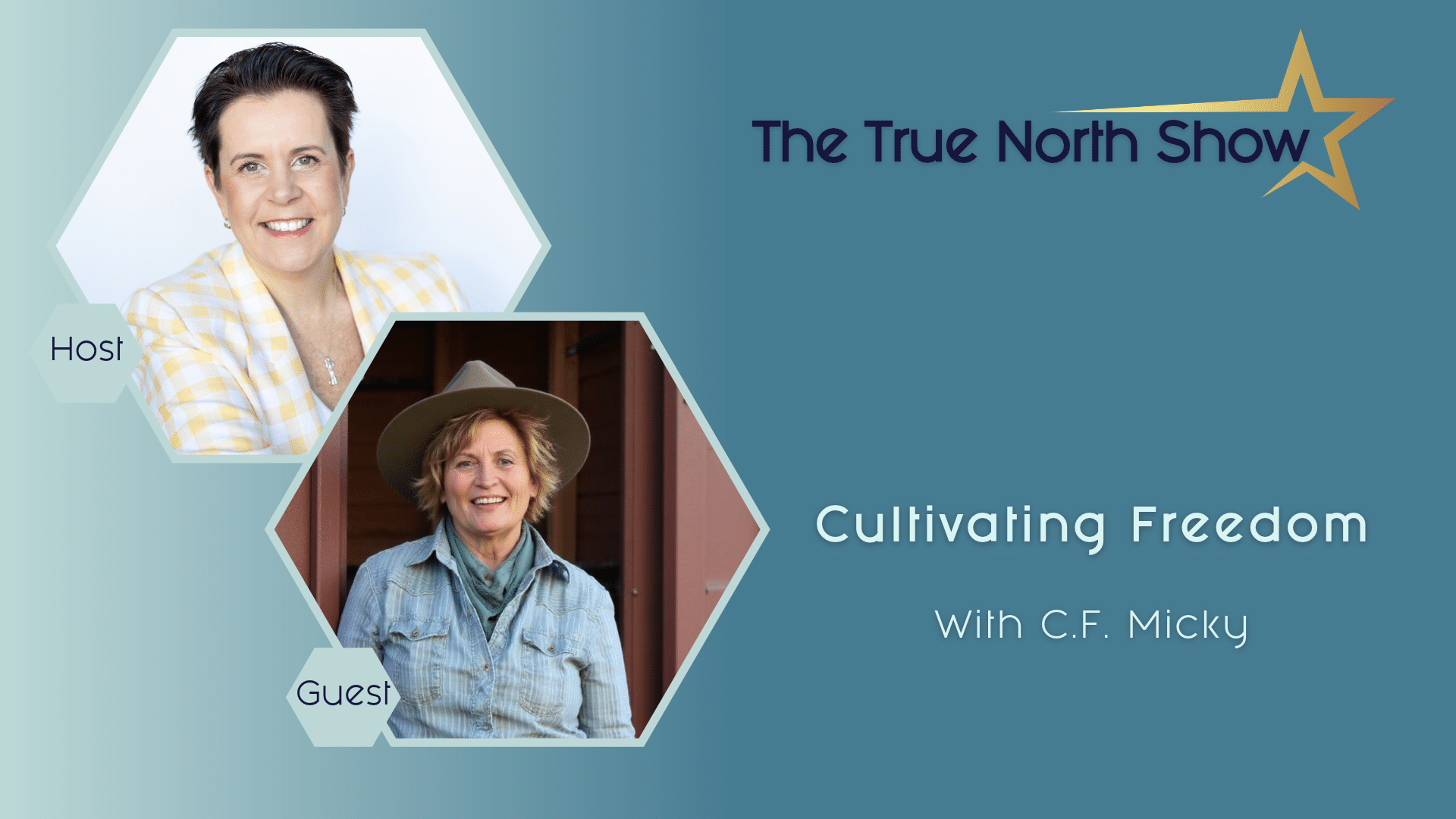
Cultivating Freedom with C.F. Micky | Ep. 67
On this week’s episode of The True North Show I am joined by C.F. Micky, also known as Caty, an incredible woman who has stepped into her feminine empowerment, not only leave her narcissistic husband, but to write about her experience and to share her story so others can feel seen and heard. She has become a strong advocate for those in a relationship with someone who has Narcissistic Personality Disorder and the work she is doing to share her story and educate others is vital. For anyone who has experienced something similar or would like to be more informed, I strong encourage you to watch or listen to this episode.
Bio:
C. F. Micky, aka Caty, is a 2-time Amazon Best-Selling Author and a recipient of The American Legacy Award for her book “Cultivating Freedom” in the category self-help relationships.
Caty is a strong advocate for promoting awareness of Narcissistic Personality Disorder. After breaking free of a 33-year marriage on a rural farm, she has personally experienced all that NPD entangles. Through trials and tribulations, Caty was also challenged with recouping her share of the farm business, and now presides on the farm solely, with her experiencing the joys of farm life.
You will find her appearing on many podcasts, along with being featured by Positive Talk Radio and Brushwood Media Network, which reach over 495 million active users in 197 countries.
Social Media:
Website: www.cultivatingfreedom.ca
Facebook: www.facebook.com/cultivatingfreedom
Instagram: www.instagram.com/cultivatingfreedom2024
TikTok: https://www.tiktok.com/@cultivatingfreedom
Transcript:
[00:34] MEGAN NORTH:
Hello and welcome to The True North Show. I’m your host, Megan North. I’d like to start by thanking the sponsors of the show: Quantum Awakening, Beth Lewis, Ann C. Clarke, and my lovely guest who paid to be featured.
Today I am thrilled to welcome to the show C.F. Micky, also known as Caty. Caty is a two-time Amazon bestselling author and recipient of the American Legacy Award for her book Cultivating Freedom in the category of self-help and relationships. But Caty’s story is not just one of writing and accolades. It’s one of extraordinary courage. After 33 years of marriage on a rural farm, Caty found the strength to break free from a relationship deeply entangled with narcissistic personality disorder, experiencing firsthand every layer of complexity, confusion, and the pain that NPD brings with it.
And if that wasn’t enough, she then faced the enormous challenge of recouping her share of the farm business in the process. Today, Caty not only survived that journey, she presides over that farm on her own terms, finding joy, freedom, and purpose in the life she has rebuilt from the ground up. She is now a passionate and powerful advocate for raising awareness of narcissistic personality disorder, and her voice is reaching the world, appearing on podcasts and being featured by Positive Talk Radio and Brushwood Media Network, platforms that reach over 495 million active users across 197 countries.
Caty is living proof that no matter how long you have been lost, it’s never too late to find your way back to yourself. Welcome to The True North Show, Caty. I’m thrilled that you’re spending this time with me today.
[02:33] C.F. MICKY (CATY):
Thank you for having me. I’m quite excited to be here too.
[02:37] MEGAN NORTH:
Thank you. Caty spent 33 years in a marriage wrapped in narcissistic abuse. And when she finally broke free, she didn’t just have to rebuild herself. She had to fight for everything she had worked for as well. Stay with us, because when we come back, Caty is going to take us inside that journey and share what it really took to walk away and start again.
Welcome back to The True North Show. I’m here with two-time Amazon bestselling author, advocate, and farm owner C.F. Micky, also known as Caty, and we’re about to have one of the most important and courageous conversations I think this show has ever seen. So let’s go back to the beginning. Caty, what was the moment that you finally knew that you had to leave that relationship?
[04:15] C.F. MICKY (CATY):
Each year I could see him, my husband, progressively going deeper into the whole persona of narcissistic personality disorder. It was around year 28 of marriage that I started getting answers from the medical field. Once I knew what I was dealing with, I tried learning all that I could. Because when I first found out, I thought we were going to beat this. I thought our marriage was going to survive.
But the more I learned, and as each year passed, I could see him going deeper. Our relationship turned not only mentally but physically. It was affecting everybody, and I knew I had to leave. The threats were coming.
[05:11] MEGAN NORTH:
And when we talk about narcissistic personality disorder, what are we talking about?
[05:18] C.F. MICKY (CATY):
It’s consistent with a number of traits. Grandiosity. Entitlement. Lack of self-awareness. Insecurity. Paranoia was a big one. During our dating I never realised that was an issue, but shortly after we were married, it was almost on a daily basis. He thought I was going to run him over in the field with a truck. He said this while hollering at me, and I started laughing. We hadn’t even been married a year. To me it was ludicrous. I married you because I loved you. Why would I run you over?
It’s a consistent pattern of quite a few traits that you’re dealing with on a continual basis. It’s not just one day he’s selfish or entitled. It’s consistent. And as time progressed towards the end, I noticed I couldn’t even talk to him about hardships that family or friends were going through without finding a smirk on his face, as though he was getting enjoyment out of other people’s misery. I can remember thinking: who are you? Who did I really marry?
There was one occasion where my 75-year-old mother was locked outside in November. And he had the fist pulled back and he had my throat. That was it.
[07:21] MEGAN NORTH:
Wow. And I would imagine, even though it started at the beginning, most people would say: why didn’t you get out early? But from my understanding, it’s these tiny little things that start building. You laughed when he said that because you thought he was joking. But then it starts to build and build.
[08:03] C.F. MICKY (CATY):
They groom you, and I was getting groomed and didn’t even know it. It’s the whole love bombing, you know: really nice one day, and then the next day pushing you away and being mean. So then you try working a little harder to get back in the good graces, not even knowing what you did. It’s tugging at you all the time. That’s where you get on this roller coaster where you’re doing everything you can to please them.
[08:41] MEGAN NORTH:
And I guess you’d have no understanding of what you’d done wrong, because there’s nothing you’ve done wrong. They can’t explain that. But your confidence would shrink. You’d be constantly second-guessing yourself, thinking you’re to blame all the time.
[09:01] C.F. MICKY (CATY):
Communication was terrible. I’d say: what’s going on here? And it was always: think about it, just think about it. It was always a game. There was no communication. No: I didn’t like it when you did this. It was how he felt in the moment.
[09:21] MEGAN NORTH:
Right. Wow. What an interesting and horrifying journey you’ve been through.
[09:34] C.F. MICKY (CATY):
I remember signs in our first year of marriage and I thought: do I leave? But I came into this marriage with a child from a previous relationship, and I thought: what’s everybody going to think about me if this is relationship number two and I can’t even survive it? What’s wrong with me? What does a normal relationship look like? Am I expecting too much? You’ve got all of this going around in your mind.
[10:11] MEGAN NORTH:
Gosh. And now on the other side of this, so much wisdom you’ve learned, about yourself, about relationships, about who you are. I’m in awe of your courage, and of your courage in now talking about it too. Because I think more people need to hear about this.
[10:42] C.F. MICKY (CATY):
Partway through my marriage we had a really tough year with a lot of fighting going on. One of the children said: “Do you want me to go to school and tell everybody how much you fight?” I knew something had to be done. I had a really tough year. Up all night crying, trying to figure it out, not showing my emotion to anybody.
It was at that point where I thought I have no choice but to stay in this marriage while the kids are young, because I didn’t want to give him fifty per cent of the time with them. I knew what he was like. So it was better for me to stay and make the best out of a bad situation, trying to give my kids the best start I could.
[11:36] MEGAN NORTH:
And being open to understanding him more, I suppose that’s both an advantage and a disadvantage. The advantage is that you’re understanding the game he’s playing. The disadvantage would be thinking: how much longer can I put up with this?
[12:08] C.F. MICKY (CATY):
That whole disadvantage you just kind of throw in the back. Because every day it’s about getting through in the best way you can.
We had cousins of his that used to come to the farm a couple of times a year, and they quit coming. I asked her why. She said they were having supper at our place and something funny happened, and all the kids looked at their dad to see if it was okay to laugh. She said: that’s when I knew something was going on.
[13:13] MEGAN NORTH:
Wow. I’ve witnessed domestic violence in my family before. It’s easy for people to say: you should say something, why don’t you say something. But until that person is ready to make a change, people will just have to support them in the best way that they can.
[13:42] C.F. MICKY (CATY):
My first priority was my kids. But even after my kids had left, I was still trying to fix our marriage. One of the kids had plans to go to the gym in the evening and his dad kept throwing more jobs on. I caught myself saying: just do this one more job and dad’ll be happy. Then I stopped and said: no, away you go. We’ve all put full days in. I’ll deal with your dad.
That’s probably where I started realising this had to stop. I’m enabling his behaviour just to try and keep the peace. And he’ll never be happy. It doesn’t matter with anything. He will never be happy.
[14:45] MEGAN NORTH:
And when you started to understand the narcissistic personality disorder, was that because you had started getting some help yourself?
[15:06] C.F. MICKY (CATY):
I started going to a counsellor once a month, trying to figure things out. I asked: will you come to the counsellor with me? And I was getting: why would I go, there’s nothing wrong with me.
Then he started complaining of depression, and that started us off at the doctor’s. The doctor had him fill out a survey and then came in and asked: have you ever felt threatened for your life? I lied. My husband was sitting there. I didn’t want him to know that I was afraid of him.
He was put on medication. We had to come back in six weeks. The first thing the doctor said was: I couldn’t let you leave last time without medicating you. I thought: we’re getting help, we’re going to fix this. And then once he got feeling better, he went off his meds. The doctor had me coming in once a month checking on me, and I was still going to a counsellor once a month.
[16:35] MEGAN NORTH:
And that would have gone on for years before you decided enough was enough.
[16:48] C.F. MICKY (CATY):
I had been going to a counsellor for about nine years. The last few years it was maybe two or three times a year, just to go over some questions and how I was doing. But she explained it as: you come in, take the bricks out of your backpack, and you go out for another round. That’s what it’s like when you’re getting away from a narcissist.
[17:17] MEGAN NORTH:
Yeah. It’s literally brick by brick.
[17:22] C.F. MICKY (CATY):
I knew I couldn’t get away unless I had a team. So that’s when I had a lawyer and my counsellor, and two or three tight family or friends that I could rely on. And with my team, that’s how I got out.
[18:07] MEGAN NORTH:
That inner circle. Some trusted advisors to help and support you. And how did writing the book come about? Are you a journaller, a writer? Tell us about that story.
[18:30] C.F. MICKY (CATY):
The counsellor kept after me: are you journalling? There were a few court processes I participated in and I felt frustrated. I came home, hit the computer, and that’s when I realised what a relief it was just to get it out. Then I joined a writing group.
When I was in my writing group, we were discussing my book of memoirs and the group was encouraging me to publish. I thought about my journey and what I had experienced and learned. I kept going back to the memory in the doctor’s office, when my husband went off his meds and I kind of got the name of what he had. I thought: how many other people are going through what I went through? Men and women.
The group said: do you know how many people are going through what you’re going through? Part of dealing with it is getting it into the open and dealing with it face on. This happened. This is how I reacted. Was it right or was it wrong? You start going through everything, your self-awareness, your triggers. There’s a lot to unravel once you get out of these relationships.
[20:08] MEGAN NORTH:
When you find your community and start talking about it, you realise how many people are struggling with something similar or exactly the same. I love that you’ve put this in a book for others to read. It gives people courage, confidence, and wisdom to start their own journey.
[20:55] C.F. MICKY (CATY):
I felt it was important for my kids to know that what happened in this house was dysfunctional. Because it was one way at home and another way in public. When I wrote the book, it was educational. These are examples. This is the red flag. This is the terminology. This is how I dealt with it.
At the back of the book I have a bunch of cheat sheets. How do I know that I’m healing? Why do I choose to go into a smaller circle and stay away from people? Why is it so hard to go out in public? Your whole self-worth and your whole identity is gone.
[21:57] MEGAN NORTH:
It would have been eroded away.
[22:00] C.F. MICKY (CATY):
You’re known as Mrs So-and-so, and then all of a sudden you’re living in town where you’d never wanted to live. I was at a funeral and a woman came over asking who was married to Brent. I put my hand up and she went off again. I have a big heart for people who have found the courage to leave, because there’s a lot they’re dealing with that others don’t realise.
[22:55] MEGAN NORTH:
Who are we to sit and judge what somebody else does? We don’t know what’s going on unless they’re sharing it with us. And even then, there’s no judgment. Just support. How can we support people?
[23:13] C.F. MICKY (CATY):
Yes. That’s definitely what’s needed.
[23:18] MEGAN NORTH:
I really love that you have cheat sheets at the end of the book. I know for me I’m not always good at reflecting on where I’ve been. I love that the cheat sheets give people some real reflection, even on how different they are from last week to this week.
[23:56] C.F. MICKY (CATY):
When you’re in a situation like this, you’re not thinking clearly. If you’re going to leave: how do you do it, what’s your exit plan? Things like having a joint credit card, getting your documents in order. All the little things you have to get in order before you go.
[24:19] MEGAN NORTH:
Fantastic. I love that you’ve gifted that wisdom to others. I love when people share these journeys and also give practical tools, because I’ve read books before and thought: this is great, but how do I use this information now?
[24:47] MEGAN NORTH:
Do you think this is the beginning of something new for you? Have you got other things in the pipeline?
[24:56] C.F. MICKY (CATY):
I’ve actually done five other book compilations. Two are already published through Amazon: She Thrives and Breaking the Silence. I’ve got three more book launches happening. One is in Philadelphia called Rebirth. One is volume five of Breaking the Silence. And She Thrives Two launches in February. I really enjoy doing what I’m doing.
[25:45] MEGAN NORTH:
I love that. So on The True North Show we talk about passion and purpose. You were introduced as a book author, an advocate, and a farm owner. What’s your passion and what’s your purpose?
[26:40] C.F. MICKY (CATY):
When I was younger I worked in a nursing home for years as a special care aide. When I got married, that went into part-time because the farm took priority. I loved the nursing home. I love the farm. I love getting outside. I love the manual labour. Harvest is my favourite time. I’ve run the combine for over twenty years. Loaded chemicals, did the books, been involved with every facet.
Now it’s time to pass over the reins. My son does the farming. It’s given me a lot of free time, and I’ve delved into this work and it’s growing. I really like what I’m doing. I feel it’s so necessary. My passion, I’m just doing it in different time frames now.
[27:53] MEGAN NORTH:
I feel like for you, it is a passion and a purpose together. You’re sharing wisdom to people on a very important topic. That’s the purpose. And your passion for writing is wrapped up in that.
[28:30] C.F. MICKY (CATY):
Yes. It’s nice to just sit in silence on the farm and hit the computer.
[28:37] MEGAN NORTH:
Wow. And through all of these significant challenges, what about mental health and wellbeing? Has it always been important to you, or is it something that came to light more recently?
[29:00] C.F. MICKY (CATY):
It came to light for me when I was struggling with dealing with my husband. I could feel myself mentally slipping. It got to a point where one of the children came in and said: if you don’t get out of this house, you’re going to be in a nursing home before you know it.
My response was: I cannot leave until I’ve done everything I can to help your dad. By doing that, I caused more damage to myself. I realised that after. But when I left, I left. There was no back and forth. It was finished.
[29:55] MEGAN NORTH:
And what do you do for your mental health and wellbeing now?
[30:13] C.F. MICKY (CATY):
I wake up with my window open and the birds singing. No traffic. The birds sing differently on the farm than they do in town. That’s my whole start to the day.
I’ve learnt to sit in silence. No TV, no radio, nothing. Wake up in the morning and give myself about half an hour to an hour of total silence. And then walking. I also work outside in the yard a lot. I’m on the tractor, rotor-tilling or spraying, and that’s peace to me. That’s happiness.
[31:12] MEGAN NORTH:
Because you’re part of something that’s growing and flourishing. I love that first half hour of silence. Being silent can be really triggering for people, but it can also be so restorative.
[31:59] C.F. MICKY (CATY):
Now that my son’s doing the farming and his family’s out here, I take pride in that. When the grandkids come out, I just love it. I was having trouble getting my shop door down. My son was giving me instructions over the phone on how to fix it. By the time I got down to the shop to look it up on YouTube, my eight-year-old grandson had the door fixed. He said: “Grandma, I fixed it for you.” He was so proud, and I was so proud. Things are good.
[32:49] MEGAN NORTH:
I love that. Are you advocating just through the book and your writing, or are you also speaking?
[33:25] C.F. MICKY (CATY):
Right now it’s been through the book and the writing. I’ve done one speaking engagement, but I definitely want to get into speaking and I’m working on that presently.
[33:47] C.F. MICKY (CATY):
I’ve taken some courses because when I write a speech, I want it to be a good one, a memorable one. It was only a small speaking gig that I did, but the woman came back to me and gave me a scholarship to be in her book and made me the feature of her magazine. I think I’m on a good path.
[34:22] MEGAN NORTH:
And the other books you were talking about, are you co-authoring those?
[34:32] C.F. MICKY (CATY):
There are about 20 authors in a book and we all write a chapter. They’re really good books because it’s not a hundred-and-some pages of one story. There’s variety: She Thrives is all on women’s health, mental health, physical health, overcoming adversities. Breaking the Silence covers a whole variety, including losing a child. They’re really good for a quick, short read.
[35:25] MEGAN NORTH:
Having heavy things in snapshots is actually easier for people to digest.
[35:42] C.F. MICKY (CATY):
When I was writing Cultivating Freedom, the editor said to me: I’m having so much trouble with your book. I said: why? She said: it’s so emotional. I was kind of proud of that. Because if I can make the editor feel something, I’m on a good path. And then I had another writer in the group read it and he said: I feel your pain.
[36:45] MEGAN NORTH:
When you sit here and think about how far you’ve come, how do you feel about yourself now? Are you proud?
[37:01] C.F. MICKY (CATY):
I’m almost dumbfounded. Because when you start writing your life out and putting it down on paper, it’s like: this is so dysfunctional. How did I ever survive?
But I had the team to help me. And now I’m enjoying life. I’ve got a wonderful family. I’ve got grandkids. I’m making jams and jellies with the grandkids. I’m grateful. Very grateful.
[37:53] MEGAN NORTH:
Were you like this as a child? Were you someone who would stand up for what was right?
[38:13] C.F. MICKY (CATY):
Determined and independent. And honestly, through my marriage I got more independent.
I was pregnant with our first child and we had no water coming from the well. It was winter time and a Sunday. Brent said: you don’t do enough work around here, you fix it. I pulled out the phone book, called an electrician, and worked alongside him because he needed someone at the well. I didn’t have a coat that covered my belly. My husband sat in the house.
At the time I didn’t think about it. We got the water running and I felt so powerful. But after, thinking about it, I thought: what kind of man would do that?
They train you to be independent. They don’t want you asking them for help.
[39:43] MEGAN NORTH:
That’s so interesting. I’ve never thought about it like that before. You’re independent, but you’re also isolated.
[40:19] C.F. MICKY (CATY):
He’d give me jobs to do, and if I asked for help, I always got the third degree. I eventually quit asking. It wasn’t worth it.
[40:36] MEGAN NORTH:
Is your mum still around?
[40:45] C.F. MICKY (CATY):
Yes. My mother is 83 and she still lives on the farm. She does all the farm books, orders the farm chemicals. She farms with my brother. She still drives everywhere, still active. Sharp as a whip.
[41:26] MEGAN NORTH:
It sounds like you’ve got a lot of her energy in you.
[41:34] C.F. MICKY (CATY):
I’ve always been stubborn, but I’ve always been very conscious about doing the right thing. Going through this journey and through the courts, I put him first in all decisions for about two to two and a half years. Then I started saying to myself: you have to look after yourself. That’s when things started changing. I started voicing up and standing up for myself.
[42:15] MEGAN NORTH:
What sort of feedback are you getting about the book?
[42:29] C.F. MICKY (CATY):
Different people from the community saying they resonated with that part. My mum would come home from church meetings and tell me that someone had said this or that had happened. I was getting confirmation from a lot of people.
[43:00] MEGAN NORTH:
And it must be really nice knowing that you’re helping someone else’s journey.
[43:11] C.F. MICKY (CATY):
Huge. Huge.
[43:13] MEGAN NORTH:
If someone’s listening today and something has sparked in them, what would you suggest as a next step?
[43:34] C.F. MICKY (CATY):
I’d advise them to go and find a counsellor. My counsellor never told me what to do. You go there, they help you sort through everything, and they teach you things. If I was going in for a court process, I didn’t want to break down. She’d give me different things to do so I wouldn’t. It’s about preparing yourself: your mind, your body, everything.
And you have to know what you’re dealing with. Read, listen, learn as much as you can about what you’re dealing with.
[44:30] MEGAN NORTH:
Fill your toolkit with things that are really going to help you move forward. When you talked about your counsellor, was she someone you found yourself or was she recommended to you?
[44:51] C.F. MICKY (CATY):
I went to the doctor and I’d seen a couple of counsellors but they quit practising. I got a name from a doctor. But I think it’s important for people to realise that not every counsellor is going to fit for you. If you have to try out a couple of different ones, go for it. Because once you’re in with that counsellor, you’re there for years.
[45:27] MEGAN NORTH:
I’m so glad you’ve touched on that. That relationship with your counsellor, and even your medical team: it’s really important that you feel comfortable. Any feelings that something’s a bit off, don’t be scared to try someone else.
[46:17] C.F. MICKY (CATY):
There was one counsellor I booked an appointment with. She phoned me up and asked: what can I prepare for our meeting? I said I need coping skills on how to deal with narcissistic personality disorder. I spent an hour with her, spent $160, and at the end she said: avoid your husband as much as possible. That was her advice.
You’re not my girl.
And at the back of the book I do have questions that you can use to interview a counsellor or a lawyer before hiring them.
[47:04] MEGAN NORTH:
That is amazing. Really so helpful. You’re on a journey for a long time with that person. There has to be a connection.
[48:00] C.F. MICKY (CATY):
I had four lawyers. My first lawyer, every time I saw her she wasn’t up on my case and I didn’t have a good feeling. I talked to someone and switched firms. I later found out that first lawyer was reprimanded by the bar because she was getting people with less experience to do her work.
So when your gut is telling you something, listen.
My last lawyer was my best one. She read through the history of what was going on and said: what does he have? She was telling me about another client dealing with the same thing. I gave her some of the psychologists I’d been listening to and got her up to speed.
[49:26] MEGAN NORTH:
Trust the gut. Particularly through major changes in your life, you need the right people in your inner circle.
[49:42] C.F. MICKY (CATY):
I was 56 when I left. I didn’t know how this was going to work out. I put what I could in the backseat of my truck and drove away.
[49:54] MEGAN NORTH:
And now you’re sharing all of this wisdom with others. What’s 2027 looking like for you?
[50:19] C.F. MICKY (CATY):
I’ve been working on Cultivating Freedom 2. I get a lot of questions from different people and I’m diving deeper into them, giving a little more insight. But I want to get on speaking stages. That’s my goal. I want to spread awareness.
[50:48] MEGAN NORTH:
I’m going to ask you the same question I love asking all my guests. What is one lesson or truth that you’ve learned on your journey that you wish you had known earlier?
[51:14] C.F. MICKY (CATY):
How to train my brain to outweigh my fears.
I believe that fear keeps us from doing a lot of things. I look at it now: I’ve got one life to live and I’m going to enjoy it. I’ve really had to work on that. Part of it is always the unknown. I drove away out of that driveway. Now what?
[52:02] MEGAN NORTH:
And when we reflect back on what we have endured, if you hadn’t been through all of that, you wouldn’t have had the courage to grant this wisdom on other people. Sometimes we need to go through something because our purpose is to help others on that same journey.
[52:39] C.F. MICKY (CATY):
That’s kind of how I feel. I feel that God places us in these situations to learn and grow from. And that’s where your whole mission comes to light, on what your meaning is.
[52:57] MEGAN NORTH:
Thank you so much. I knew our conversation would be really deep and insightful. You’ve got this beautiful energy, and I love that you still laugh at yourself. I have no doubt that there are a lot of people who are going to learn a great deal through this conversation.
[53:26] C.F. MICKY (CATY):
Yes. And reach out, because I’ve already had one woman reach out who is dealing with child alienation. It affects all of us. If we can be together and say: I learnt this, I learnt that, then we start helping each other.
[53:49] MEGAN NORTH:
Absolutely. Creating that community and that support. Thank you very much. I’d also like to thank all of my amazing and dedicated supporters, my audience, and again all my sponsors. Hope everybody has an amazing week and I’ll see you all again next week. Thank you so much, Caty.
[54:12] C.F. MICKY (CATY):
Glad to be here.



![True North Show [podcast] - Season - Eli Brackenbury](https://megannorth.com/wp-content/uploads/2026/09/True-North-Show-podcast-Season-Eli-Brackenbury-768x432.png)