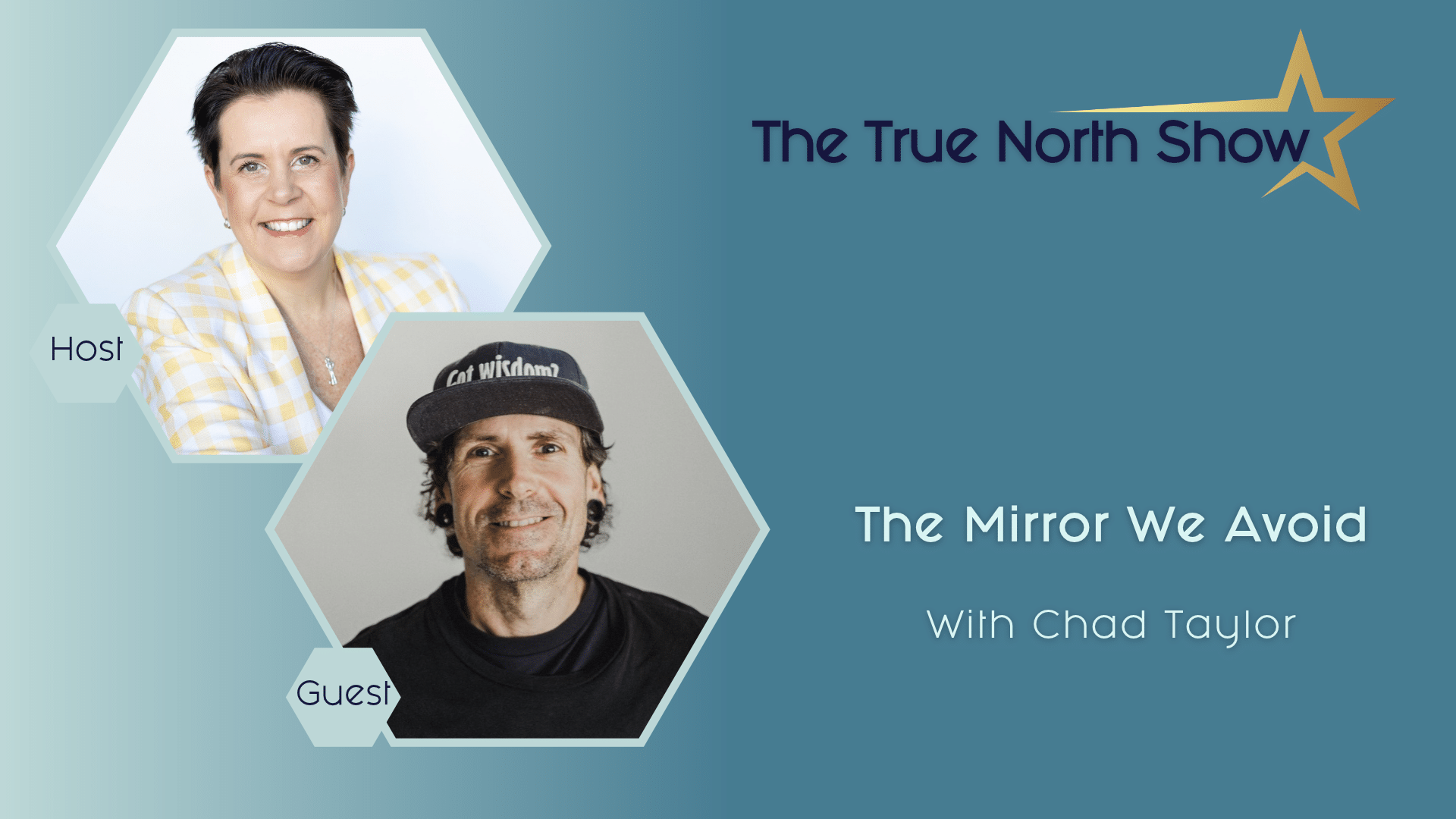
The Mirror We Avoid with Chad Taylor | Ep. 71
On this week’s episode of The True North Show I am joined by Chad Taylor, a wonderful fellow “Aussie” who shares with us his incredible journey that he has been on for most of his life. Chad is so clear and concise about the work he does, both on himself and with his clients and I love his deep belief that even though he is the therapist, he too works with a therapist to ensure he is consistently up-levelling and showing up as the best version of himself for his personal and professional life. Our conversation is very different to those I’ve had before, but definitely not one to miss, there is a lot of personal transformation that he shares that is truly inspiring.
Bio:
Chad Taylor is a clinical psychotherapist, author of “It’s You. Oh F*ck. It’s Me.”, and host of “Who the F*ck Are You? In Session with a Psychotherapist”. His work focuses on relationships, projection, addiction, intimacy, blame, and the unconscious patterns that quietly run our lives while we convince ourselves the problem is somewhere else. Chad’s approach to psychotherapy comes from both clinical training and lived experience. After entering recovery from drug and alcohol addiction at 22, his own path has included more than two decades of sobriety, therapy, study, relationships, failures, and confronting the parts of himself he once found much easier to blame on other people.
That experience sits at the heart of his work. Chad believes relationships rarely fall apart simply because people stop loving each other. More often, two people become trapped inside their own fears, projections, defences, expectations, and unresolved issues. Instead of recognising what is happening internally, they point outward. It becomes, “It’s you.” His work is about reaching the far more uncomfortable realisation, “Oh f*ck. It’s me.” Not as blame. Not as shame. As responsibility.
Chad works with individuals and couples to understand what actually happens when intimacy exposes the parts of us we would rather avoid. Why we become defensive, shut down, attack, escape, or repeat the same relationship patterns with different people while remaining convinced we just keep choosing the wrong partner. His work also explores addiction beyond drugs and alcohol. The endless search for relief can show up through work, sex, relationships, money, achievement, social media, substances, or anything else that temporarily allows us to avoid what is happening inside us.
Chad does not present himself as someone who has figured everything out. Quite the opposite. His work is grounded in the belief that insight means nothing if it does not change how we actually behave when we are triggered, rejected, frightened, angry, or desperate to be right. His conversations are direct, personal, psychologically informed, and occasionally uncomfortable, because sometimes the person f*cking up your relationship is not sitting across from you. Sometimes it’s you.
Social Media:
- Website: https://chadtaylorpsychotherapy.com.au/
- Facebook: https://www.facebook.com/profile.php?id=61587473754148
- Instagram: https://www.instagram.com/chad.taylor.psychotherapist/
- LinkedIn: https://www.linkedin.com/in/chad-taylor-36b896165/
- YouTube: https://www.youtube.com/@chad.taylor.psychotherapist
Transcript:
Megan North [00:34]
Hello and welcome to The True North Show. I’m Megan North, and I’d like to start by thanking the sponsors of the show: Quantum Awakening, Beth Lewis, and Anne C. Clarke.
My guest for today’s episode is Chad Taylor, a clinical psychotherapist, author, and host of one of the most refreshingly honest and confronting podcasts out there right now. Chad is the author of It’s You, Oh F**k, It’s Me. And if that title alone does not make you stop and think, I’m not sure what will. He is also the host of Who the F**k Are You: In Session with a Psychotherapist.
I think it’s fair to say that Chad approaches his work a little differently from most. Chad entered recovery from drug and alcohol addiction at 22 years old. More than two decades of sobriety, therapy, study, relationships, failures, and some very uncomfortable self-confrontation later, that lived experience sits at the absolute heart of everything he does, clinically and personally.
His work focuses on the unconscious patterns that quietly run our lives while we convince ourselves the problem is somewhere else. The projections, the defences, the fears, the unresolved stuff we carry from relationship to relationship, while remaining absolutely certain we just keep choosing the wrong person.
Chad believes relationships rarely fall apart because people stop loving each other. More often, two people become trapped inside their own fears and expectations, and instead of looking inward, they point outward. It becomes you. His work is about reaching the far more uncomfortable, and ultimately far more liberating, realisation: oh f**k, it’s me. Not as blame or as shame. As responsibility.
Chad does not present himself as someone who has figured everything out. Quite the opposite, actually. And that honesty is exactly what makes him so extraordinary. Chad, I am so happy to welcome you to The True North Show today.
Chad Taylor [02:52]
Thank you. I was just sitting there thinking, if I ever make it big in the world, I’ve got my perfect introduction.
Megan North [03:01]
I actually really love it. There’s a reason I leave people on screen to read out the bio, because we often don’t reflect on what we’re doing, or where we’ve come from, or where we’ve been. I think it’s quite nice to sit and hear someone else introduce you.
Chad Taylor [03:17]
Yeah, especially for someone who struggles to get compliments. It’s actually amazing when you’re sitting there and observing. I think that’s something I see a lot of clients, and a lot of people, including myself, struggle with. I could notice myself switching off there, but wanting to stay present.
Megan North [03:35]
I love that self-awareness. So Chad has spent more than two decades doing the kind of deep, uncomfortable, and ultimately liberating inner work that a lot of us spend our entire lives trying to avoid. And he’s built this entire career around one profoundly confronting idea: the person causing the most damage in your relationships might not be who you think it is. Stay with us, because when we come back, Chad is going to take us inside that realisation and what it truly means to own it.
Welcome back to The True North Show. I’m here with clinical psychotherapist and author Chad Taylor. I have to say I’ve been really looking forward to this conversation. Chad and I met a few weeks ago and there was an instant connection, so I knew he’d be a great guest. Chad, let’s start where I always do. Can you share what were the pivotal moments in your life that kept you following your true north? And would you say the work you’re doing now is a true north purpose?
Chad Taylor [05:24]
That’s a hard one, because there have been so many. Sometimes I feel like I’ve had about six lifetimes inside of one lifetime. Even sitting here, ten years ago I was a plumber with a pretty successful plumbing business, and this part of my life was voluntary, done on a purely altruistic basis in hospitals, detox facilities, and youth rehabs.
I think sometimes we don’t question where we are or whether we still enjoy something. We just keep doing it because it’s become our identity. And I think that’s where I have been different, sometimes to my detriment. If I’m not really feeling something anymore, I will move on to something new. Not in partners, but in my purpose.
For me, probably the biggest pivotal point was my sobriety. I was twenty-two, pretty much a kid. I lost thirty-two jobs in the last two years of my drinking, from twenty to twenty-two. I was in a bad place. It wasn’t really drugs for me so much, it was more the alcohol. I’d spew blood every weekend after a bender and thought I was going to die.
Then the transition from plumbing to this as a full-time career, going to university as someone who didn’t finish school. That was probably the biggest pivotal moment, because it was very hard to leave something that was paying really well. Five to ten times what I get paid now. I had ten employees, fast cars, Harleys. And people thought I was mad to walk away from that.
It didn’t come easily. It came through me not handling my emotions well. I had two altercations over two years with builders who owed me money and the police got involved. And then one night it was just like, this is the universe telling me to pivot. The Christians talk about metanoia, which means to turn around, to turn 180 degrees. And that was what it was.
I had everyone against me. Family, friends, even my partner at the time. She was accustomed to the lifestyle we had. And when I went to university, going from making good money to just getting by on savings, that was a big change for our relationship.
Megan North [10:05]
When you say you just know things are going to work out, how would you describe that? I always say it’s an innate trust. Is it similar to how you feel when you just know that a change needs to happen and it’s going to be okay?
Chad Taylor [10:29]
Yeah. There’s a lot of fear around it, but courage isn’t the absence of fear. Courage is feeling the fear and pushing through it. With the book, for example, I knew I wanted to write one. We went on holiday last December and in three and a half weeks the book just came out, and it was ready to publish when I got on the plane to come home.
I think if something is going to give to the world and it’s not for a selfish reason, there’s a lot more chance. I don’t spend all my money, but I’m pretty free with it. And I trust. Probably more the universe than myself. I just trust it’s going to be okay.
Megan North [12:24]
That really resonates. When I stepped out of my big corporate role five and a half years ago, I had people saying, are you crazy? I was earning well over two hundred thousand dollars a year and going to starting my own business with no clients. But I just knew. And I think when we’re really comfortable with the money, because it comes easily, we keep saying, I’ll just do one more year. And then it just gets to the point where you have to do it.
Chad Taylor [13:28]
Yeah. It isn’t always a beautiful transition. There was a period after I sold the plumbing business where I moved back to the coast and I called it my Superman time. I’d do one or two therapy clients in the morning, then throw my plumbing gear on, jump in the ute and do a couple of small plumbing jobs, then race home for a shower for an afternoon client. It was very hard to go from putting in a hot water system to then sitting with someone on the couch and being fully present.
Interestingly, as a maintenance plumber I was in people’s homes a lot. Old ladies, couples, people on their own. A lot of them would be telling me their problems. So there was actually a lot of informal therapy happening in being a maintenance plumber.
Megan North [14:53]
And what about mental health and wellbeing? Were you aware of it as you went through all of this, or is it something that became really important as your journey progressed?
Chad Taylor [15:12]
I had my first sit in the client’s chair at about nine or ten. A lot of panic attacks through my early teens. A guy from school died in the surf and there were just these phenomenal panic attacks. I was always a kid who questioned a lot, and the more I questioned, the more anxiety and fear I created.
When I found alcohol and drugs, I think my first addiction was probably daydreaming, very young. Almost dissociate and daydream. I was always in trouble for it. Now we’d call that ADD. But I think a lot of it is environment. If you grow up in a pretty chaotic environment, the psyche knows to remove you from it.
Then food came along and I started eating my emotions through primary school. I was a very overweight kid. And as soon as I found alcohol at about nine or ten, I chased it. It was the elixir that was going to change the way I felt.
By fifteen or sixteen, I was already on a pretty high dose of antidepressants. By the time I got to detox at twenty-two, I was on seventeen pills a day.
A lot of therapists don’t come with an apprenticeship in the chair. They go to uni and learn it all in a book. For me it was almost the opposite. And Alcoholics Anonymous is a spiritual programme. The basis of it is that we are powerless. Powerless over our thinking, powerless over whatever is going on. I’m powerless over my ex-partner leaving me, over my kid getting sick. And if we look at that first step, it’s profound. In the early days I’d do five to seven meetings a week. When times were really tough, I’d go to three a day.
For anyone out there who may have a drug and alcohol problem, or really any problem, there are over three hundred twelve-step fellowships now, from Gamblers Anonymous to Debtors Anonymous. There’s even one now for internet and technology use. So yes, mental health has always been at the forefront for me, especially the last twenty-five years in recovery.
Megan North [20:06]
That ties in perfectly with what I wanted to explore. Mental health is more open now, more discussed. But do you think we’re actually getting better at doing the inner work, or just getting better at talking about it?
Chad Taylor [20:48]
Intellectual learning and lived experience are two completely different things. I could get a PhD in midwifery. But the last person you want in a delivery room is someone who’s only ever read about it. Most midwives are generally women who have had babies and have the experience.
I think we are good at talking about it. I think businesses are good at tick-boxing it with things like R U OK Day. But I still think people who are struggling with mental health are shunned in offices. I still think it’s seen as weakness, or as a choice.
The real measure of how your inner work is going is not what you can do on the meditation mat. It’s how you react when someone cuts you off in traffic. That’s a reflection of where your inner work is, not what you can do with the headphones on.
Megan North [23:55]
I also think it’s about finding what works for you. I don’t sit and meditate, but I pray. I’m connected to my mum who’s passed away, my dad who’s passed away. I tune into my guides and angels. That’s my version of meditation. And I think we get tied up in people telling us we should do it a certain way. Try it, test it, work out what works for you.
Chad Taylor [24:54]
Absolutely. Meditation doesn’t always look like sitting on a mat. It’s really anything that allows us to go deeper and be present. The problem is that ninety-five per cent of what we do by age thirty-five is unconscious. That’s what we’ve got to try to reach. And if we just keep doing, we can read all the books. I’ve just written a book, but I say to people jokingly: if self-help books worked, we’d only need one. There’d only be one in the world.
I run a study group at home for about six or seven people from AA. Every time I read the book, it’s only a hundred and sixty-four pages and I’ve been reading it for twenty-five years, I go in with an open mind. Every time I find something new.
Megan North [26:20]
I used to drink and now I don’t. I was a binge drinker on weekends. When I stopped, I really had to face a lot of what I’d been ignoring. The work at the beginning is really hard. But the more work you do, the freer you become. And the other things that pop up after that feel lighter because you’ve dealt with the deeper stuff.
Chad Taylor [27:53]
Yes. I think there’s a protector and a defender built into all of us from childhood. In my book I talk about how when we’re born, we’re connected. A child from zero to three is in the present moment. They don’t know about the past or the future, they don’t worry. Then around age three, we start to realise we’re disconnected, and that’s when fears creep in.
The body has inbuilt mechanisms to keep us safe. If we get sick, it produces a fever. If we cut our arm, it coagulates the blood. Well, the psyche has the same thing, an inbuilt mechanism we never talk about: egocentricity. As we experience rejection, even small ones, the psyche puts up a wall. By the time we’re ten, twelve, fifteen, we’re completely encapsulated by this egocentricity. We become egocentric. That’s what Jung called the persona. We believe we are a certain thing, and when someone wants to poke through it, that’s what reacts. And inside, there’s a part of us trapped so far away.
I love the parable of the clay Buddha. A gold Buddha, the most prized possession of a town, covered in clay before a wartime invasion to protect it. The town was taken over and everyone was killed. For 1,500 years, people took for granted that there was just this big clay Buddha. And then one day someone meditating nearby looked down and noticed a bit of mud had come away from its foot. She looked in, and it was gold. They dismantled all the clay and underneath was this prized possession they’d forgotten.
That is us. We are the gold Buddha. And we’ve got to get through the clay. It’s not until something cracks that the light gets in. Leonard Cohen said something like that. We miss it and go, “Oh you’re crazy for leaving your well-paying job.” That’s the clay speaking to the clay.
Megan North [32:57]
There’s something powerful about a therapist who has done their own deep work. How does that lived experience shape the way you sit with your clients?
Chad Taylor [33:26]
I probably break every rule there is. Number one, I throw the notepad in the bin. I don’t take notes. If I’m writing for thirty per cent of the conversation, I’m missing thirty per cent of the conversation.
The first thing I let clients know is that I sit in that chair regularly myself. There was always a shaman, a medicine woman, a medicine man in every tradition. There was always someone in the tribe who wasn’t our sister or our mother or our best friend that we could go to. So I tell clients straight away: I go to therapy once a week. And the number one question I think you should ask any therapist is, are you in therapy?
I would say that eighty to ninety per cent of psychologists in Australia have never done one therapy session themselves. In psychotherapy, we had to provide receipts every year proving we were in paid, supervised therapy. Forty sessions to be signed off. That, to me, is the apprenticeship.
In summer I won’t wear shoes to work. I wear a hoodie and a hat. My office has lots of windows. If I’m trying to model the behaviour of becoming your true self, I need to model that. I use analogies. I’ll say, let me tell you when I did that last week, my wife said this and my black wolf went to this place. I grew up in a home where my father was violent and attacked. My pattern is to shut down and withdraw rather than attack. That’s part of my history that I work on, and I try to stay open.
Sometimes people ask, so when does the therapy start? Which I like.
Megan North [37:52]
And it’s important. As a coach, I’m always working with someone on something myself. I want to be the best version of me for my clients, but also I want to constantly improve. Of course we share our personal experience, because it helps people resonate with us.
Chad Taylor [38:42]
A lot of people don’t believe that. A colleague of mine is a clinical psychologist, and she removes pictures her grandkids have done from her wall before a Zoom session, because she doesn’t want anything of herself present, because the session is about the other person. And she’s really good at what she does.
I’ve had couples say, so when are you going to tell us to break up? After maybe a year of sessions. And I’m like, I’ll leave that up to your friends and family. A lot of people want someone else to make a decision for them. That’s why there’s this big movement around influencers who’ll tell you what to do or tell you why the other person is the problem. But what they don’t tell you is what part of you thought that person was a good choice.
I’m not victim blaming, but if you’ve been in five relationships that are domestically violent, before something worse happens, let’s have a look at what you’re choosing. There might have been a sign early on. He yelled at his mum, or was rude to a waitress, or spoke badly about an ex. Behind the scenes, our body is sending messages. These are body symptoms, or what some people might call intuition.
Megan North [41:46]
So let’s talk about the book. It’s You, Oh F**k, It’s Me. What should people expect from reading it?
Chad Taylor [42:06]
It’s more of a journey. There’s no prescribed start to finish. I don’t give activities on purpose, because I want people to find their own version of what works for them. It opens with the premise that relationships fail because we’re unconscious of our own stuff. That’s virtually how I open it.
It takes you through a journey. I achieved everything the world told me was going to make me happy. The house paid off, a race car, a hot rod, a Harley, passive income, everything happening. And I still felt terrible. Everyone was telling me I’d made it. And I was thinking, if this is making it, I want to be dead.
The only thing left was a bit of disharmony in my relationship, which I thought was her. So I left the relationship, because obviously it must be her if I’ve got everything else. But that was the journey. Getting sober wasn’t enough. There was still so much more to look at.
The back cover reads: this book isn’t here to make you feel good. It’s about realising it’s not your partner, your past or the world. It’s you. If you’re done blaming, bullshitting, and ready to take responsibility, read it. If not, don’t.
It’s blunt. But I’ve tried to make it humorous as well, because there’s a big difference between deflecting with humour and going through something with humour.
Megan North [44:28]
Did you enjoy the writing and publishing process?
Chad Taylor [44:35]
I loved it. There’s a part of me that wishes I’d sent it out to a few more people before self-publishing. But I know that could have been a five, ten year process of knockbacks and rejections. So I just did it. I sell around fifty to a hundred books a month. I’ve sold bulk lots to organisations including the Mankind Project, who took it to a leadership seminar, and to Anglicare.
The book led to the podcast, which then evolved into an online group called F**k It’s Me. We meet weekly, worldwide. If you’re in Australia it’s six AM to seven-thirty AM on a Tuesday morning. The membership is through Patreon. It’s eighty dollars a month, which is the same as a gym membership. I think of it as the gym membership for the soul. There are around twenty to twenty-five people already, and it’s only been going three or four months.
I also run workshops in businesses now, and I’ve adapted a programme for school groups. I was surprised how many senior students connected with it.
I’m passionate about this work. My wait list is around fifty people. I won’t do more than twenty to twenty-five sessions a week because I burn out. But I have clients from five years ago who still come every two weeks because they see the benefit. Proper psychotherapy is a three to five year process. Real growth takes that long.
Megan North [52:22]
We’re almost out of time. I’m going to ask you the question I ask all of my guests. What is one lesson or truth you’ve learned on your journey that you wish you had known earlier?
Chad Taylor [52:27]
It’s not them.
And leading on from that: when we say to somebody, “you make me feel this way,” just try to remember that no one makes us feel anything. We might have a reaction to what someone does that makes us feel a certain way. So changing your language from “when you do this, you make me feel so angry” to “when this happens, I feel so angry” brings it back to yourself straight away. You didn’t make me feel anything. I felt it. That doesn’t mean what you did didn’t matter. But I felt it.
It’s pretty simple, but it comes from that unconsciousness, the belief that the problem always lies outside. It’s always the wife, or the work, or the traffic. It’s always someone else making us feel the same way. It’s not. It’s us.
Megan North [53:36]
Yeah. It’s the external.
Chad Taylor [53:38]
It’s you. The person listening. And me.
Megan North [53:44]
Thank you. I knew this would be a great conversation. And there are so many other things I wanted to explore, so you definitely have to come back. Thank you so much for sharing your time with me today.
Chad Taylor [53:57]
I loved it. Looking forward to the next one.
Megan North [54:02]
I’d also like to thank all of my amazing and dedicated audience, my supporters, and again my sponsors. I hope everybody has a great rest of the week, and I’ll see you all again next week.